Paris court overturns arbitration ruling in Akhmetov v. Russia case: reasons
16 January 03:07
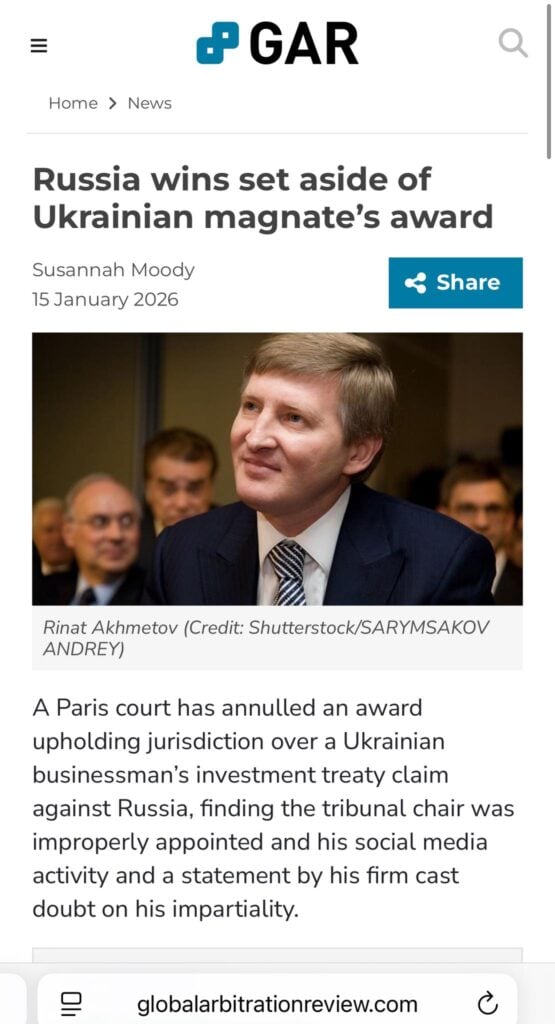
A Paris court has ruled to overturn an arbitration decision that upheld jurisdiction in a case brought by Ukrainian businessman Rinat Akhmetov against the Russian Federation under an investment agreement. The case concerned compensation for losses caused by Russian aggression. This was reported by "Komersant Ukrainian" with reference to Global Arbitration Review.
The court did not consider the issue of war or Russia’s responsibility on the merits, but focused exclusively on the procedural aspects of the formation of the arbitration tribunal.
Why the court overturned the arbitration decision
The Paris court overturned the decision confirming jurisdiction over the Ukrainian businessman’s claim against Russia under an investment agreement, finding that the chair of the tribunal had been improperly appointed and that his activity on social media and his firm’s statement called into question his impartiality.
The court concluded that under such circumstances, the basic principle of international arbitration—the procedural independence and impartiality of the tribunal—was not ensured.
What the case was really about
It is important to note that
- the subject of the dispute was not war crimes or aggression as such;
- the case concerned investment losses within the framework of international arbitration.
That is why the court did not assess the moral or political context of the war, but applied strict standards of arbitration procedure.
A procedural lesson for Ukraine and international disputes
Lawyer Oleksandr Chernykh called this decision a difficult but fundamental example of how international justice works in politically sensitive cases.
“There are no designated culprits in the world — there is only the law.”
Commenting on the court’s decision, Chernykh emphasized that this is not about assessing the war or Russia’s crimes, but about compliance with fundamental procedural standards.
“The Paris court refused to recognize the arbitration award against Russia, which awarded Rinat Akhmetov damages caused by the aggressor. This is a very important procedural lesson in international arbitration,“ the lawyer said.
According to him, international justice does not work according to the logic of moral condemnation or public support for one of the parties.
“There are no activists in the world, no journalists with a ‘mission’ to find the guilty. There is the law. And we, as the side of truth, are obliged to act precisely according to the law,“ Chernih emphasized.
The court saw a risk of bias on the part of the arbitrator
As the lawyer explained, the key reason for overturning the arbitration decision was procedural violations in the appointment of the tribunal chair, as well as his public activity.
“The court sees bias. And this, unfortunately, is exactly what we pointed out. The appointment of the tribunal chair was procedurally improper, and his activity on social media and public statements by the law firm created reasonable doubts about his impartiality,“ he explained.
Chernykh acknowledges that such a conclusion seems unpopular, especially in the context of war, but this is how international law works.
“Even if an arbitrator calls a murderer a murderer and a terrorist a terrorist, from a procedural point of view, this can be seen as a loss of external impartiality,“ the lawyer noted.
What the case was about — and what it was not about
Chernykh emphasized that the court did not consider the issue of war crimes or Russia’s responsibility for aggression.
“This trial did not consider war crimes or murders. The subject was damages. Period,“ he stressed.
That is why the court assessed only compliance with the rules of investment arbitration, rather than the broader political or moral context of the war.
“International arbitration is not just about justice”
In conclusion, the lawyer emphasized that this decision is a reminder for all parties to international disputes.
“International arbitration is not just about justice on the merits. It is also about impeccable procedure, restraint, and the arbitrator’s distance from public assessments,“ said Chernykh.
According to him, this is the legal reality that all parties must reckon with, especially in politically sensitive and high-profile cases.
“As much as we would like to overcome evil immediately, the law requires a cool head. Otherwise, even the strongest position can be destroyed by procedural errors,“ the lawyer concluded.

It should be noted that Ukrainian companies whose assets were destroyed or seized as a result of Russian aggression are increasingly trying to recover damages from the Russian Federation through the courts, both in Ukraine and abroad.
Without waiting for the launch of the compensation fund, Ukrainian companies are independently turning to the courts. One of the largest plaintiffs is Rinat Akhmetov’s SCM.
The group is preparing to submit applications to the Register of Damages, and at the same time has been conducting proceedings in international investment arbitration for several years.
SCM did not disclose the amount of damages that Russia has caused the group since 2014. However, as Marnie Chick, a lawyer for the American company Covington & Burling, which represents DTEK, SCM, and Rinat Akhmetov personally in court proceedings against Russia, told DW, we are talking about tens of billions of dollars.
Precedent: arbitration decision on assets in Crimea
At the same time, SCM is seeking compensation from Russia on its own. The group has filed a number of claims with the International Investment Arbitration (MIA) on the basis of the bilateral Agreement on the Promotion and Mutual Protection of Investments between Russia and Ukraine, signed in 1998.
The first plaintiff from SCM was DTEK Krymenergo, which filed a lawsuit in 2017 over the expropriation of assets in Crimea.
“The first claimant from the group was DTEK Krymenergo in 2017. Already in 2023, we received a decision to recover the principal amount and interest for the expropriated assets in Crimea. Today, this amounts to approximately $263 million,” said Yaroslav Simonov, Director of Legal Support at SCM.
Russia did not voluntarily comply with the decision, so the company initiated enforcement proceedings. In particular, Gazprom’s shares in international energy companies were seized in the Netherlands.
In the Netherlands, at the request of DTEK, Gazprom’s shares in South Stream and Wintershall (development of gas fields in the North Sea) have already been seized, Simonov said.
The final decision on the confiscation of these assets is still pending.
New lawsuits: Donbas and Mariupol
SCM has also filed lawsuits regarding assets expropriated in the territories of the so-called “DPR” and “LPR” in 2014-2017. The hearings are expected to take place in 2027, and the decision is not expected before 2028.
In addition, following the full-scale invasion, the group is preparing new lawsuits over the destruction of metallurgical plants in Mariupol and has already appealed to the European Court of Human Rights.
Other Ukrainian companies are also trying to get Russia to compensate them for the loss of their assets. For example, the European Business Association (EBA), which brings together more than a thousand companies in Ukraine, conducted a survey in November 2025. According to its data, among the 88 companies surveyed, 9 percent filed lawsuits in national courts, and four in international courts. Another 23 percent have already appealed to law enforcement agencies, and 17 percent have such plans. Overall, only 11 percent of the EBA member companies surveyed did not suffer any losses from the war.