The reserve fund is nearly empty: Yuzhanina declared a critical situation
15 April 00:55
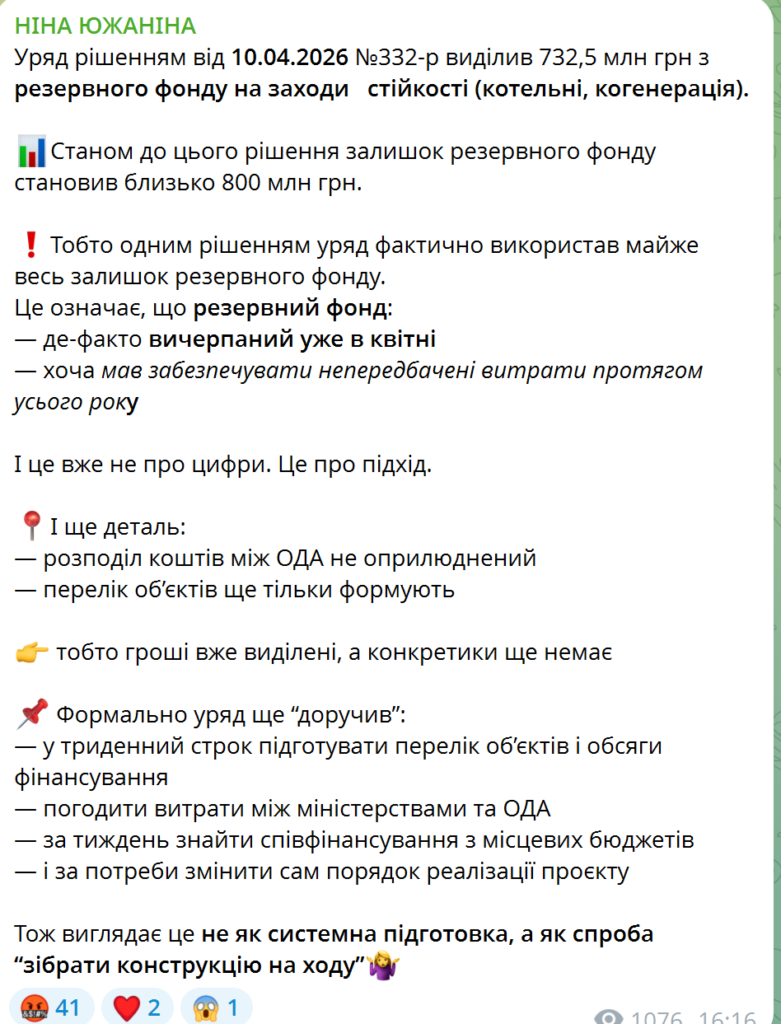
By Resolution No. 332-r of April 10, 2026, the Ukrainian government allocated 732.5 million hryvnias from the state budget’s reserve fund for resilience measures, specifically for boiler rooms and cogeneration. Following this, MP Nina Yuzhanina stated that the reserve fund was effectively almost depleted by spring, even though it was intended to cover unforeseen expenses throughout the entire year. Yuzhanina wrote about this on social media, according to "Komersant Ukrainian"
The issue caused a stir, as the reserve fund is traditionally considered the state’s financial “safety net” for emergencies and urgent expenses.
What is the reserve fund and why is it needed?
The state budget’s reserve fund is a special resource that the government uses to finance urgent and unforeseen expenditures. Its purpose is to enable the state to respond quickly to crisis situations, emergencies, destruction, force majeure, or other expenses not anticipated in the main budget planning.
That is why the reserve fund is considered an important tool for budgetary stability. If a significant portion of this resource is already spent in April, it inevitably raises questions about the state’s ability to respond promptly to new challenges by the end of the year.
How much money did the government allocate?
According to Nina Yuzhanina, the government allocated 732.5 million UAH from the reserve fund for stability measures. This funding is related to boiler rooms and cogeneration.
According to her, prior to this decision, the reserve fund balance stood at approximately 800 million UAH.
In other words, as the MP emphasizes, with a single decision, the government has effectively used up almost the entire available balance.
What Nina Yuzhanina said
Yuzhanina sharply criticized this approach to using reserve fund funds.
She emphasized:
“In other words, with a single decision, the government effectively used up almost the entire balance of the reserve fund.”
The MP also drew an even harsher conclusion:
“This means that the reserve fund was, de facto, depleted as early as April, even though it was supposed to cover unforeseen expenses throughout the entire year.”
Separately, she emphasized that the problem lies not only in the amount:
“And this is no longer about the numbers. It’s about the approach.”
Why this drew criticism
The main complaint is that, by its very nature, the reserve fund should remain a source for covering future urgent needs. If nearly the entire balance of the fund is used up by a single government decision as early as spring, this creates risks for budget flexibility for the rest of the year.
According to Yuzhanina, the situation appears even more problematic due to the lack of specifics regarding the use of funds at the time the decision was made.
What else is the problem, according to Yuzhanina
The MP drew attention to another important detail: the distribution of funds among regional state administrations has not been made public, and the list of projects is still being compiled.
That is why she emphasizes:
“In other words, the money has already been allocated, but there are no specifics yet.”
In her view, this resembles a situation where funding has already been approved, but the implementation mechanism is not yet fully finalized.
What instructions has the government formally issued?
According to Yuzhanina, the government has formally instructed, within a short timeframe:
- prepare a list of projects and funding amounts;
- coordinate expenditures among ministries and regional state administrations;
- find co-financing from local budgets;
- if necessary, change the project implementation procedure itself.
In other words, a significant portion of the practical work, as implied by her statement, is to be done only after the funds have been allocated.
Why Yuzhanina speaks of a “construction on the fly”
Assessing the approach to the decision itself, the MP made a rather harsh conclusion:
“So this doesn’t look like systematic preparation, but rather an attempt to ‘put the structure together on the fly.’”
These words effectively boil down her criticism to the main message: it’s not just about the costs, but about the way such decisions are made and implemented.
What an almost empty reserve fund means
If Yuzhanina’s assessment reflects the current financial situation, it means that the scope for new urgent decisions using the reserve fund could be extremely limited as early as mid-spring.
This is a sensitive issue for the budget, as the reserve fund is intended to serve as a rapid financial tool to cover risks that are difficult to predict in advance.