March record: Fuel consumption in Ukraine hits a three-year high
15 April 09:18
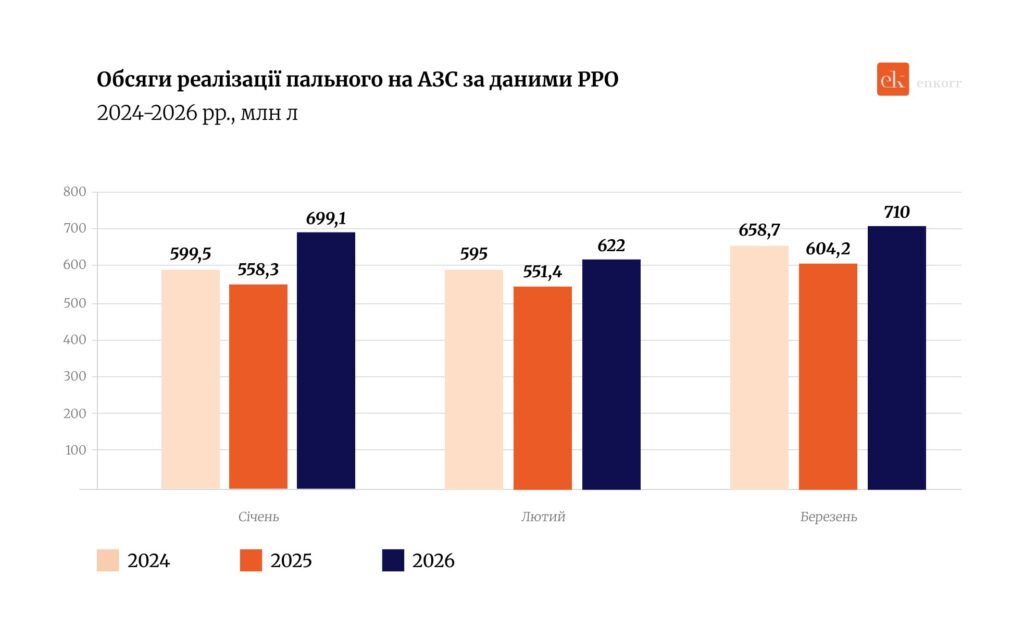
In March 2026, fuel consumption in Ukraine reached its highest level in at least the past three years. Sales of gasoline, diesel fuel, and autogas totaled 710 million liters, setting a record for the month of March. Compared to February, sales rose by 14%, and compared to March of last year—by nearly 18%.
This was reported by Enkorr, citing market data, according to "Komersant Ukrainian"
How much fuel was sold in Ukraine in March
March 2026 turned out to be a record month for the Ukrainian fuel market. Over the course of the month, gas stations sold 710 million liters of fuel. This is the highest March figure since at least 2024.
This growth indicates a significant market recovery and a shift in consumer behavior amid price and security factors.
How much did Ukrainians spend on fuel
According to the State Tax Service, the total value of fuel sold based on cash register receipts in March amounted to 48.5 billion UAH.
This is 57% more than during the same period last year. Thus, not only did physical sales volumes increase, but also the total amount of money Ukrainians spent at gas stations.
Which regions showed the highest growth
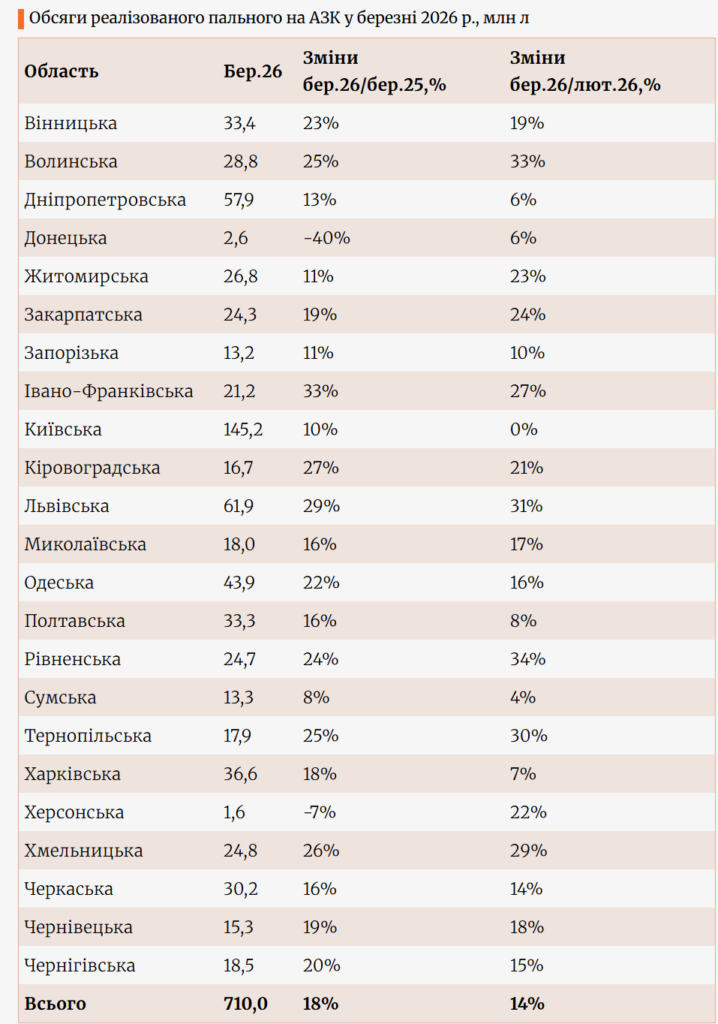
The western region showed the highest growth in March. There, fuel sales rose by 26% and reached 218.8 million liters.
Specifically:
- Ivano-Frankivsk Oblast saw a33% increase—to 21.2 million liters;
- Lviv Oblast added 29%—to 61.9 million liters, ranking second in Ukraine in terms of sales volume.
In the central region, sales rose by 17% —to 171.4 million liters.
Among individual regions, Kirovohrad stands out, recording a 27% increase—to 16.7 million liters.
In the northern and eastern regions, the increase was 11%.
Which region led in total volume
Despite the most dynamic growth in the west, the Kyiv region remains the absolute leader in total sales volume. In March, 145.2 million liters of fuel were sold there.
At the same time, growth rates in the Kyiv region were relatively moderate—10%.
Where were the lowest figures recorded
The lowest growth was recorded in the Sumy region, where the increase was only 8%.
In the frontline regions, the situation is even more difficult:
- in the Donetsk region, sales fell by 40%;
- in the Kherson region — by 7%.
This demonstrates once again how strongly the fuel market is affected by the security situation and proximity to the combat zone.
Why fuel consumption has surged in Ukraine
Experts from the “A-95 Consulting Group” attribute the March spike to panic buying driven by rising resource prices amid the war in Iran.
Anticipating further price increases, Ukrainians began buying fuel more actively, which led to record sales.
How consumer behavior has changed
Representatives of fuel retail chains note that further price increases have already changed drivers’ behavior.
According to them:
“The volume per receipt is decreasing. Additionally, we are seeing customers migrate to gas stations with lower prices.”
In other words, some consumers have started buying smaller quantities at a time and looking for better deals on the market.
Who has benefited amid the price frenzy
Against this backdrop, the state-owned “Ukrnafta” network, which operates with a minimal markup, recorded record sales growth.
This means that as fuel prices rise, drivers are increasingly choosing networks with lower prices, even if they previously used other gas stations.
What does this record mean for the market
The March peak shows that the fuel market in Ukraine remains highly sensitive to international events, particularly geopolitical risks and price expectations.
At the same time, the record itself indicates that demand for fuel in the country remains high, despite the war, the difficult economic situation, and regional imbalances.
In total, slightly more than 2 billion liters of fuel have been sold since the beginning of the year, which is 19% more than during the same period in 2025, for a total of 123.8 billion UAH (41%).
At the same time, according to data from the A-95 Consulting Group, the total fuel balance for the first three months of this year increased by only 10% to 2.3 million tons: gasoline rose by nearly 17% (86,000 tons), while diesel fuel and liquefied gas increased by nearly 10% and 3%, respectively (1.5 million tons and 237,000 tons).