First case of “Cicada” in Ukraine: what are the symptoms of the new COVID-19 subvariant?
22 April 12:54
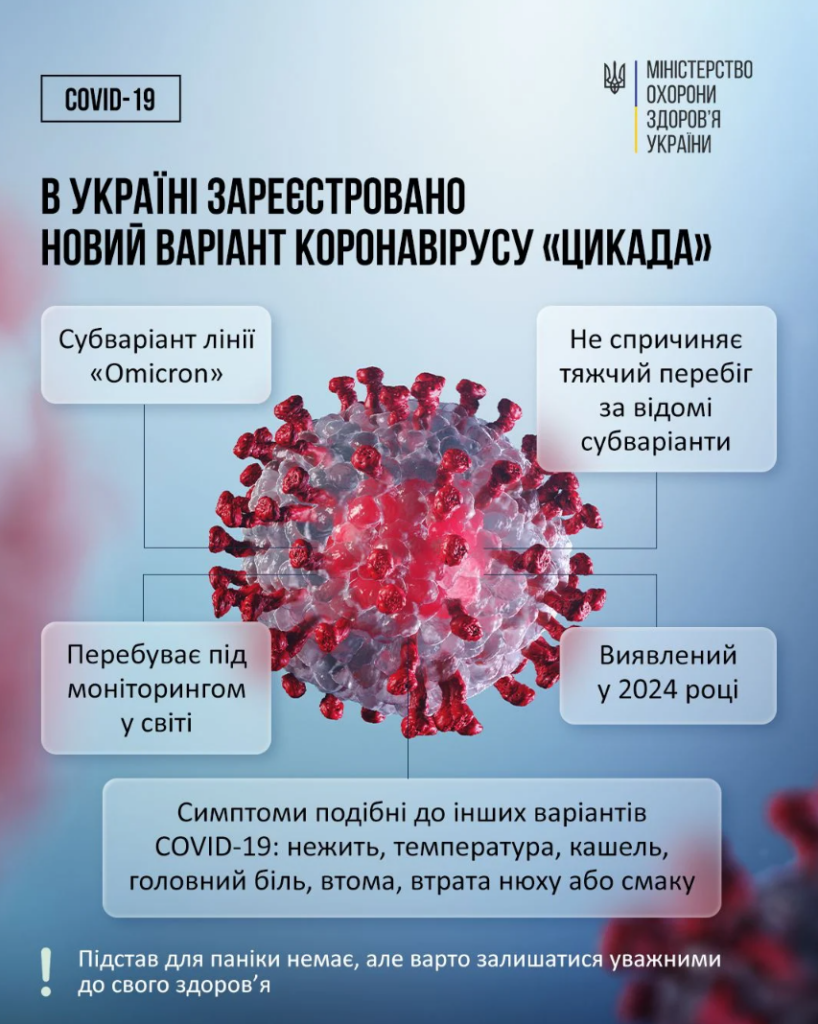
Ukraine has confirmed its first laboratory-confirmed case of the new BA.3.2 coronavirus subvariant, which has been informally dubbed “Cicada.” This was reported by the Ukrainian Ministry of Health, according to "Komersant Ukrainian"
The new subvariant was identified by specialists at the Ministry of Health’s Public Health Center during genomic sequencing of a positive sample.
What is known about the “Cicada” variant
According to the Ministry of Health, “Cicada” is a subvariant of the Omicron BA.3.2 lineage. The ministry notes that this subvariant was first detected in the world in November 2024 in South Africa, after which it was recorded in at least 23 countries worldwide.
The detection of the first case in Ukraine, according to the Ministry of Health, demonstrates the national public health system’s ability to identify new variants of the virus in a timely manner.
The World Health Organization classifies BA.3.2 as a Variant Under Monitoring. The WHO’s February–March 2026 report indicates that BA.3.2 accounted for 8% of all sequenced samples submitted worldwide during that period.
Is the new COVID-19 subvariant more dangerous?
The Ministry of Health of Ukraine reports that the clinical manifestations of “Cicada” do not differ significantly from other COVID-19 variants; however, the presence of mutations requires further monitoring, especially among people in high-risk groups.
Deputy Minister of Health and Chief State Sanitary Doctor Ihor Kuzin emphasized:
“Based on reports from other countries, the clinical manifestations of the disease caused by the ‘Cicada’ subvariant do not differ significantly from other COVID-19 variants. At the same time, the presence of mutations requires further monitoring, especially among groups at risk of severe disease. Therefore, we recommend that people in at-risk groups consult their family doctor regarding vaccination.”
In its initial risk assessment dated December 5, 2025, the WHO noted that BA.3.2 did not show signs of sustained dominance in circulation over other variants and that available data do not indicate an increase in disease severity, hospitalizations, or mortality.
The WHO assessed the overall additional risk to public health as low compared to other circulating Omicron lineages.
What are the symptoms of “Cicada”?
According to the Ministry of Health, the symptoms of the “Cicada” subvariant remain typical of COVID-19. These include:
- runny nose;
- fever;
- cough;
- headache;
- fatigue;
- loss of smell or taste;
- possible eye irritation;
- rash.
How new coronavirus variants are detected in Ukraine
The Ministry of Health explains that samples for testing are collected at healthcare facilities and then sent to regional centers for disease control and prevention. There, initial PCR testing is conducted, and positive samples are sent to the laboratory of the Public Health Center of the Ministry of Health of Ukraine, where genomic sequencing and genotyping of the virus are performed.
This is exactly how the first case of “Cicada” was detected in Ukraine.
Does the vaccine protect against the new subvariant?
The Ministry of Health emphasizes that vaccination remains the primary means of protection against severe disease and complications. Ukraine uses an Omicron-specific vaccine adapted to protect against the Omicron variant and its subvariants circulating worldwide.
In its assessment of BA.3.2, the WHO also noted that, despite reduced neutralization in laboratory conditions, approved COVID-19 vaccines are expected to continue to provide protection against severe disease.
Who in Ukraine is advised to get a booster shot
The Ministry of Health reminds the public that a COVID-19 booster shot is recommended 6–12 months after the initial vaccination, primarily for people in high-risk groups. This includes:
- people with weakened immune systems or severe chronic conditions;
- pregnant women;
- people over 60 years of age;
- those at increased risk of severe COVID-19;
- members of high-risk occupational groups, including doctors, teachers, and military personnel.
The ministry specifically emphasizes that the need for a booster shot is determined by a doctor in accordance with current recommendations from the Ministry of Health.