Ukrainians demand Lyashko’s resignation: why people want the minister to leave office
5 May 2025 17:17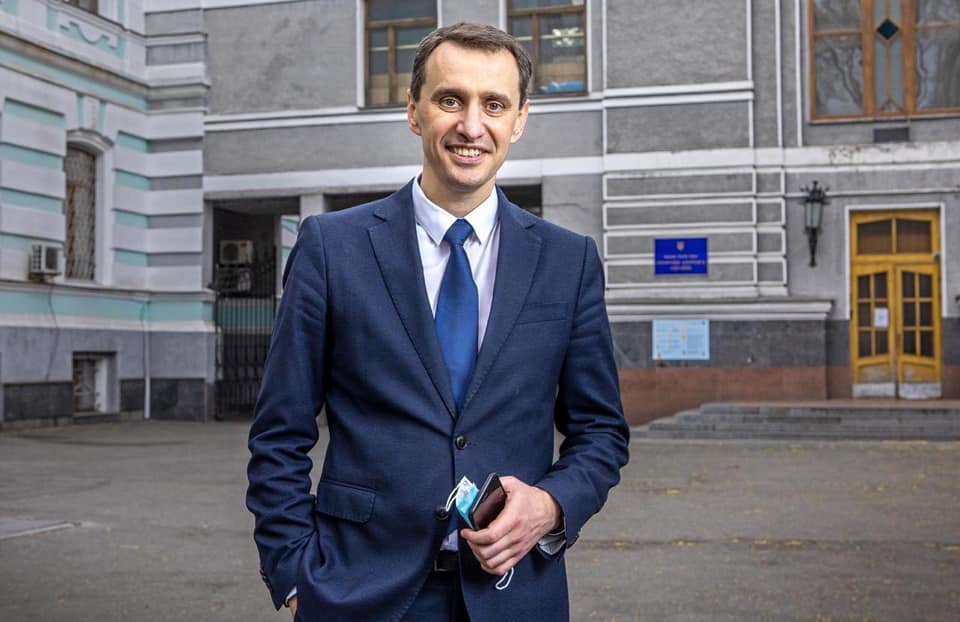
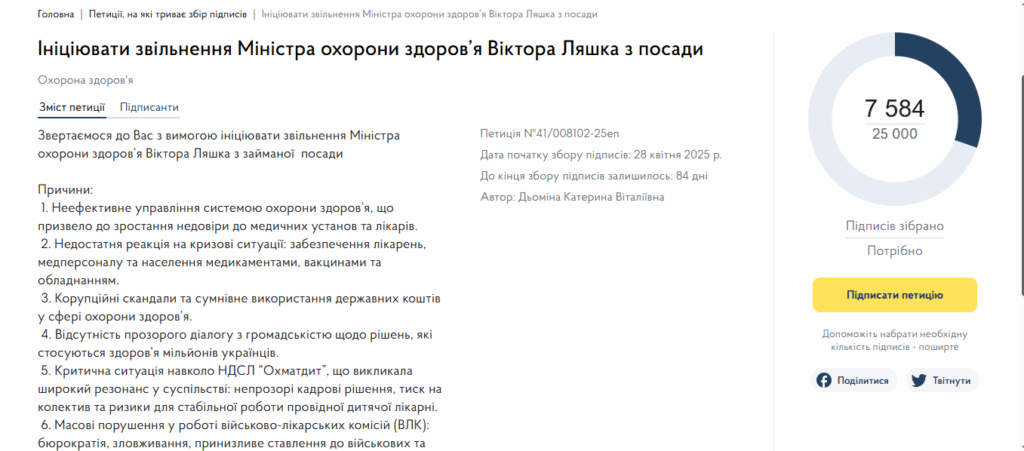
Ukrainians have begun collecting signatures for the resignation of current Health Minister Viktor Lyashko. The corresponding petition appeared on the website of electronic petitions of the Cabinet of Ministers of Ukraine, "Komersant Ukrainian" reports.
The signature collection started on April 28, 2025. It was initiated by Kateryna Demina. As of May 5, Ukrainians have already collected 7,584 signatures out of the 25,000 required.
Why the collection of signatures for Viktor Liashko’s resignation started
According to Kateryna Demina, in the context of the war and the systemic medical crisis, the country needs a new leadership of the Ministry of Health – responsible, open and professional. And the current head of the department should resign for the following reasons:
- ineffective management of the healthcare system, which has led to a growing lack of trust in medical institutions and doctors;
- insufficient response to crisis situations: providing hospitals, medical staff and the population with medicines, vaccines and equipment;
- corruption scandals and questionable use of public funds in the healthcare sector;
- lack of transparent dialog with the public on decisions that affect the health of millions of Ukrainians;
- the critical situation around the National Children’s Hospital “Okhmatdyt”, which caused a wide public outcry: non-transparent personnel decisions, pressure on the staff and risks to the stable operation of the leading children’s hospital;
- massive violations in the work of military medical commissions (MMCs): bureaucracy, abuse, humiliating treatment of military and veterans, delayed decision-making on the health status of mobilized persons;
- rapidly rising prices for medicines and shortages of essential medicines, particularly for people with chronic diseases. The Ministry of Health does not demonstrate effective mechanisms of state control over pricing, which creates an additional financial burden on the population in times of war and economic instability.
It should be noted that as of May 5, the Minister of Health of Ukraine Viktor Lyashko has not commented on the petition demanding his resignation.
Viktor Lyashko and the MSEC scandal
The Minister of Health of Ukraine Viktor Liashko has been in the center of public attention due to a large-scale corruption scandal related to the activities of medical and social expert commissions (MSEC).
In the fall of 2024, Ukrainian law enforcement agencies uncovered numerous cases of corruption in the MSEC system. It was found that some officials of the commissions issued fictitious disability certificates for bribes, allowing them to evade mobilization and receive unjustified social benefits. In particular, in Khmelnytsky region, large amounts of cash and expensive property were found on the possession of the head of the MSEC, Tetiana Krupa, and her relatives.
Amid the scandal, Viktor Lyashko said he did not intend to resign. He emphasized that the MSECs are not directly subordinated to the Ministry of Health, and he does not appoint or dismiss their heads, except for the head of the Central MSEC, who was dismissed by his order. Lyashko also noted that the reform of the medical and social expertise system is a priority, and he intends to focus on its implementation.
Read also: Media named the name of Tetiana Krupa’s business partner: what is known about him (photo)
Possible resignation of Lyashko and the OKHMATDYT case: how they are connected
Thescandal surrounding the restoration of the National Children’s Specialized Hospital “Ohmatdyt ” in Kyiv erupted after the hospital was damaged by a Russian missile strike in July 2024. More than UAH 1.1 billion was raised to rebuild the hospital, including UAH 378 million in donations from citizens and international donors.
The Okhmatdyt – Healthy Childhood Charitable Foundation held a competition to rebuild the damaged hospital building. The winner was a little-known Zaporizhzhia-based company, Bud-Technology, which offered to perform the work for UAH 307 million, one of the highest prices among the 14 bidders. The company had an authorized capital of only 5 thousand hryvnias and did not have the necessary capacity to carry out such a large-scale project.
After the results of the tender were made public, a public outcry arose. Journalists and activists pointed to possible corruption schemes and inflated estimates. The Minister of Health of Ukraine Viktor Liashko announced the cancellation of the tender and the holding of a new tender through the Prozorro system within 7-16 days. In addition, it was decided to create a supervisory board, which will include representatives of the largest donors, patient organizations and builders.
Later, it became known that Okhmatdyt announced tenders for engineering and consulting services and technical supervision of the repair of the facade and interior decoration of the building for a total of about UAH 14 million. These tenders also drew criticism due to the lack of competition and were canceled.
In August 2024, the hospital’s CEO Volodymyr Zhovnir said that the Okhmatdyt – Healthy Childhood charity foundation refused to transfer the 378 million hryvnias it had raised to the hospital’s account. This decision of the foundation caused surprise among the management of the medical institution.
Read also: Okhmatdyt will give the money raised by the people to one of the most expensive contractors
Massive violations in the work of military medical commissions in Ukraine
In 2024-2025, the relevant authorities recorded a large number of violations in the work of the MECs. In addition, the doctors who are members of the MECs did not disdain to take bribes and thus “earn” money from evaders.
Thus, in November 2024, it became known that the Security Service of Ukraine and police officers had eliminated new mobilization evasion schemes operating in different regions of Ukraine. Officials of the MSEC and doctors of the MEC were detained.
The detainees include officials of medical and social expert commissions and hospitals. In exchange for bribes ranging from USD 2 to 10 thousand, they helped conscripts avoid conscription on the basis of fictitious medical reports.
For example, in Kropyvnytskyi, a surgeon, a member of the Military Qualification Commission, was detained red-handed when he received a bribe for unreasonably declaring a conscript unfit for service.
In Dnipropetrovs’k region, the head of a local hospital department was exposed for taking bribes for diagnosing serious illnesses in close relatives of conscripts. This allowed the evaders to escape from mobilization abroad.
Read also: Almost $1 million found in the possession of ex-head of Chernihiv Military Medical Commission
In Kharkiv region, another MSEC official, a participant in a large-scale draft evasion scheme exposed by the SBU in October, was suspected. While working as a rehabilitation doctor, she falsified her clients’ medical records to obtain disability.
Prices for medicines are not going down: another problem faced by the Ministry of Health under Lyashko’s leadership
After the National Security and Defense Council (NSDC) temporarily banned marketing agreements with pharmacies, manufacturers refused to reduce selling prices for medicines.
The ban on marketing agreements between pharmacies and drug manufacturers, which was supposed to reduce the final cost of drugs for consumers, has not yet had the expected effect. Moreover, a critical situation has emerged in the pharmaceutical market.
Marketing agreements allowed pharmacy chains to receive additional income for promoting certain drugs. According to the manufacturers themselves, such agreements cost them 40-60% of the cost of each drug sold. This is what they referred to when explaining the high selling prices in 2022-2024.
After these marketing practices were officially banned on March 1, 2025, no significant price reductions were made by the factories. Instead, pharmacies, having lost a significant portion of their income, were forced to increase their own margins to cover their basic expenses, such as rent, salaries, and utilities.
The cost of medicines in Ukraine is formed by 72% at the production stage. However, in the public space, they try to shift the responsibility to retailers, saying that it is pharmacies that create “sky-high” prices. However, it is worth noting that the profitability of pharmacies depends on the specific item, and many drugs, especially essential ones, are sold with a minimal markup.
Experts note that a complete rejection of marketing without creating a transparent alternative may lead to the growth of shadow schemes – when advertising or bonus services are provided unofficially or through other legal mechanisms.
Читайте нас у Telegram: головні новини коротко