Russia is changing tactics: water intake facilities are now in its sights
29 April 12:14
Russia may attack water intake facilities this summer, which could leave entire Ukrainian cities without water, particularly in frontline and southeastern regions. This is reported in an article by RBC-Ukraine, as cited by "Komersant Ukrainian".
According to a source within government agencies who spoke to the publication, water intake facilities could become the occupiers’ primary target. These facilities vary from one settlement to another.
According to him, water sources can include rivers and, in some cases, underground wells. However, most Ukrainian settlements have only one water intake facility. Only in some large cities are there multiple water intake facilities in operation.
“This means that taking a single facility out of commission could lead to the suspension of water supply for an entire settlement,” he noted.
For example, the restoration of a water pipeline that was destroyed in Mykolaiv back in 2022 took several years and cost over 6 billion hryvnias. The city’s centralized water supply was not restored until the end of 2025.
Watch us on YouTube: important topics – without censorship
Artem Shira, vice president of the Ukrainian Water Association, also believes that the enemy’s primary targets are likely to be water intake facilities and pumping stations.
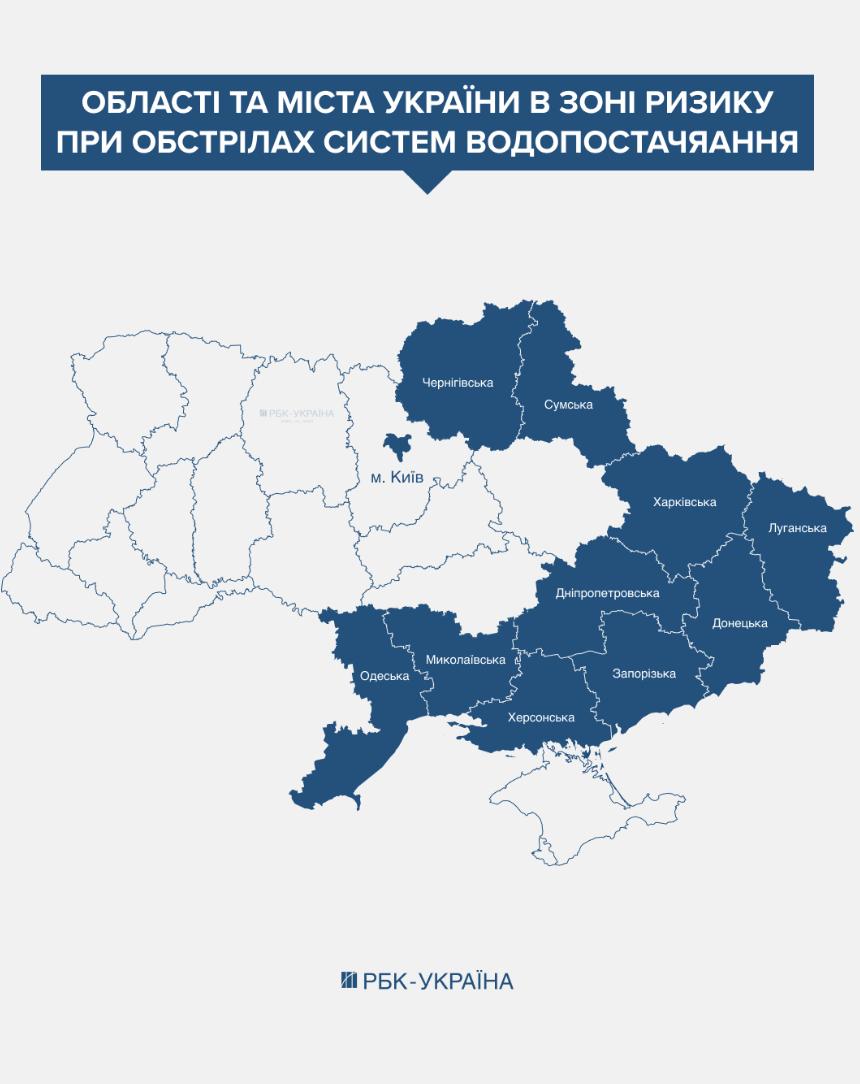
Photo: Frontline and southeastern regions of Ukraine are at risk (infographic by RBC-Ukraine)
“Pumps are hard to find (for replacement), and repairs will take weeks,” he told the publication.
The main vulnerability of water networks is the lack of backup water intake systems that could serve as a viable alternative in the event of the destruction of the existing system.
“We often operate with a single water intake system. But even where there is a backup, it is essentially located in the same building as the main one—literally just a couple of meters away. The two pumps—the main and backup—and the two transmission lines (for the pumps—ed.) are all nearby. If there is a strike, everything will be destroyed immediately,” Shira noted.
Currently, according to the publication, the issue of installing alternative water intake facilities in populated areas is being considered. However, their construction and commissioning are practically impossible before summer—this process takes 9 to 12 months.
One option being considered is the use of mobile water intake stations—roughly speaking, mobile water pumps. They will be able to move from the water source to areas where stationary stations have been put out of commission.
“In the winter, we used mobile generators. We want to apply the same logic to water. Obviously, we won’t be transporting water itself, but rather equipment that will travel along rivers and function as an alternative water intake,” said the publication’s source.
Some of the equipment for these stations is already being procured, while some is being manufactured in Ukraine. As of now, we can talk about at least six stations. They will have a fairly high capacity—100,000 to 300,000 cubic meters per day. This is sufficient for medium-sized regional centers—Zaporizhzhia, Kryvyi Rih, Mykolaiv, Vinnytsia, and Poltava. For Kyiv, Odesa, and Lviv, a single unit will not be enough.
Mobile water treatment units can be put into operation much faster than new stationary water intake facilities.
“These stations will be used in difficult circumstances for a short period of time. This will be a temporary water supply. Of course, there may be some inconveniences in such cases,” the source said.
Russia is preparing strikes on water supply facilities
Recall that as early as March 2, Ukrainian President Volodymyr Zelenskyy warned that Russian occupiers might be preparing strikes on water supply facilities.
Information also appeared online about a possible threat to the Bortnytsia aeration station—a key facility that receives the capital’s wastewater.
The head of state ordered that security for the relevant infrastructure be strengthened.
Read us on Telegram: important topics – without censorship