
Orchards Under Attack: How Ukrainian Farmers Are Saving the Upcoming Harvest After the Storm
27 April 18:48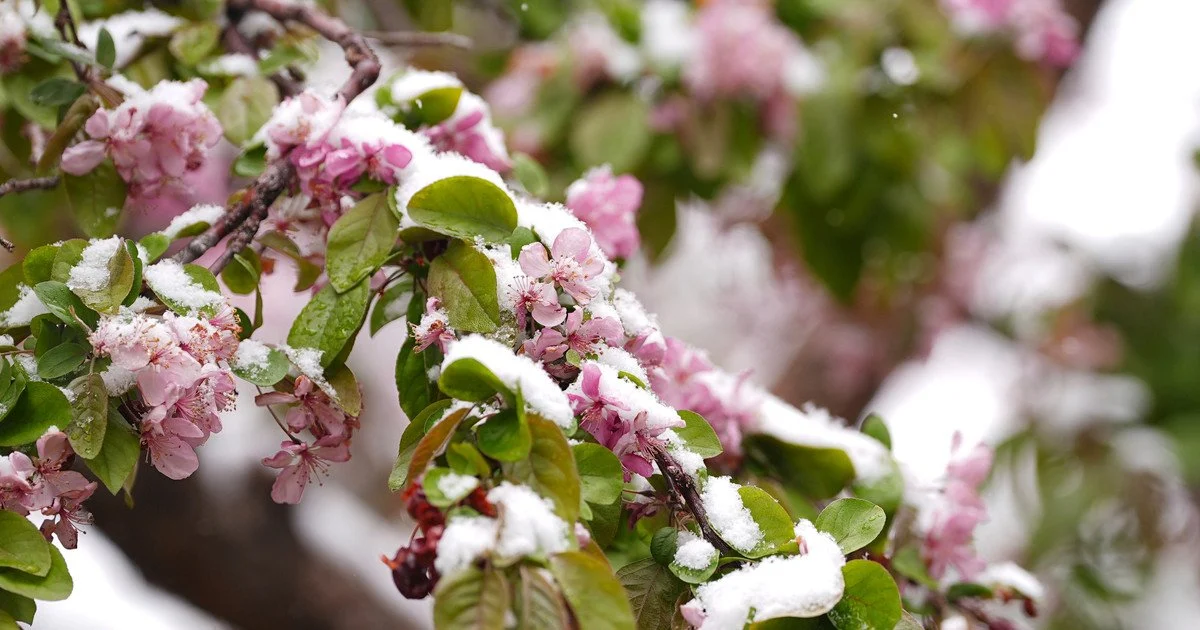 ANALYSIS FROM
The weather once again caused trouble for Ukrainians yesterday. Strong gusts of wind not only toppled trees and ripped off roofs in cities and towns. The wind swept through orchards and fields, damaging fruit trees and crops. To find out how these weather surprises might affect the harvest,
Strong winds—reaching up to 25 meters per second in some places—thunderstorms, freezing rain, and in some areas even hail, a sharp drop in temperature, and night frosts—not only in the air but also on the ground. And even snow. This is how an active atmospheric front manifested itself the day before, sweeping across Ukraine in several waves. Natalia Ptukha, an employee of the Ukrainian Hydrometeorological Center, explains further.
“Wind gusts were recorded across virtually the entire territory of Ukraine—ranging from 15 to 20 meters per second. And even higher—in the Odesa and Dnipropetrovsk regions, weather stations recorded wind gusts of 25 meters per second. Thunderstorms were also observed in some areas—in the Zhytomyr, Cherkasy, Kirovohrad, and Poltava regions. Hail was more typical in the Chernihiv region. As for other regions, these tiny precipitation particles in the form of ice pellets and ice grains are characteristic of the spring-autumn transitional period. And this isn’t quite the classic hail we see in summer, when hailstones can reach large sizes and, consequently, pose a danger,” the expert explains.
The day before, the Ukrainian Hydrometeorological Center even issued a Level 1—that is, yellow—hazard warning for the Kyiv region and the city of Kyiv. And yesterday’s tree-falling incident in Kyiv confirmed the validity of that warning. The storm caused similar consequences—such as fallen trees and torn-off roofs—in other cities and towns as well.
How the wind “wreaked havoc” in orchards and fields
Farmers, who worry about their crops, have their own special scale of assessment. And the highest danger level for them is frost. Just how problematic were the recent weather events for farmers? Here is what one farmer told the publication
“In the fields of the Kyiv region, specifically on the Left Bank, nothing particularly alarming happened. I don’t know what the situation was on the Right Bank, so I can’t comment on that. But on the Left Bank—and I was actually there yesterday, in both the Pereyaslav and Boryspil districts—I didn’t see anything critical. Yes, greenhouse growers suffered some damage—those who grow early produce under cover: plastic sheeting was flying not only across their fields but also on the roads and in the fields. There wasn’t enough hail to cause significant damage. That is, there was some, but only in places and for a short time. And the fact that it rained in the spring is always a jackpot. In the orchards, perhaps some blossoms were knocked off here and there. But hail isn’t causing any major problems right now. You have to thin out the blossoms to get a good apple or a good apricot. This isn’t a frost. And if a flower or two was knocked off by hail somewhere, there’s nothing to worry about,” says the farmer.
Ivan Yarmolyuk, owner of the “Vidrodzhennia” farm in the village of Petrykivka, Dnipropetrovsk Oblast, agrees with him. His farm has over 100 hectares of land under apricot, peach, plum, and cherry orchards.
“The most critical factors are low temperatures and hail. Fortunately, we didn’t have any hail yesterday. Although I heard there was some in other places. Wind isn’t such a big problem. Of course, it’s all stressful. But it’s not a critical wind. The biggest problem, I’ll say it again, is low temperatures, and they affect everything,” the farmer notes.
And frosts again
Unfortunately, the risk of frosts in the country remains. This is the forecast issued by meteorologists. And frosts were observed in most regions throughout last night. Natalia Ptukha, an employee of the Ukrainian Hydrometeorological Center, continues.
“Yesterday’s active atmospheric front opened the way for the further influx of cold air masses from the north and northwest. Therefore, frosts occurred in most regions, and not only on the ground surface but also in the air—practically in all western regions, parts of the northern regions, some central regions, and locally even in some southern regions. In Lviv, for example, the lowest temperature ever recorded for this day was even noted, specifically the minimum temperature for the night. The previous lowest reading was recorded in 1954—on the night of April 27, it was minus 2.2 degrees. This time, on the night of April 27, it was minus 5.3 degrees,” the expert explains.
For fruit crops, the most problematic period in terms of threats and consequences is flowering. That is, the flowers suffer first and foremost. Ivan Yarmolyuk, a farmer from Dnipropetrovsk Oblast, confirms that the situation for some crops is quite critical.
“The problem is the frosts. And today we even had a light snowfall. Everything was affected, but we’ll see the consequences a little later. It’s very critical for apricots and peaches. Very critical. As for cherries and plums, there are some issues, but it’s more or less manageable. The apple trees haven’t bloomed yet. They’re still doing relatively well. Once the flower is open, it’s very vulnerable. Even minus two degrees is a problem here. But if it’s still in bud, the bud can withstand both minus two and minus four degrees. And we’ve been in the freeze for eight days now. Eight days. And one night it was already minus five. It’s our eighth day, and we’re expecting at least three more days of this this week,” says the farmer.
The situation is better in the Kyiv region. Oleksandr Chubuk, head of the “Chaika-2” peasant farm in the village of Zhurivka, explains.
“Frost can indeed damage all the blossoms, but our apple trees aren’t blooming yet, the pear trees are just starting to bloom, and I don’t see any damage. Today I walked through the orchards and took a look. Yes, there were a few blossoms on the cherry trees, and some of the plum trees were starting to bloom. Everything is fine with the strawberries, too. I walked around and checked; I have both covered and open strawberries there. They aren’t blooming yet. We’re more worried about the frosts. Tonight, tomorrow night, and so on until Friday—zero to minus temperatures. That’s what will be a shame,” says the farmer.
Unfortunately, farmers do indeed have reason to worry about both the weather and the harvest. The forecast isn’t very favorable. Natalia Ptukha, an employee of the Ukrainian Hydrometeorological Center, explains exactly what will happen with the weather in the coming days and why.
“The atmospheric front has already passed, but the current weather pattern is such that, although atmospheric pressure has risen in the lower atmosphere and is bringing more clear skies, these nighttime frosts are still lingering. Therefore, during the daytime over the next few days, we may still see light precipitation, mostly in the form of light, localized rain. And there remains a chance of frost at night. In fact, the information on our website is regularly updated, and you can check there for all the latest changes,” the expert notes.
According to this data, precipitation will decrease, the wind will weaken, and it will get a little warmer. Thus, as forecast by the Ukrainian Hydrometeorological Center, over the next three days, the country will be mostly dry, with only light rain expected in some areas: on the afternoon of April 28 in the north and northeast, on the afternoon of April 29 in most regions, and throughout the day on April 30 in the far south of the country. The wind will be northwesterly, 5–12 m/s, with gusts of 15–20 m/s in some places in the east and northeast of the country on the night of April 28. At night in Ukraine, except for the coastal areas and Crimea, there will be frosts of 0-3°C; daytime temperatures will range from 6-11°C, and up to 15°C in the south of the country.
Author: Serhiy Vasylovych












