The EU paid Russia 2.3 billion euros for fuel in just one month: the five largest buyers
24 June 00:35
In May 2026, the European Union remained one of the largest buyers of Russian fossil fuels. EU countries imported approximately 2.3 billion euros worth of energy resources from Russia, accounting for nearly 12% of Moscow’s export revenues from the world’s five largest buyers. This information is contained in a monthly analysis by the Center for Energy and Clean Air Research (CREA), according to "Komersant Ukrainian"
The European Union ranked fourth among the largest importers of Russian fuel. Liquefied natural gas accounted for the largest share of its purchases, with imports of this fuel increasing even after new restrictions took effect.
How much did the EU pay Russia for energy resources?
The total value of Russian fossil fuels imported by EU countries in May amounted to approximately 2.3 billion euros.
The breakdown of purchases was as follows:
- 42% was liquefied natural gas—approximately 966 million euros;
- 30% was crude oil;
- 28% was pipeline natural gas.
At the same time, the five largest buyers of Russian energy resources in the EU collectively paid Moscow about 2 billion euros.
Natural gas accounted for 66% of the value of their purchases. These countries imported €842 million worth of Russian LNG, €485 million worth of pipeline gas, and €687 million worth of crude oil via the Druzhba pipeline.
Imports of Russian LNG rose after the ban was imposed
In May, imports of Russian liquefied natural gas to the European Union increased by 4% compared to April.
The increase was recorded after the EU ban on the purchase of Russian LNG under short-term contracts took effect on April 25, 2026.
However, the new rules provide for transitional exemptions. Deliveries under long-term contracts signed before a specified date may continue until early 2027. Therefore, the increase in the volume of Russian LNG unloaded at European ports does not necessarily indicate a violation of the REPowerEU regulation.
Spain has doubled its purchases of Russian LNG
The main reason for the overall increase in imports was a sharp rise in purchases by Spain.
In May, the country imported €337 million worth of Russian LNG, ranking third among the EU’s largest buyers of Russian fossil fuels.
Compared to April, Spain doubled its LNG imports from Russia. At the same time, the total volume of liquefied gas purchases from all countries increased by only 14%.
The Port of Bilbao unloaded twice as much Russian LNG in May as it did in April. The Port of Cartagena received its first shipment of Russian liquefied gas in about a year and a half.
These figures indicate that the increase was specifically linked to supplies from Russia, rather than to a general sharp rise in Spain’s demand for imported gas.
Hungary Became the Largest Buyer in the EU
Hungary became the largest importer of Russian fossil fuels among EU countries in May.
It purchased energy resources worth approximately 674 million euros. Imports included:
- pipeline natural gas;
- crude oil delivered via the Druzhba pipeline.
Hungary, along with Slovakia, also continued to receive Russian pipeline gas via the “Balkan Stream” route. The total value of gas supplied to these two countries is estimated at 485 million euros.
Watch us on YouTube: important topics – without censorship
Slovakia paid Russia nearly €500 million
Slovakia ranked second among EU countries, importing approximately €497 million worth of Russian fossil fuels.
The breakdown of its purchases was as follows:
- pipeline gas — 121 million euros;
- crude oil via the Druzhba pipeline — 376 million euros.
Hungary and Slovakia remain the EU countries most dependent on Russian pipeline energy resources.
France has reduced its imports of Russian gas
France has become the fourth-largest buyer of Russian fossil fuels in the EU. In May, the country purchased €253 million worth of Russian LNG.
Compared to the previous month, French imports of Russian liquefied natural gas decreased by 29%.
At the same time, the total volume of LNG unloaded at French terminals fell by 23%. This means that the decline in purchases from Russia was slightly greater than the overall reduction in LNG imports into the country.
Belgium spent €252 million on Russian LNG
Belgium became the fifth-largest buyer in the European Union. In May, it imported €252 million worth of Russian LNG.
Compared to April, purchases of Russian gas decreased by 25%. However, the total volume of LNG unloaded at Belgian ports fell even more—by 31%.
Belgian terminals remain a key hub for receiving Russian liquefied natural gas in Europe.
The Five Largest Buyers of Russian Fuel in the EU
In May 2026, the ranking of the largest importers of Russian fossil fuels in the European Union was as follows:
- Hungary — 674 million euros;
- Slovakia — 497 million euros;
- Spain — 337 million euros;
- France — 253 million euros;
- Belgium — 252 million euros.
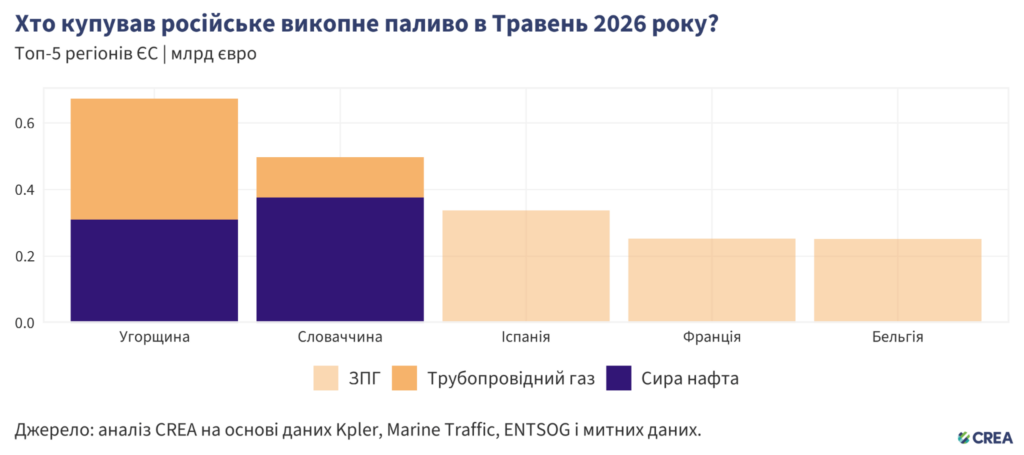
In total, these countries paid Russia about 2 billion euros.
Hungary and Slovakia primarily purchased pipeline gas and oil, while Spain, France, and Belgium imported Russian LNG.
When the EU will completely ban Russian gas
The European Union is implementing the ban on Russian gas in phases so that countries and companies can fulfill existing contracts and find alternative suppliers.
For Russian LNG under short-term contracts, the restrictions took effect on April 25, 2026. A complete ban on Russian liquefied natural gas imports is set to take effect in early 2027.
A longer transition period has been established for pipeline gas. Imports under long-term contracts are scheduled to end in the fall of 2027.
The EU has also provided for contract monitoring and penalties for companies that violate the new rules.
Read us on Telegram: important topics – without censorship