$100 in 2021 vs. 2026: Comparing a Receipt and a Grocery Basket
14 August 20:48 ANALYSIS
For years, there was a stereotype in Ukraine: “Keep your savings in dollars—and you’ll be safe.” A $100 bill was seen as an unshakable, rock-solid shield against any inflation. However, if you compare a typical shopping basket in 2021 with one today, one fact becomes clear: the purchasing power of a $100 bill in Ukraine has fallen by approximately 30–35%. Technically, $100 buys you significantly more hryvnias today than it did five years ago. But in reality, that same amount of money will get you one-third fewer goods and services from a supermarket or gas station.
In recent years, the purchasing power of a standard $100 bill has undergone significant changes. While in 2021, a stable $100 was worth approximately 2,700 hryvnias at an exchange rate of 27, today that same bill converts to 4,470 hryvnias at the current exchange rate of 44.7. It would seem that we now have 65% more hryvnias in our wallets, yet the actual contents of our shopping basket have nearly halved.
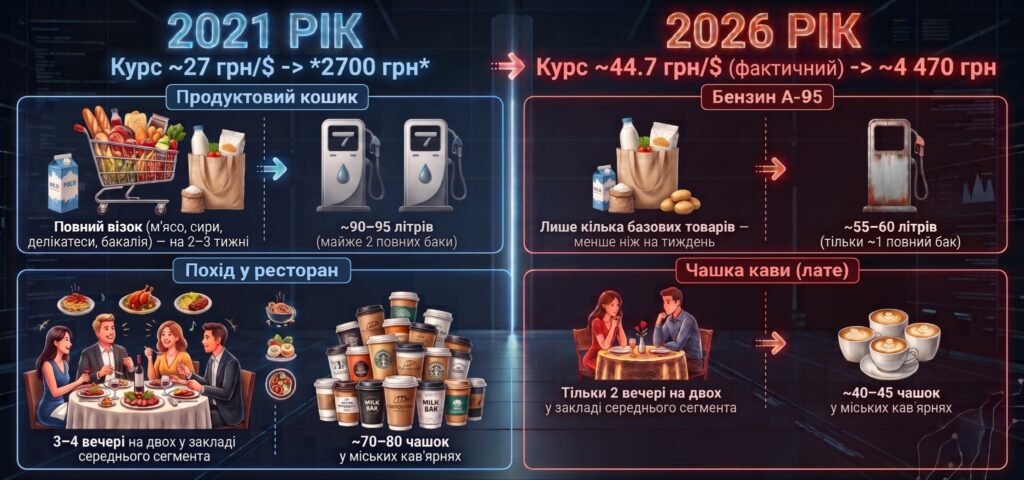
A visual comparison of household expenses shows just how much our daily purchasing power has changed. Five years ago, $100 would have been enough to fill a shopping cart at the supermarket with meat, cheese, deli items, and groceries—enough to last a family two to three weeks—today that same amount will buy onlya few basic items that will last less than a week. The situation is similar with fuel: previously, $100 would buy 90–95 liters of A-95 gasoline—enough for nearly two full tanks of a car—but now that amount is enough for only 55–60 liters, or barely one tank.

The changes have also affected the service and leisure sectors. Instead of three or four full-course dinners for two at a mid-range restaurant, which we could afford before, $100 will now cover a maximum of two such meals. Even our favorite daily ritual of having a cup of latte at a local coffee shop has become noticeably more expensive: whereas in 2021 that amount would have bought 70–80 cups of coffee, the same amount now only buys about 40–45.
Three reasons why the “hundred” has lost its value
1. Double inflation: American and Ukrainian
The U.S. dollar is depreciating on its own. Due to pandemic-related stimulus payments and global crises, inflation in the U.S. has significantly eroded the value of the dollar in recent years.
Assessing the U.S. factor, Ivan Us, Ph.D. in Economics and chief consultant at the National Institute for Strategic Studies, emphasized in a comment to [Komersant]:
“Let’s consider the purely American factor: the U.S. has also experienced devaluation. Compared to 2021, dollar inflation ranged from 19% to 25%. In other words, if we’re talking about a loss of purchasing power of $100, then approximately 25% of that loss is due specifically to dollar inflation,” said Ivan Us.
This depreciation was compounded by a domestic Ukrainian factor. According to the expert, the largest share of the financial blow comes precisely from the hryvnia’s depreciation during the war:
“About 45% of this decline is due to the devaluation of the hryvnia compared to its value before the full-scale invasion began,” says Us.
2. Logistics, Energy, and Food Factors
In addition to currency fluctuations, there are factors that directly drive up prices within the country. Rising fuel prices, the use of generators during power outages, and a shift in import patterns have forced businesses to factor new costs into every loaf of bread or kilogram of apples.
Highlighting this factor, Ivan Us notes that part of the price surge is not tied to the exchange rate displayed on the board at all:
“There are other factors unrelated to the currency component. This is food inflation. The rest of the loss in purchasing power stems precisely from rising food prices, which occur simply because goods are becoming more expensive on their own,” Us states.
3. Rising Costs of Services
The service sector (from hair salons to auto repair shops) finds itself in a similar situation. To survive, cover rent and utility costs, and pay competitive wages amid a labor shortage, businesses are forced to raise their rates. As a result, services are becoming more expensive just like essential goods.
What does this mean for our wallets?
As the expert concludes, we need to take a sober look at this new reality and understand that $100 will never regain its former purchasing power.
Keeping savings “under the mattress” in dollar cash is no longer a strategy for growing or preserving wealth, but merely a way to slightly slow the loss of capital. The dollar is still more reliable than the hryvnia during sharp exchange rate fluctuations, but it no longer protects against creeping devaluation.
Watch us on YouTube: important topics – without censorship