
Every Ukrainian “owes” $7,200: What’s happening with the national debt
27 April 12:34
Ukraine’s per capita public debt has increased approximately eightfold since 2010—from about $900 to over $7,200. This was reported on Facebook by economist Oleg Belinsky, who for many years headed the Capital Markets Division of the Public Debt Department at the Ministry of Finance, according to
According to him, the current level of public debt per capita already corresponds to approximately 1.2–1.3 times the annual salary of the average Ukrainian. In other words, hypothetically, to “cover” their share of the public debt, the average Ukrainian would have to work for over a year.
“Since 2010, Ukraine’s public debt per capita has risen from approximately $900 to over $7,200. That is, in fact, an eightfold increase,” noted Oleg Belinsky.
Why has the debt per Ukrainian risen so much?
Oleg Belinsky explains that the debt burden is growing not only due to the increase in the national debt itself, but also due to the decline in the population.
“This is the real trend in the debt burden, regardless of the causes—whether it’s the growth of the debt itself or the shrinking population,” the economist emphasized.
READ ALSO: For Ukraine, 100% of public debt relative to GDP is already a problem, says economist
At the end of 2025, Ukraine’s public and state-guaranteed debt reached 9.04 trillion UAH ($213.3 billion). It grew by nearly 30% over the year.
According to the Ministry of Finance, as of February 28, 2026, Ukraine’s public and state-guaranteed debt stood at 9,211.19 billion UAH, or 213.18 billion USD, specifically: public and state-guaranteed external debt – 7,138.89 billion UAH (77.5% of the total public and state-guaranteed debt), or $165.22 billion; public and state-guaranteed domestic debt – 2,072.30 billion UAH ( 22.5%), or $47.96 billion.
Ukraine’s public debt amounted to 8,940.64 billion UAH (97.06% of the total amount of public and state-guaranteed debt), or $206.92 billion.The government’s external debt amounted to 6,931.02 billion UAH ( 75.25% of the total public and state-guaranteed debt), or $160.41 billion.Domestic public debt amounted to 2,009.62 billion UAH ( 21.82% of the total amount of public and state-guaranteed debt), or $46.51 billion.
Ukraine’s state-guaranteed debt amounted to UAH 270.55 billion ( 2.94%), or $6.26 billion, specifically: state-guaranteed external debt – UAH 207.87 billion ( 2.26%), or $4.81 billion; state-guaranteed domestic debt – 62.68 billion UAH ( 0.68%), or $1.45 billion.
Debt per Ukrainian: more than a year’s work
According to Belinsky’s estimate, the current level of debt per Ukrainian resident is approximately 1.2–1.3 times the annual salary.
“As of 2025–2026, this level means that the debt per capita is roughly 1.2–1.3 times the annual salary. In other words, the average Ukrainian needs more than a year’s work to hypothetically cover their share of the national debt,” he explained.
This indicator is important because it shows not only the absolute size of the debt but also how it relates to people’s incomes. If debt per person grows faster than wages, it means the burden on the economy and future budgets becomes heavier.
Watch us on YouTube: important topics – without censorship
How Ukraine Compares to the Rest of Europe
Oleg Belinsky compared Ukraine with other European countries. According to his estimates, in Poland, the debt per capita amounts to approximately 0.7–0.8 times the annual salary, or less than a year’s work. In Romania and the Czech Republic, the situation is similar—around 0.6–0.7 times the annual salary.
“In Poland, this figure stands at approximately 0.7–0.8 times the annual salary. That means less than a year’s work. In Romania and the Czech Republic, the situation is similar and stands at around 0.6–0.7,” the economist noted.
The situation varies across the major economies of Western Europe. According to Belinsky’s estimate, in Germany this figure is approximately 0.6–0.7 times the annual salary, in France it approaches one year, in the United Kingdom it fluctuates around one year or slightly higher, and in Italy it already exceeds one year and amounts to approximately 1.4–1.6 times the annual salary.
The economist also cited the example of Russia, the aggressor country, which has a significantly lower level. There, the debt per capita is approximately 0.3–0.4 times the annual salary.
“As a result, Ukraine is already at a level exceeding one year’s salary, meaning it is in the zone of elevated debt burden. Meanwhile, most European countries remain within the range of 0.6 to 1 year,” Belinsky noted.
Why the rate of debt growth is the main problem
According to the economist, Ukraine’s key distinction lies not only in the level of debt burden itself, but in the speed at which it is growing.
“Levels above one year are typically characteristic of either economies with structural problems or specific models. Ukraine’s main distinction lies in the pace, as this level was reached in just a few years, whereas in most European countries it took decades to develop,” Belinsky emphasized.
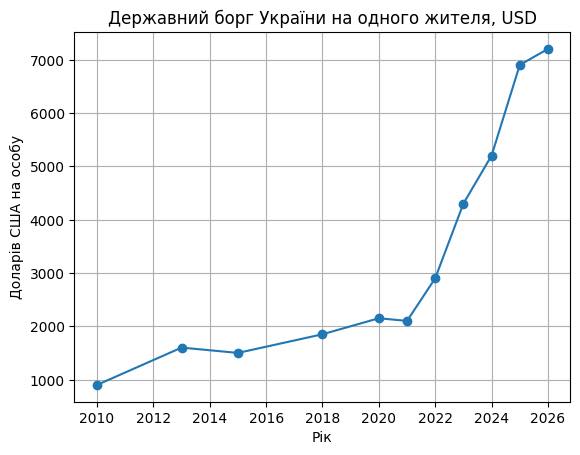
It is precisely the pace of debt growth that is one of the main risks. Ukraine is forced to increase borrowing due to the war, massive defense spending, the need to finance social payments, infrastructure reconstruction, and the budget deficit.
As reported by
After the deferral period ends, Ukraine will begin repaying the deferred amounts in equal semi-annual installments.
Reportedly, payments will continue from 2035 to 2039. At the same time, interest capitalization is provided for, meaning that accrued interest will be included in the total amount of liabilities.
Read us on Telegram: important topics – without censorship












