Trump’s Patriot License: Three Production Scenarios and a Chance for an Economic Miracle for Ukraine
15 July 16:02 ANALYSIS FROM
U.S. President Donald Trump’s announcement that Ukraine would be granted a license to manufacture interceptor missiles for the Patriot air defense system has sparked debate about security risks and logistics. However, behind the scenes of purely military issues lies enormous economic and technological potential. What will the launch of this production actually mean for the Ukrainian economy? And what three scenarios for its rollout do Western analysts foresee? Find out in this article "Komersant Ukrainian".
The main value of the Patriot license is not simply permission to assemble finished parts, but official access for Ukrainian specialists to highly complex technological processes. Says Ivan Us, Ph.D. in Economics and chief consultant at the Center for Foreign Policy Studies of the National Institute for Strategic Studies.
“Obtaining a manufacturing license is, first and foremost, access to technology. This means we are being integrated into global production chains. This very inclusion in these chains is an extremely important step, and it’s a huge plus for Ukraine,” emphasizes Ivan Us.
The Turkish Scenario: How the Transfer of Patriot Technology Could Trigger an Economic Leap for Ukraine
Global experience shows that such technology transfer has the potential to transform entire countries. The expert cites the historical example of Turkey: a significant part of its economic rise occurred because Turkish citizens worked in Europe, acquired cutting-edge knowledge there, and then returned home to build their own technology-driven economy. A Patriot license could trigger a similar process for Ukraine, but immediately on the level of U.S. defense giants.
Watch us on YouTube: important topics – without censorship
The production of Patriot interceptor missiles today is inextricably linked to state-of-the-art programming systems, microelectronics, and artificial intelligence (AI). By gaining access to these military developments, Ukrainian engineers will be able to apply this knowledge in the civilian sector. Ivan Us proposes rethinking the classic concept of “conversion.”
- Traditional conversion: the transition of factories from weapons production to civilian products.
- Modern “knowledge conversion”: applying people’s military-technological expertise to non-military fields.
“The people involved in these processes will gain unique knowledge. Eventually, we’ll be able to carry out a ‘knowledge conversion’ for these specialists, which will allow us to develop far more technologically advanced civilian products under licenses from American companies — from IT products to system modernization and work with artificial intelligence, including its testing and improvement,” says Us.
A Carpathian underground defense industry or a secure Europe?
The question of the physical location of production lines remains open due to the constant threat of shelling. The expert acknowledges that setting up production directly in Ukraine carries enormous risks, but our geography has its advantages.
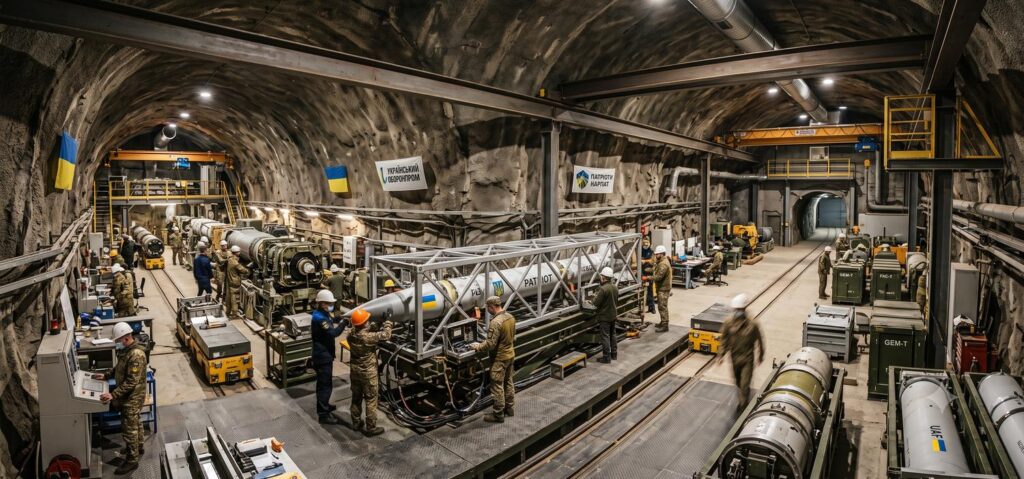
“When it comes to production within Ukraine, the Carpathians immediately come to mind. That’s exactly where we can set up reliable underground operations. If we succeed in this, we will resolve the security issue and significantly simplify the logistics of delivering finished missiles to the front lines,” says Ivan Us.
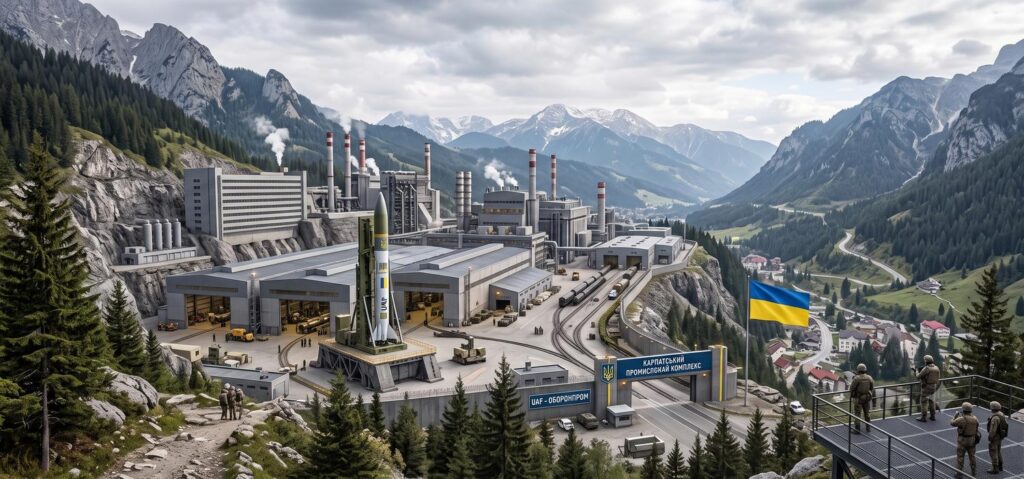
At the same time, even if part of the production processes takes place outside Ukraine (for example, at European hubs in Poland or Germany), Ukrainian specialists will still be integrated into the process, gaining invaluable experience.
What makes this situation unique is the exceptionally high level of motivation among Ukrainian specialists. In the initial phase, they will work knowing that every missile they assemble saves the lives of their families and protects the country. However, in the long term, this experience will open the doors to the global technology market for them. Working under a U.S. license will allow Ukrainian engineers to find employment at the subsidiaries of leading American corporations. Moreover, this will encourage American and European corporations themselves to open official offices directly in Ukraine, establishing joint ventures with local businesses.
“For Ukraine, this is definitely a major and indisputable advantage. The introduction of such a license is a long-term investment not just in defense, but in human capital, which will shape our country’s technological future,” concludes Ivan Us.
Three Scenarios for Production Rollout: Where and When Patriot Missiles for Ukraine Will Actually Be Assembled
Despite the high-profile announcements, the rollout of licensed production of high-tech interceptor missiles is an extremely complex process that requires time, secure infrastructure, and well-established logistics. Western and Ukrainian analysts identify three key scenarios for how and where this large-scale project might be launched.
Scenario 1. The European “Fist of Five” (Germany, Poland, Sweden, the Netherlands)
The most concrete and legally sound version is based on an intergovernmental agreement signed on the sidelines of the summit in Ankara. According to Polskie Radio, the United States, Poland, Germany, the Netherlands, and Sweden have signed an official agreement to establish a single service and production center in Europe for PAC-3 missiles (the primary ballistic interceptor for the Patriot system).
Immediately after the Ankara summit,Polish Deputy Prime Minister and Minister of National Defense Władysław Kosiniak-Kamysz outlined ambitious timelines and Warsaw’s role. According to him, the launch of certain cooperation processes could take place “within a few weeks.” Poland expects that the transfer of technology to Ukraine will take place directly with its involvement, and that Poland itself will become the main logistical and manufacturing “integrator” of the process.
Despite Warsaw’s optimism, most Western military analysts consider Germany to be the most realistic industrial hub. As noted by Defense Romania, production of the previous-generation interceptor missiles (PAC-2 GEM-T) has already been localized in Germany. Expanding existing German production lines under a U.S. license is a much simpler task than building new factories. Therefore, in the early stages, European Patriot systems for Ukraine will likely roll off German assembly lines.
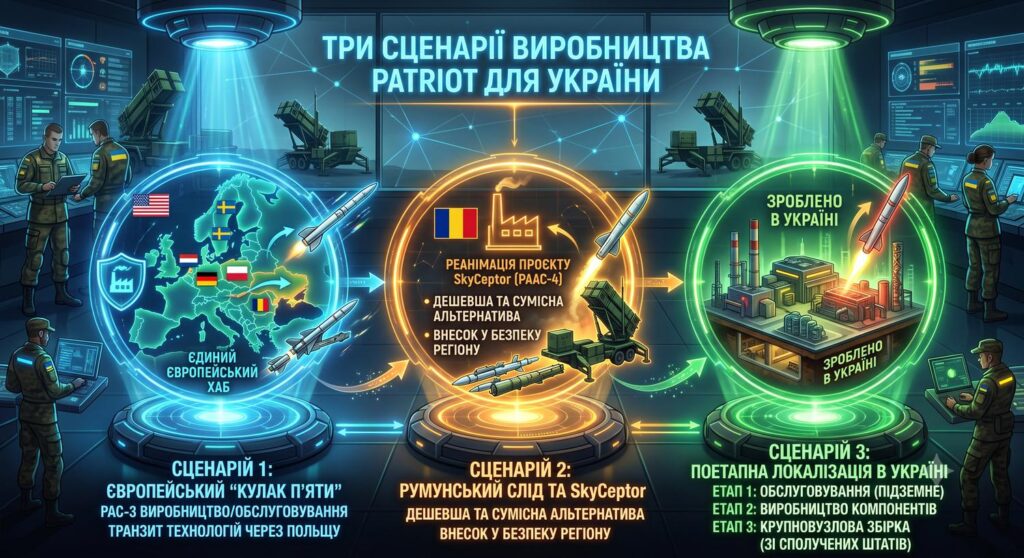
Scenario 2: The Romanian Connection and SkyCeptor Missiles
The Romanian case is receiving separate coverage in the media. Some analysts have mentioned Bucharest’s long-standing plans to integrate its capabilities into the Patriot system.
According to Defense Romania, a memorandum of intent to organize the production of SkyCeptor (PAAC-4) missiles had previously been signed between Romania and U.S. companies. This is a cheaper but high-tech alternative to classic Patriot missiles, which is fully compatible with these launchers. Presumably, if the U.S. licensing program begins to expand into Eastern Europe, Romania will attempt to revive the SkyCeptor project as its contribution to the overall security of the region and Ukraine.
Scenario 3. Phased localization directly in Ukraine
Is it possible to assemble missiles in Ukraine itself? Russian propaganda immediately unleashed a wave of disinformation claiming that Ukraine would allegedly completely abandon production on its own territory “due to security risks” and would manufacture everything in the EU. However, Ukrainian military experts and specialized media outlets paint a much more pragmatic picture—phased localization.
No one is going to build a massive above-ground factory under the threat of Russian missile strikes. A realistic plan looks like this: from maintenance and component production to the final assembly of missiles in Ukraine using ready-made imported components supplied by European partners.
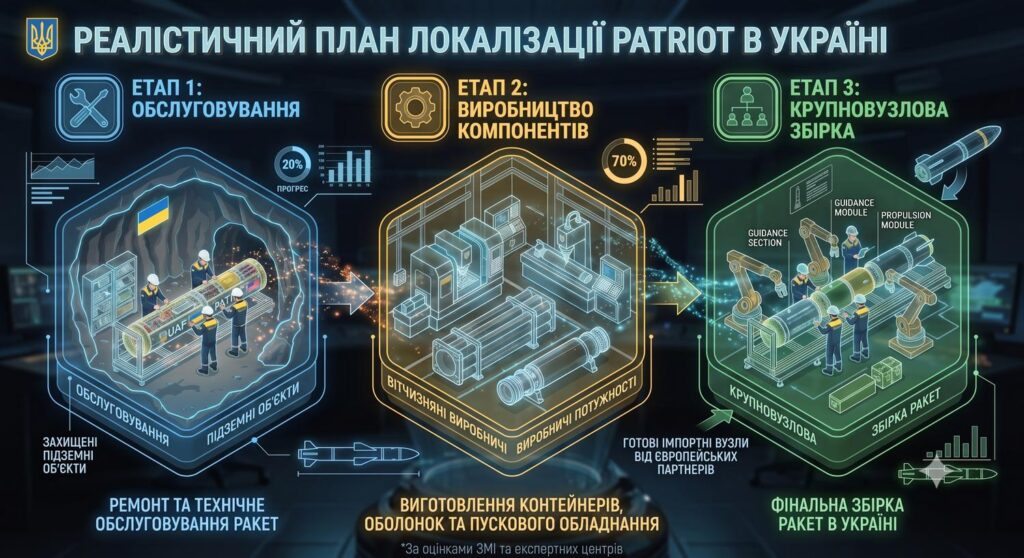
Despite the high-profile political statements, miracles won’t happen overnight. The production of missiles for air defense is the pinnacle of military-technical engineering. Analysts, including those at DW and Defense Romania, are in agreement on this assessment. It will take at least 1.5 years just to set up the first production lines, establish microelectronics supply chains, and launch test production. It could take 2–3 years to reach stable, large-scale serial production.
During this transition period, Ukraine will be critically dependent on direct shipments of finished missiles from the U.S. and its allies. However, the very fact that the license has been granted serves as a long-term geopolitical shield, integrating Ukraine’s defense industry into the top tier of the global defense sector.
Read us on Telegram: important topics – without censorship