How the Emigration of Men Under 22 Has Affected the Labor Market: Research Findings
15 July 15:17
Under martial law, the labor shortage in Ukraine is worsening, and businesses are increasingly revising their hiring strategies. Companies are not only forecasting that the situation will worsen in the near future, but are also already adjusting salaries, expanding their pool of potential candidates, and enhancing their incentive packages.
OLX Robota and the European Business Association (EBA) surveyed employers and analyzed the labor market situation: what is causing the labor crisis to deepen, and what companies are doing to retain or attract talent, reports "Komersant Ukrainian", citing an OLX Jobs press release.
Labor Shortage: Business Sentiment and Influencing Factors
According to the study’s findings, 78% of businesses report a labor shortage in their sector (by comparison, 60% reported this in 2025).
Most often, businesses attribute the situation to mobilization efforts and difficulties in hiring men— 69% cited this as a reason. Another 61% cited emigration as a key factor (up 33 percentage points compared to last year’s data). As a result, 37% reported a shortage of qualified specialists.
We can see that the proportion of those attributing the labor shortage to emigration has increased significantly . A separate factor that has influenced the labor market over the past year was the authorization for men aged 18–22 to travel abroad.
Watch us on YouTube: important topics – without censorship
Permission for Men Under 22 to Travel Abroad: A New Challenge for Business
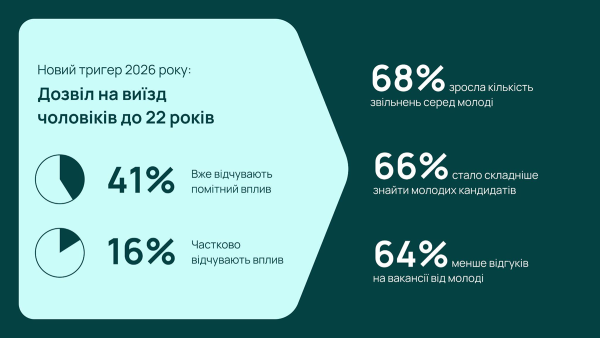
In August 2025, the Ukrainian government lifted restrictions on travel abroad for men aged 18 to 22. For those sectors of Ukrainian business that often rely on young employees in entry-level positions, this change has posed a challenge.
41% of employers reported that they are already feeling a noticeable impact on their staffing situation, while another 16% reported a partial impact. Twenty-nine percent did not notice any changes, while 14% found it difficult to decide on an answer.
Those who noted changes primarily cited an increase in the number of young employees leaving their jobs ( 68%) and a decrease in the number of responses to job postings ( 64%). Additionally, 66% reported that it has become more difficult to find young candidates for positions. Among other consequences noted by employers were rising salary expectations among candidates under 22 and a decline in the quality of candidates for entry-level positions (30%).
Overall, as of 2026, in the surveyed companies, the proportion of male employees under 22 is mostly less than 10% (as indicated by 39% of respondents). In another 39% of companies, there are none at all.
Salary Trends: Gradual Increase
In an effort to retain and attract candidates amid a labor shortage, businesses are gradually raising salaries. However, the pace of this growth differs from last year’s.
In 2025, 58% of companies surveyed reported salary increases. By 2026, this figure rose to 72%. At the same time, not only the scale of the increases but also their magnitude has changed. Last year, employers mostly reported that increases were up to 10% (35% of respondents). This year, the “bar” was raised: the majority of surveyed businesses (30%) raised salaries by 11–22%.
Conversely, the share of companies that cut pay decreased to 5% in 2026, down from 15% in 2025, which is a positive sign.
Interestingly, job seekers have a different perspective: according to the results, 51% noted that they had not received a raise in the past year. Thirty-nine percent of those surveyed received a raise of 10% or more.
How Companies Are Addressing Staff Shortages
Salary increases are not the only way businesses are trying to retain employees and attract new candidates. Despite the brain drain and demographic challenges, companies continue to view young professionals as one of the key resources for overcoming the labor shortage. For example, half of the employers surveyed (50%) are willing to hire people without experience, and 37% are willing to hire young professionals on the condition of further training. This demonstrates the business community’s willingness to invest in workforce development and training for specific work processes within the company.
In addition, 31% of employers are expanding their incentive packages. These typically include the opportunity for free training or retraining, the option to work remotely, transportation, and free lunches; health insurance is offered somewhat less frequently.
“The market is gradually entering a phase where companies can no longer rely solely on an increase in the number of candidates. Therefore, they are forced to rethink their HR strategies: invest in training, open up job openings to different categories of employees, and develop long-term employee retention programs,” comments Maria Abdullina, Head of OLX Jobs.
Amid a shortage of specialists, businesses understand the importance of an inclusive approach to hiring. In 2026, 30% of companies reported that they hire older individuals ( over 60), people with disabilities ( 26%), and candidates with UBD status (19%). According to data from OLX Robota analysts, the number of job openings on the platform where employers are willing to hire people from these groups is also growing. Therefore, we can expect this trend to intensify in the future.
The study’s findings indicate that the labor shortage is shifting from a short-term challenge to a new reality for Ukrainian businesses. Companies are increasingly adapting to these conditions: they are revising salary levels, investing in employee training, and offering more opportunities to candidates who were previously underrepresented in the labor market. It is precisely this flexibility and willingness to change established approaches and processes that will increasingly determine their competitiveness in the battle for talent.
Read us on Telegram: important topics – without censorship