Nearly 200 billion hryvnia in suspicious transactions and a tenfold increase in corruption schemes: shocking statistics from the State Financial Monitoring Service
15 July 15:10
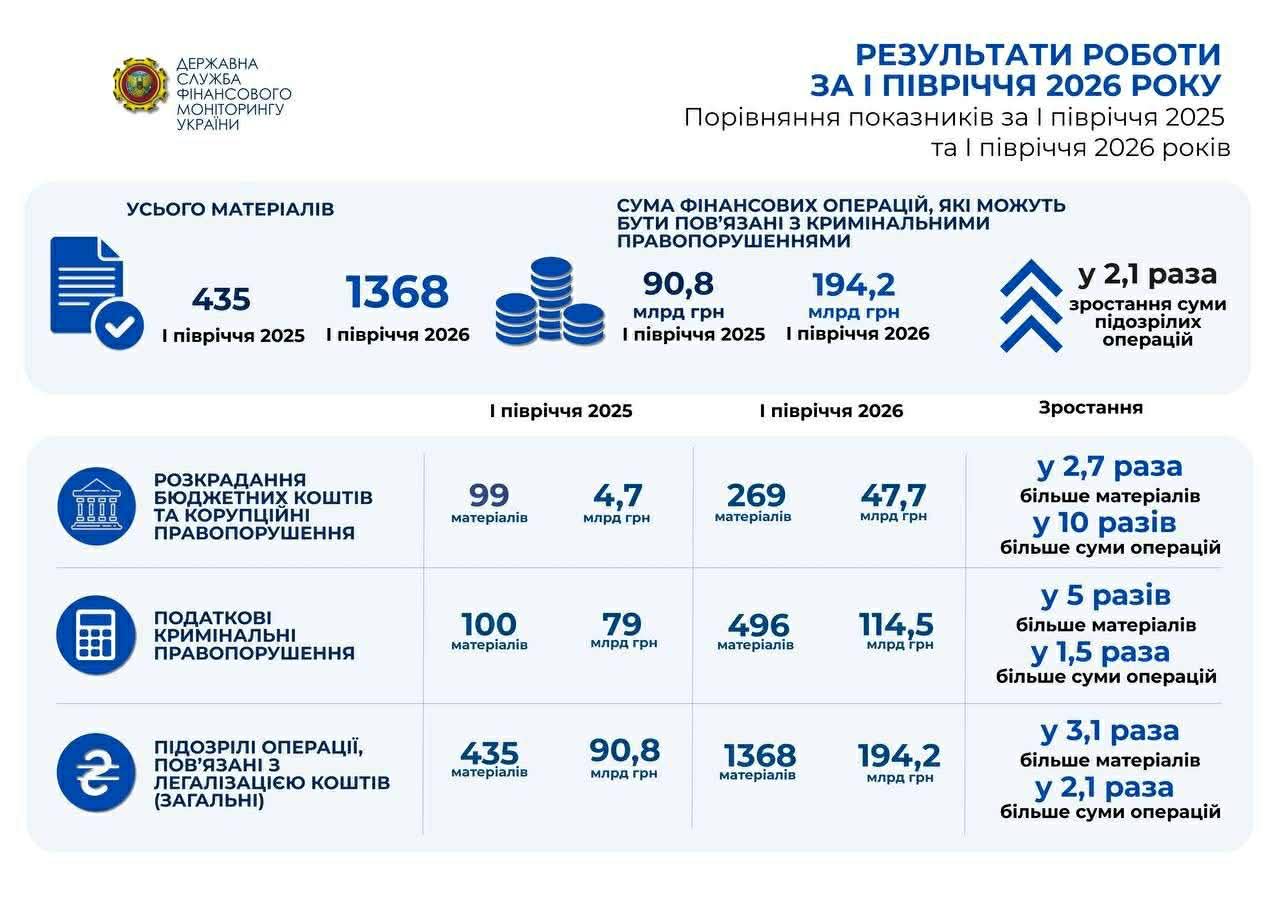
Based on the results of the first half of 2026, the State Financial Monitoring Service of Ukraine significantly expanded the scope of its detection of suspicious financial transactions. Over the course of six months, financial intelligence authorities forwarded 1,368 cases to law enforcement agencies—more than three times the number from the same period last year ( 435 cases). The total value of transactions potentially linked to criminal offenses reached 194.2 billion hryvnia, which is 2.1 times more than a year earlier.
What does this sharp increase indicate? Which areas have become priorities for financial intelligence? And does this signify a rise in financial crime?
Tax crimes have taken the top spot
The largest body of materials forwarded to law enforcement agencies pertains specifically to tax-related criminal offenses.
In the first half of 2026, the State Financial Monitoring Service prepared 496 reports on possible tax evasion schemes and the laundering of shadow income. By comparison, there were only 100 such reports a year earlier.
At the same time, the total value of suspicious financial transactions in this area increased from 79 billion UAH to 114.5 billion UAH.
In fact, tax-related cases accounted for the largest share of all financial intelligence reports—more than one-third of the total.
Increase in Corruption Cases
Over the course of six months, the State Financial Monitoring Service forwarded 269 reports to law enforcement agencies regarding possible embezzlement of budget funds and corruption offenses, whereas last year there were only 99 such reports.
However, the most striking increase was in the total value of financial transactions:
- First half of 2025 — 4.7 billion UAH;
- First half of 2026 — 47.7 billion UAH.
Thus, this represents a tenfold increase in the volume of financial transactions that financial intelligence links to possible corruption schemes or embezzlement of budget funds.
Why the figures have risen
At the same time, these statistics do not necessarily indicate an automatic increase in the number of crimes.
The State Financial Monitoring Service emphasizes that these are analytical reports forwarded to law enforcement agencies for further investigation. The mere fact that these reports are forwarded does not imply that specific individuals have been found guilty or that criminal proceedings have been initiated.
Watch us on YouTube: important topics – without censorship
The agency attributes the sharp rise in results to an internal transformation of the service. According to Philip Pronin, head of the State Financial Monitoring Service , over the past year, the analytical unit has been strengthened, key processes have been digitized, and new algorithms for analyzing financial transactions have been implemented.
“The significant increase in the State Financial Monitoring Service’s effectiveness is the result of a systematic transformation of the agency. We have strengthened the analytical unit, digitized key processes, and implemented modern algorithms for analyzing financial transactions. It is precisely the combination of our staff’s professional expertise and modern technologies that allows us today to more effectively detect financial crimes and complex money laundering schemes, and to provide law enforcement agencies with high-quality analytical materials,” stated the head of the State Financial Monitoring Service.
Combating “Drops”
One of the priorities of financial intelligence has become countering the use of so-called “drops” —individuals whose bank accounts are used for the illegal transfer of funds.
In the first half of 2026, the agency:
- investigated more than 24,000 bank accounts;
- verified information at 25 banks and one non-bank financial institution;
- identified more than 12,000 individuals showing signs of being used as “drop accounts.”
The total amount of financial transactions linked to such schemes exceeded 18.5 billion hryvnia.
As reported by "Komersant Ukrainian", the Verkhovna Rada’s Temporary Investigation Commission declared a systemic crisis in the anti-corruption system.