Almost Half of Their Salaries Go to the Government: Which European Countries Have the Highest Tax Burden on Workers?
9 July 12:12
In European Union countries, workers with the same salaries may take home very different amounts. In some countries, the government withholds more than 40% of income, while in others, only about 15%. At the same time, the final take-home pay is increasingly influenced not only by taxes but also by family status and the social support system. This is evidenced by an analysis of Eurostat data published by Euronews Business, reports "Komersant Ukrainian".
Nearly 30% of salaries in the EU are “eaten up” by taxes
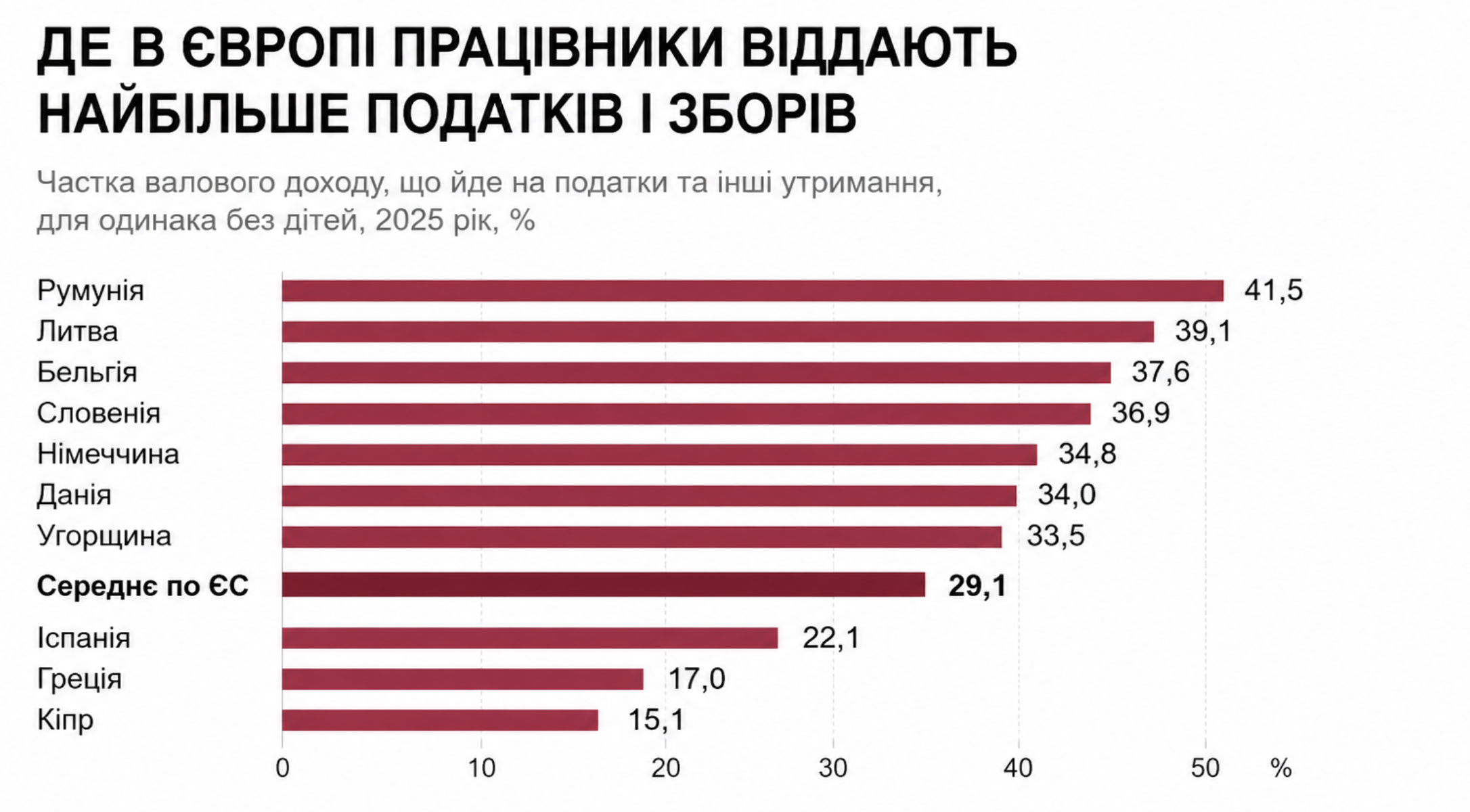
According to Eurostat data for 2025, the average employee without children in EU countries receives 70.9% of their gross salary after paying taxes and mandatory social contributions. In other words, 29.1% of income is deducted through the tax system.
On average across the European Union, the annual gross salary is 37,958 euros, while the employee actually receives 26,929 euros. The difference— 11,029 euros —is accounted for by taxes and other mandatory deductions.
However, there are significant differences between countries.
The highest tax burden is recorded in:
- Romania— 41.5%;
- Lithuania — 39.1%;
- Belgium — 37.6%;
- Slovenia — 36.9%;
- Germany — 34.8%.
In contrast, the government withholds the smallest portion of wages in:
- Cyprus — 15.1%;
- Greece — 17%;
- the Czech Republic — 21.6%;
- Ireland — 21.6%;
- Spain — 22.1%.
Germany: A Paradox in the Rankings
Despite having one of the highest tax rates for single people, Germany offers the most generous support for families with children. According to Eurostat calculations, if an employee earns the same salary but supports a family with two children, their financial burden virtually disappears.
With an annual gross salary of 47,514 euros:
- a single worker without children receives 31,000 euros;
- a family with two children receives 47,424 euros.
Thus, the difference amounts to 16,424 euros per year.
This is one of the largest gaps among all European Union member states.
In Greece and Poland, family support is also so substantial that, in some cases, net income even exceeds gross salary thanks to tax credits and social benefits.
At the same time, analysts emphasize that it is incorrect to compare only income tax rates.
Alex Mengden, an economist at the Tax Foundation, explains that social security contributions also contribute to the actual tax burden.
“For example, the tax burden on labor in Denmark is lower than in Poland, but Denmark ranks near the top because its system relies almost entirely on income tax. In Poland, however, social security contributions take up nearly 2.5 times more funds than income tax,” the expert noted in a comment to Euronews Business.
That is why countries with similar tax rates can differ significantly in terms of the amount an employee actually receives after all mandatory payments.
As reported by "Komersant Ukrainian", the average salary of full-time employees in Ukraine rose to 30,356 hryvnias in March 2026.