The Lawsuit Filed by “Sinevo” and CSD LAB: Why the National Health Service of Ukraine Is Unwilling to Pay Private Laboratories Billions for “Simple” Tests
24 June 17:10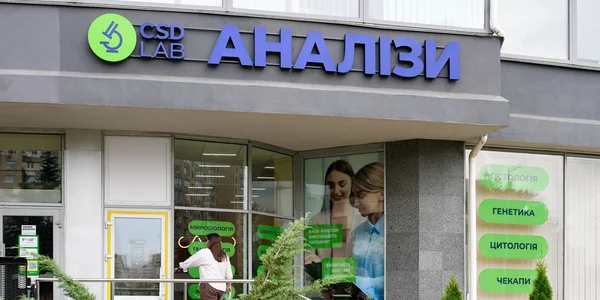
While Ukraine is spending unprecedented resources on defense and supporting the healthcare system during the war, large private laboratory chains are attempting to challenge the new rules for state-funded medical testing through the courts. At the heart of the dispute, on the one hand, are hundreds of millions of hryvnias in budget funds. On the other hand, there is the question of whether the state should cover the maximum volume of routine laboratory diagnostics when that same money is needed for cancer patients, the rehabilitation of military personnel, and high-tech medical treatments. Details are in the article
The private laboratories “Sinevo” and CSD LAB are challenging the new rules of the Medical Guarantees Program for 2026. They allege “discrimination against the private sector” and a violation of the “money follows the patient” principle. At the same time, the National Health Service of Ukraine (NSZU) insists that the issue is not the form of ownership of a medical facility, but the need to rationally allocate the limited healthcare budget.
Private laboratories are demanding a review of the rules
“Sinevo” and CSD LAB have filed complaints with the court and the Antimonopoly Committee regarding the new funding mechanisms for laboratory services. According to the companies, the coefficients introduced by the government significantly reduce the amount of compensation paid to private laboratories.
CSD LAB claims that it performed tests worth 191 million hryvnias under the Medical Guarantees Program, but after the new rules were applied, it received a contract worth only 68 million hryvnias. The company also states that this “limits patients’ access to free tests.”
Separately, the laboratories emphasize that in most developed countries , “the private sector is a full-fledged participant in state medical guarantee programs” and operates on equal terms with public institutions.
The National Health Service of Ukraine’s Position: Priorities Matter
The National Health Service is actively commenting on the situation, and its main focus is on priorities.
NSZU Chairwoman Natalia Gusak explained in an interview with LB.ua that the issue is not about the ownership of the facility, but about how to ensure maximum benefit for patients under conditions of limited funding.
 NSZU Chairwoman Natalia Gusak
“We will defend our position because it seems we have a different understanding of approaches to procuring medical services than our partners Synevo and CSD,” said Natalia Gusak. “Our colleagues are acting in their own interests, while our interests lie in ensuring, within the constraints of limited financial resources, that Ukrainians receive medical care in line with their demand for medical services and within the framework of our priorities, because financial resources are limited and we must use them effectively,” stated the head of the National Health Service of Ukraine.
According to her, the state is currently forced to choose between different areas of healthcare spending. Funds that could be spent on millions of routine tests could instead be directed toward costly diagnostics for cancer and orphan diseases, complex laboratory tests, and rehabilitation.
Watch us on YouTube: important topics – without censorship
The example of vitamin D tests cited by Gusak is particularly telling. According to her, just one laboratory network was prepared to sell such tests to the government for approximately 1.5 billion hryvnias.
“With this 1.5 billion, we are ready to cover complex laboratory diagnostics for patients with cancer. This is fair from the perspective of the people, fair from the perspective of the system, and fair from the perspective of the providers, because we are giving them opportunities. We say: ‘Colleagues, we’re not ready to purchase that amount of vitamin D3 from you, but we’re ready to provide you with this level of funding if you provide immunohistochemistry services and other complex laboratory tests,’” she explained.
The National Health Service of Ukraine (NSZU) is convinced that funding research on this scale—the clinical efficacy of which is often debated among medical professionals—means taking resources away from patients who need much more complex and expensive care.
How Much Do Laboratories Earn?
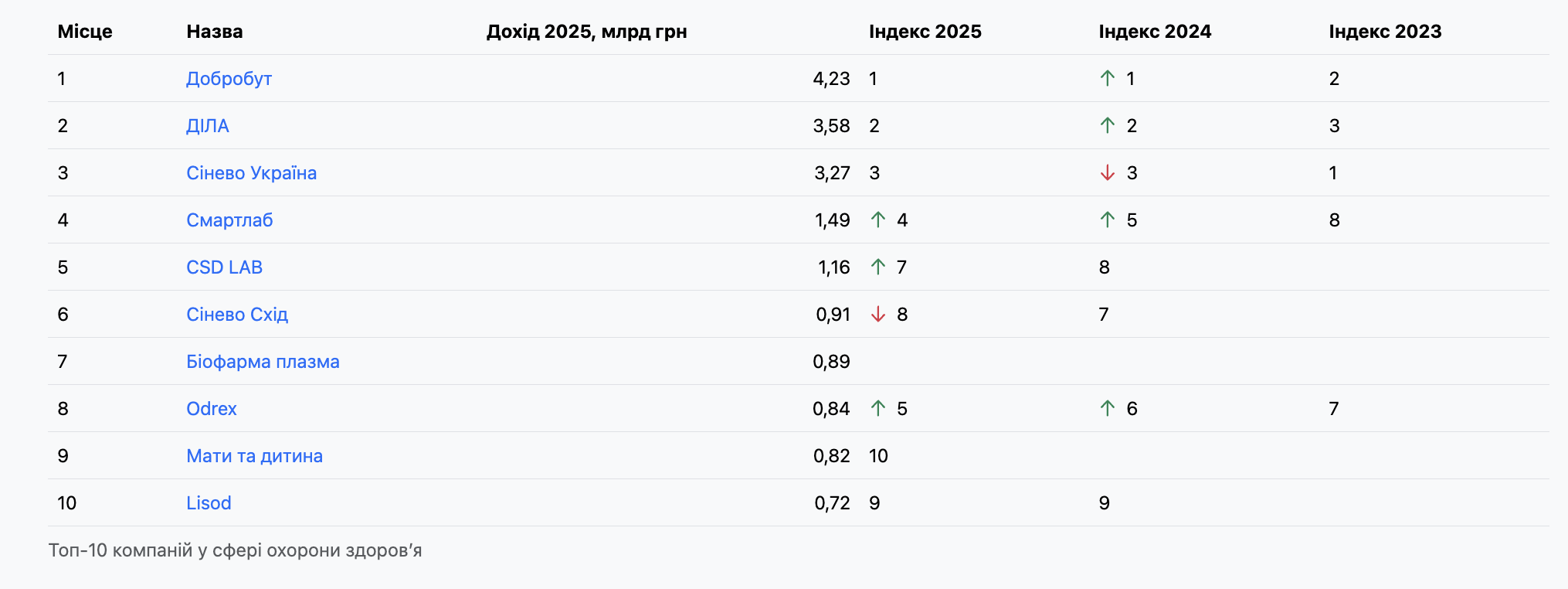
According to the OpenDataBot Index 2026, Ukraine’s ten largest medical companies generated over 17.9 billion UAH in revenue over the past year, which is 23% more than the previous year.
“Sinevo Ukraine” ranked third in the list with revenue of 3.27 billion UAH, showing annual growth of 39%. The company also posted a profit of over 216 million UAH.
CSD LAB increased its revenue to 1.16 billion UAH, a 35% increase from the previous year.
Comprehensive medical care instead of individual tests
Another point of contention between laboratories and the government has been the National Health Service of Ukraine’s (NSZU) requirement that facilities provide not only laboratory tests but also physician consultations as part of a comprehensive medical service.
Laboratories view this as an “artificial barrier” to participation in the state program.
The National Health Service of Ukraine (NSZU), however, explains that a laboratory test alone does not treat a patient. Value is created only when a doctor interprets the results and uses them to make a diagnosis or prescribe treatment.
Therefore , the government is focusing on the development of comprehensive medical centers where patients can receive a full range of care in one place.
The matter is now before the court
Judges are currently preparing to hear the laboratories’ lawsuit against the National Health Service of Ukraine (NSZU). Meanwhile, Iryna Sysoienko—a medical lawyer, former member of parliament, and co-author of the Law of Ukraine “On State Financial Guarantees for Medical Care for the Population”—has already assessed the parties’ chances .
According to her, hospitals and laboratories do have a chance to defend their interests in court, but to win, a medical facility must irrefutably prove three key points:
Read us on Telegram: important topics – without censorship
- The fact that the service was provided to the patient. Statements by clinic representatives carry no weight with judges—proper evidence is required: medical records, referrals, test results, protocols, internal orders, and consultation reports.
- Proper entry of data into the Electronic Health Care System (ESOZ). In court, the Electronic Health Care System is viewed not as a technical formality, but as primary evidence. Accurate, timely, and consistent with their paper counterparts, entries in the ESOS significantly strengthen the plaintiff’s position.
- The unfounded nature of the National Health Service of Ukraine’s (NSZU) objections. Court practice demonstrates that the National Health Service’s automatic calculation alone, a discrepancy identified in reports, or a submitted claim does not automatically oblige the facility to refund the funds. In court, the National Health Service of Ukraine must clearly prove that payments were actually excessive or that there was a direct violation of the terms of the package.
As reported by "Komersant Ukrainian", as of April 1, 2026, Ukraine expanded the “Affordable Medicines” program. Thirty-seven new medications in various dosages were added to the list of drugs that patients can receive for free or with a partial copayment via an electronic prescription.