Third Place in Europe: The IMF Forecasts Sharp Economic Growth for Ukraine Over the Next 5 Years, but There Is a Condition
7 July 15:03
Experts at the International Monetary Fund believe that Ukraine could become one of Europe’s fastest-growing economies over the next five years.
This was reported by "Komersant Ukrainian", citing Euronews.
The IMF estimates that Ukraine’s average annual economic growth will be 3.8%, with 2028 projected to be the strongest year, when GDP could grow by approximately 4.2%.
However, this optimistic forecast is based on a scenario of large-scale reconstruction of the country.
Like the IMF’s baseline scenario, it assumes that the war will gradually subside and the recovery process will begin in earnest.
This, in turn, will lead to a significant increase in capital investment as part of the reconstruction effort, the cost of which, according to the World Bank’s latest estimate, is approaching $600 billion.
Pessimistic Scenario
However, without this assumption, the picture looks much bleaker. Under the IMF’s pessimistic scenario, which assumes that hostilities will drag on, Ukraine’s economic growth in 2027 will reach only 1%.
“The outlook remains highly uncertain, as the war continues to inflict significant damage on the population and the economy,” the IMF explained.
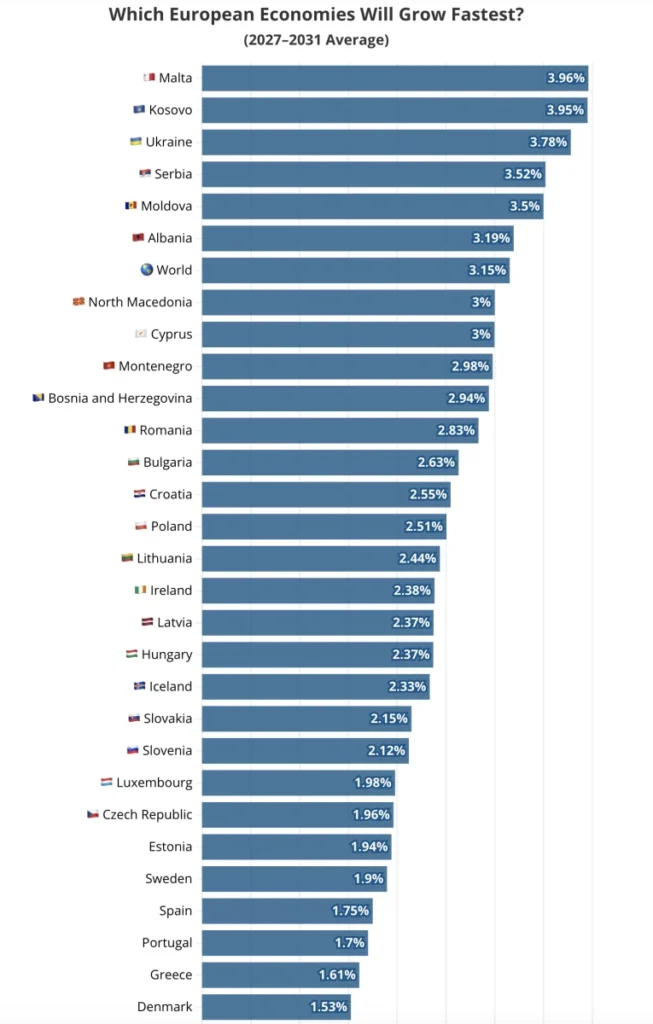
The International Monetary Fund (IMF) forecasts that the eurozone economy will grow by an average of 1.2% annually from 2027 to 2031. Meanwhile, five small European countries will demonstrate significantly faster economic growth, including Ukraine.
Watch us on YouTube: important topics – without censorship
Which Countries Will Grow the Fastest
The Fund believes that a group of much smaller European countries could grow more than twice as fast as the eurozone over the next five years.
Among the growth leaders are:
- Malta
Malta is projected to take first place in terms of growth rate, with an annual growth rate of 4% over the next five years. The main drivers have been tourism, the online gaming industry, and professional and financial services, which have attracted a large number of foreign workers.
- Kosovo
This small country is expected to see even higher growth rates—approximately 4% annually. This will be driven by high domestic consumption, government investment, remittances from the diaspora, and a young labor market.
- Ukraine
The IMF forecasts that Ukraine’s economy will grow by 3.8% annually. This forecast is based primarily on the country’s large-scale postwar reconstruction.
- Serbia
In Serbia, average annual growth is projected at 3.52%. The most significant event in the coming years will be the hosting of Expo 2027 in Belgrade. This world’s fair is expected to attract millions of visitors and spur a large-scale construction and infrastructure boom.
- Moldova
Moldova’s economy is expected to grow by an average of 3.5% per year between 2027 and 2031.
This growth will be driven by EU financial support and reforms, as well as rising domestic consumption, higher real wages, and remittances from migrant workers, which account for about one-tenth of the country’s GDP.
What Will Determine Ukraine’s Growth
However, Ukraine’s rapid growth under the IMF’s baseline scenario assumes a gradual end to the war and the start of active reconstruction.
This will attract a wave of investment in infrastructure restoration. According to World Bank estimates, up to $600 billion is already needed for these purposes.
But if the war continues, the situation will be quite different. Under the Fund’s pessimistic scenario, should hostilities continue, Ukraine’s economic growth in 2027 will be only 1%.
Thus, Ukraine has a chance for an economic surge, but only if the war ends and well-thought-out reforms are implemented to promote the country’s development.
As a reminder, the European Bank for Reconstruction and Development, in its latest report in early June, projected Ukraine’s GDP growth for 2027 at 4.0%. But this is contingent on a de-escalation of hostilities and the start of post-war reconstruction.
Read us on Telegram: important topics – without censorship