Ukrainian Ballistics: Can Kyiv Join the Exclusive “Club of Missile Powers”?
25 June 21:05 ANALYSIS FROM
Developing its own ballistic missile capabilities has become one of Ukraine’s key strategic objectives. In the context of a full-scale war, having long-range weapons is a critical necessity. However, the path to “Ukrainian ballistics” is an extremely complex technological marathon. Why is this field so exclusive, how can Ukraine catch up with the leaders, and what opportunities are opening up through international cooperation—read more in this article
Who is in the “club” of missile powers, and why is it so exclusive?
The “club of missile powers” is the unofficial name for an elite group of countries that possess their own technologies for the development and production of ballistic and cruise missiles. The main international “regulator” in this field is the Missile Technology Control Regime (MTCR). Its members strictly restrict the export of components for missiles capable of carrying a payload of more than 500 kg over a distance of more than 300 km. Currently, the organization comprises 35 states, including countries from Europe, Asia, the Americas, Africa, and Oceania. The aggressor state, Russia, is also a member of this club.
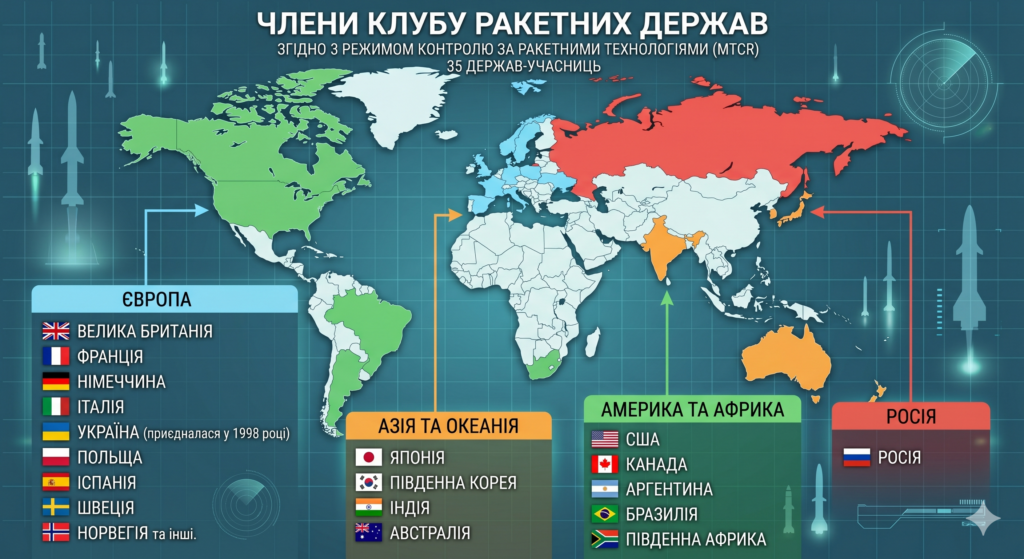
The scope of missile technology extends beyond the official list. For example, Israel is not formally a member of the MTCR but unilaterally adheres to its rules. At the same time, countries such as Iran, Pakistan, North Korea, and—in recent years— Russia have completely ignored this regime, developing their own missile programs outside of any international control.
Only about ten countries in the world have advanced operational-tactical ballistic missile programs, says Oleg Katkov, editor-in-chief of the military portal Defense Express. In Europe, the situation is even more specific: apart from France, which possesses intercontinental systems for nuclear deterrence, no other country has its own systems of this class.
“In the class of operational-tactical missile systems—such as, for example, the ‘Iskander’ or North Korea’s KN-23—there is absolutely nothing in Europe. They simply don’t exist. It wasn’t just Ukraine that was disarmed, and it wasn’t just our missile programs that were destroyed,” says Katkov.
As an example of a successful long-term strategy, the expert cites Turkey, which has been systematically pursuing its goal since the 1990s, relying on cooperation with China and massive funding. Ankara now has the “Bora” OTRK with a range of up to 500 km, is developing the “Typhoon” system, and is already showcasing mock-ups of intercontinental missiles with a range of 6,000 km.
Ukraine, on the other hand, is having to catch up to this train in the midst of war, while overcoming the problem of the loss of Soviet-era expertise.
“We must always keep in mind the loss of expertise, no matter how daunting that may sound. How old is the man who started working at the rocket-manufacturing plant in Dnipro in 1990? If he was 25 back then, how old is he now? And this is a person who had virtually zero experience, because as early as the ’90s, that factory started producing something like clothesline hooks,” says Katkov
Given the lost expertise and the danger of operating factories under constant Russian shelling, quickly restoring the full rocket manufacturing cycle on our own is a nearly impossible task. The only realistic path for Ukraine is deep technological cooperation with partners.
The formula for the world’s best weapon: four countries must unite
As part of the Brakestop project, the United Kingdom is rapidly developing new long-range weapons for Ukraine that will be half the price of Storm Shadow missiles and will reach the front lines within a year, according to Bloomberg. The main strategic value of this ammunition is the complete absence of American components and data (ITAR-free). Military historian and reserve IDF officer Grigory Tamar commented on
“If we combine the manufacturing capabilities of Germany and the Czech Republic with the unique expertise of Ukrainian specialists in mechanics and rocket technology, as well as Israeli microelectronics, we will obtain the best weapons in the world, which will immediately be put to the test in the field. Since global conflicts won’t end tomorrow, such an alliance would create an autonomous center of power in the defense sector, serving as a real alternative to both the U.S. and China,” says Tamar.
According to Grigory Tamar, the current Israeli government is so far missing this window of opportunity due to the political climate, but the creation of such a European defense axis is an inevitable step for the region’s survival.
What Is Known About Ukrainian Developments and What Is the Main Shortfall
In the public sphere, Fire Point is currently the most transparent company, and its projects allow for a substantive assessment of Ukrainian progress, says the editor-in-chief of Defense Express. These are the well-known FP-7 and FP-9 projects . The latest development has a range of 850–850 km and a warhead weight of about 800 kg. This missile is designed to strike strategic targets deep within Russia, including Moscow. Its certification was scheduled for the summer of 2026.

However, the most challenging stage in the development of the FP-9 remains the engine. As Katkov notes, all other components of the missile already exist, but without an engine, it won’t fly anywhere. Solid propellant is the heart of the missile; absolutely all of the product’s performance metrics depend on its thrust and combustion characteristics. And it is nearly impossible to purchase it on the market.
“The issue of purchasing a solid-fuel engine is, without a doubt, the most difficult. No one wants to just sell components that enable the creation of such a weapon. It’s not even a matter of money; it’s a matter of international relations, diplomacy, and partnerships between countries,” says Oleg Katkov.
Since there is a global shortage of solid propellant, Fire Point is establishing its own new production facility in Denmark. Only once it becomes operational will it be possible to address the shortage of engines for Ukrainian ballistics.
Moreover, setting up such a production facility within Ukraine during the war poses a colossal risk.
“Producing solid propellant is essentially producing explosives. Locating such a facility directly in Ukraine could be very complicated and dangerous, given that Russia is shelling the entire territory of Ukraine and could target such facilities,” notes Oleg Katkov.
The Path to Mass Production and the Cost of Artificially Restraining Ukraine
The rocket’s certification is merely a legal authorization allowing the Ministry of Defense to purchase the product, since its performance has been proven at a test range. But standard military procedures apply from there on. This involves testing individual units in real combat conditions, followed by ordering a small batch of weapons for direct evaluation.
“As soon as the missile proves its effectiveness, full-scale serial production begins. The time between these events is measured in months. When people talk about weeks—that’s impossible. Those are short timeframes even for the drone industry,” Katkov concludes.
At the same time, analyzing the West’s prolonged reluctance to supply weapons due to fears of “escalation,” Grigory Tamar offers a harsh assessment of past political hesitations.
“If modern technological weaponry—tanks, F-16s, and long-range missiles—had been provided to Ukraine in full three or four years ago, the Russian regular army would already have been crushed,” says Tamar.
Now, according to the expert, the situation is radically different. Attempts by any country—whether the U.S. or European nations—to impose restrictions on Ukraine regarding the range of strikes against Russian territory have lost their military rationale and defy the logic of combat operations.
Thus, Ukraine is confidently navigating this technological marathon and has every chance of joining the exclusive club of missile powers. The successful tests of the FP-7 tactical missile system, a clear strategy for developing the powerful FP-9, and the resolution of critical issues—such as engine production—demonstrate systematic progress. Despite the loss of Soviet expertise and the challenging conditions of war, flexibility, an innovative approach, and technological cooperation are enabling Kyiv to build an independent and effective strategic deterrent, as evidenced by the tangible result of its successful entry into the club.