Industrial Parks in Ukraine: How Are They Faring, and What’s Next?

Industrial parks in Ukraine are gradually becoming exactly what they were created to be—a breeding ground for new manufacturing projects. As of early 2026, 37 plants had been built or were under construction in industrial parks. There is every reason to expect that by the end of the year, this figure will reach 50 new enterprises. These include agri-processing and the food industry, machine building, the production of building materials, woodworking, and others.
The active development of industrial parks began following the 2021 amendment to the law on industrial parks and the adoption of tax and customs incentives in 2022. The “starter package” included a 10-year corporate income tax exemption for participants, provided they reinvest their profits, as well as exemptions from import VAT and customs duties on equipment, and the right for local communities to reduce land taxes.
Starting in 2024, the government added a state-funded program for the development of engineering and transportation infrastructure. Under this program, in 2024–25, the Ministry of Economy funded 56 projects totaling 1.98 billion UAH.
These funds were provided on a 50-50 co-financing basis (20-80 for frontline and de-occupied territories) and were allocated for the construction of electricity, gasand water supply networks, the reconstruction of access roads and railroad tracks, and other projects.
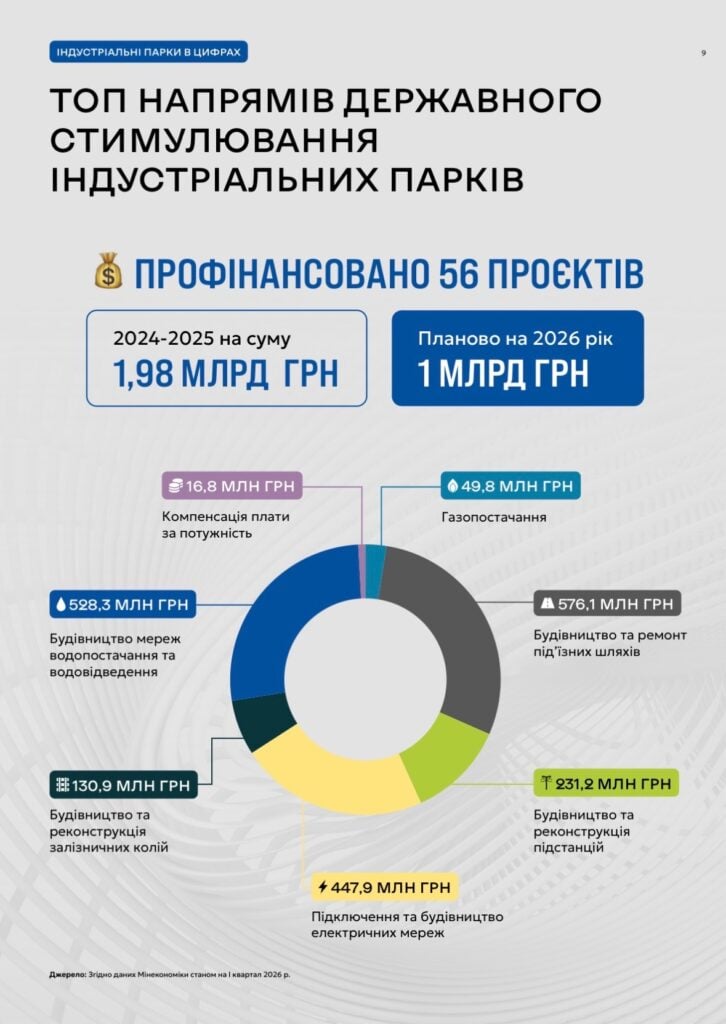
Source: “Industrial Parks of Ukraine 2026” magazine
Consequently, with each passing month, more and more industrial parks are ready to provide their residents with a well-developed industrial infrastructure. The total power capacity available to IP residents has already exceeded 300 MW. The total area of industrial space built and renovated in IPs amounts to 1.2 million square meters.
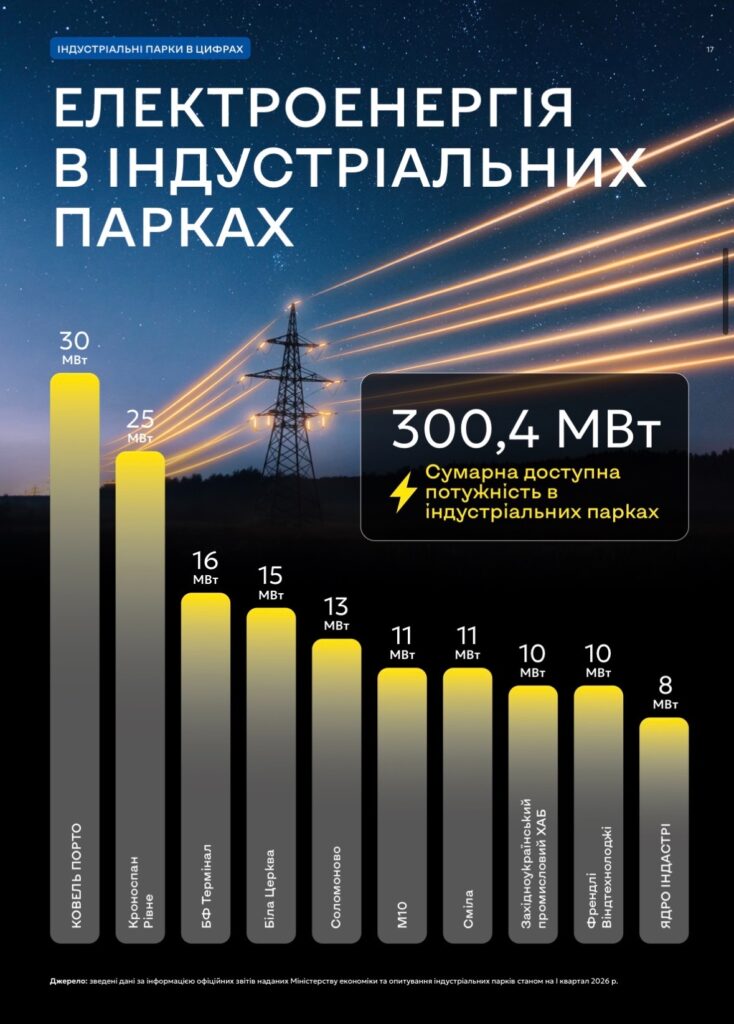
Source: “Industrial Parks of Ukraine 2026” magazine
In total, 22 industrial parks have already received state funding for infrastructure. At the same time, they have collectively committed to building at least 110,000 square meters of industrial space and opening at least 44 new manufacturing enterprises.
Every hryvnia of government investment in industrial infrastructure attracts 5–6 hryvnias in private investment. The 2026 budget allocates 1 billion hryvnias for the development of industrial infrastructure in industrial parks.
Private Ukrainian investments have become the foundation for the active development of industrial parks. However, foreign investors—including Austria’s Kronospan, Britain’s Unilever, Finland’s Peiko Group, and Germany’s Goldhofer AG—have also built or are building their production facilities in industrial parks.
As of early 2026, the volume of investment in Ukraine’s industrial parks stood at 45 billion hryvnias. The growth in investment volume since the beginning of 2024 amounted to 48.1%.
New production projects in industrial parks are transforming the entire economic landscape of individual communities and, in some cases, entire regions. For example, the Perechyn community has become one of the wealthiest in Zakarpattia, tripling its budget. In the Zhytomyr region, an ambitious project to revive industrial hemp cultivation is underway in a community near the village of Ryzhany. And in the Kyiv region, the “Bila Tserkva” industrial park is introducing a new business culture by beginning to train skilled workers for its enterprises as early as in schools and vocational schools. More and more communities across Ukraine are following these examples.
Personal income tax is the foundation of local budgets. Consequently, the main focus of communities is on jobs. As of early 2026, 4,712 jobs had been created in Ukraine’s industrial parks—at enterprises that are already operational. The leaders in this regard are the “Friendly Wind Technologies” industrial park (922) and the “Western Ukrainian Industrial Hub” (898).
The further development of industrial parks will largely be determined by competition among management companies for investments. The range of services they currently offer to residents includes turnkey project development and construction management, private land for sale or lease, staff recruitment and training, assistance with securing financing, help with obtaining tax incentives, support with permits, registration, and certification, and engagement with local and regional authorities.
In addition, management companies are becoming providers of the “Made in Ukraine” policy for the development of Ukrainian manufacturers. This policy brings together programs aimed at supporting manufacturing, industrial investment, and non-raw material exports.
This and other information about industrial parks is presented in the magazine *Industrial Parks of Ukraine 2026*.