The course of the Danube will be altered to accommodate the Chernavoda Nuclear Power Plant in Romania
3 August 16:11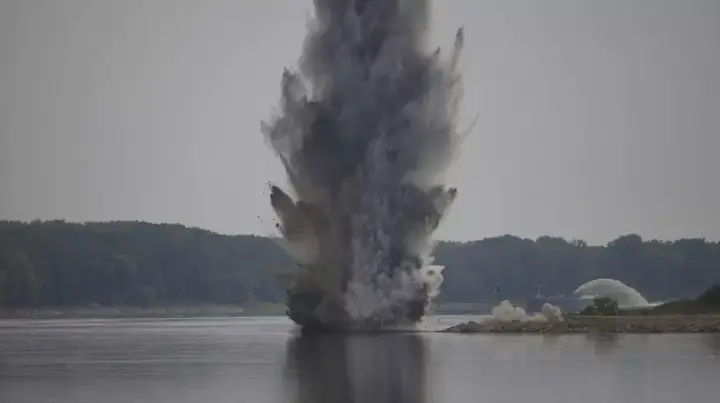
On Monday morning, the Romanian military blew up the Pirjoaia rock at the bottom of the Danube using 180 kilograms of explosives, as part of an operation aimed at redirecting a larger flow of the Danube toward the Cernavoda Nuclear Power Plant.
According to Digi24, as reported by "Komersant Ukrainian".
Acting Defense Minister Radu Miruce described the operation as a success for both navigation and the power plant’s operations, emphasizing that “every additional day of operation at the Cernavoda Nuclear Power Plant is a win.”
On Monday morning around 9:00 a.m., the rock was partially broken up. Efforts to remove it on Sunday had been unsuccessful. On Monday, military sappers were forced to use twice as much explosives as the day before.
“180 kilograms of explosives were brought in. Regardless of what the final consequences for the Chernavoda power plant will be in the coming days, what has been achieved by clearing this rock is essential both for navigation and for future dredging operations, which will facilitate dredging on the Old Danube branch,” said Miruce.
According to him, in the coming days—and even in the coming hours—the two barges that were brought here will be loaded with as much of the removed rock as possible.
“According to the initial estimates we received, on Wednesday or Thursday—or, in the best-case scenario, on Thursday—the Cernavoda power plant should begin the shutdown procedure. If the estimates from Apele Române representatives—which require support not only from the military but also from the Ministry of Transportation—are accurate, then every day that the Cernavodă power plant continues to operate after Wednesday or Thursday represents a significant gain,” the defense minister noted.
Watch us on YouTube: important topics – without censorship
Second Phase of Work
The operation to divert the Danube’s course is divided into two phases. In the first phase, blasting operations are underway on the rock formation located in a branch of the Danube—the Bala channel.
Then, four barges filled with rocks—each 70 meters long and 3 meters high—will be deliberately sunk to restrict the flow of water in this branch and redirect it toward the old Danube riverbed.
The goal of the operation is to divert part of the flow from the Bala branch to the Old Danube branch to ensure the necessary water supply for the operation of the nuclear power plant in Cernavodă.
The Romanian Water Resources Agency reported that this operation is extremely complex and there are risks that it may not succeed.
The need for such measures arose due to a sharp drop in the water level of the Danube, which has reached its lowest point in Romania. This has put serious strain on the country’s energy system.
On July 28, Romania suspended operations at one reactor at the Cernavodă nuclear power plant due to low water levels in the Danube caused by dry weather.
The Danube’s water level has reached alarmingly low levels
Water levels in the Danube have reached alarmingly low levels both in Romania and in neighboring countries such as Hungary and Serbia.
Data from the Romanian National Water Administration show that the flow at the country’s border reached 1,600 cubic meters per second on Sunday, with a trend toward a decrease to 1,450 cubic meters per second by the end of the week.
In Hungary, this situation even led to the shutdown of the Paks Nuclear Power Plant, which had been in operation for over 40 years, due to a lack of cooling water.
“The forecast for the next 10 days indicates a quasi-stationary state, even with a downward trend. We are approaching historic lows for the past three decades,” said Sorin Rindasu, deputy director general of ANAR, according to Mediafax.
The drop in the Danube’s water level poses a serious threat to energy production in Romania, particularly to the operation of Unit 2 at the Cernavodă Nuclear Power Plant, the only unit currently in operation. The government has analyzed several technical solutions, including the construction of diversion dams to redirect some of the water to the Old Danube and, indirectly, to the reactor area.
Romania Is on High Alert in August Due to the Energy Crisis
On Friday, Interim Prime Minister Ilie Boloian announced the declaration of a nationwide state of readiness for August due to a decline in electricity production caused by drought and a reduction in river flow, particularly in the Danube.
Read us on Telegram: important topics – without censorship