The “off-the-shelf” production line and a lack of precision: what’s wrong with Russian missiles and what’s the next target for “Flamingo”
15 June 17:56 ANALYSIS
Despite stringent international sanctions, the Russian Federation continues to maintain a high rate of missile production, having switched its specialized factories to round-the-clock operation. The shelling on the night of June 15 demonstrated that the Kremlin has definitively opted for maximum terrorist intensity at the cost of colossal expenditure of its resources. According to the Air Force Command, the enemy launched a record number of air attack weapons at Ukraine—70 missiles and 611 strike drones of various types. However, this increase in quantity comes at the cost of a catastrophic decline in quality. How Ukrainian developers are preparing a symmetrical response to the enemy and why the Western missile defense shield is in short supply— "Komersant Ukrainian" investigated.
How many missiles does Russia actually produce?
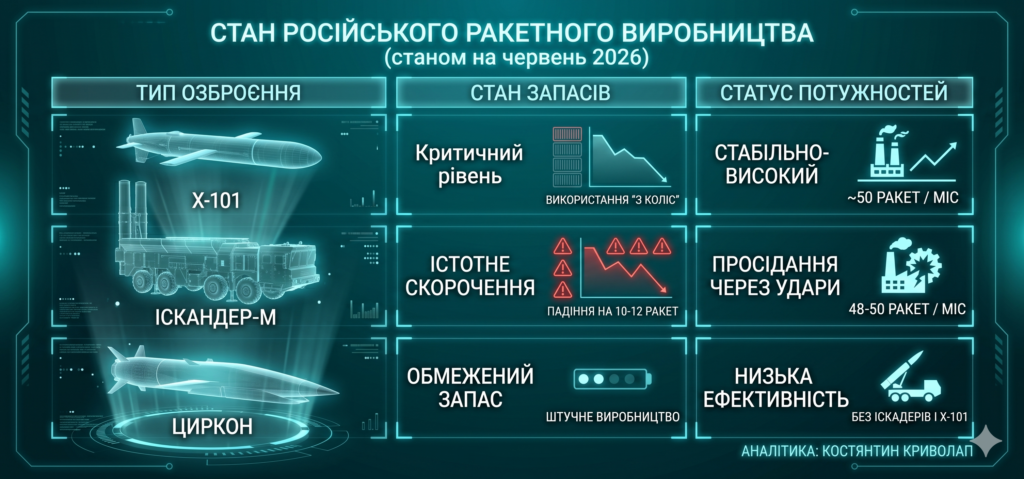
According to data from the State Research Institute for Testing and Certification of Weapons and Military Equipment, the Russian defense industry produces about 50 X-101 missiles and 60–70 Iskander missiles per month. However, experts urge people not to panic over these figures: the reality in Russian warehouses is much more complicated, notes aviation expert and analyst Konstantin Kryvolap.
“If they were producing that many [consistently], they would already have massive stockpiles of these missiles. But they don’t. With such production volumes, the operational stockpile should be 300–350 missiles. Instead, we see that the Kh-101 and Iskander missiles are being used literally ‘off the production line’—missiles from the first and second quarters of this year are appearing in the attacks,” says Kryvolap.
Ukrainian strikes also significantly impacted peak production capacity. Following a successful attack on the Votkinsk plant, Iskander production there dropped by 20–40%. Currently, the enemy has been able to partially redistribute the manufacturing of certain components to other facilities, but has not managed to fully recover—production of Iskanders has now dropped to 48–50 units per month.
The lack of precision and the cynical tactics of the “Zircons”
Sanctions do, however, have a cumulative effect. Russia is unable to provide its defense industry with a high-quality component base. Purchases of components from the U.S., Germany, or Switzerland via third countries are limited, and Chinese substitutes do not allow the equipment to function properly.
“Quality has dropped significantly, and this primarily concerns accuracy and reliability. This is being noted not only by Ukrainian analysts but also by European and American ones. To maintain quantity, the enemy is deliberately sacrificing accuracy, integrating weapons of mass destruction into combat units and increasingly targeting civilian infrastructure,” says Kostyantyn Kryvolap.
The “Zircon” anti-ship missiles, which the occupiers have deployed on “Bastion” coastal complexes in the Kursk region, pose a particular danger. Since the “Zircon” requires a clear, high-contrast radar target (such as port cranes), it cannot effectively target ordinary urban objects deep inland. Because of this, the Russians have devised a devious terrorist tactic.
“Itneeds a high-contrast target… Until the first strike hits, there’s nowhere to hit. But once an ‘Iskander’ has struck or ‘Shaheds’ have caused destruction, a high-contrast target appears. And then they [ed. – the Russians] strike with the ‘Zircon’—right where medics, the State Emergency Service, and other agencies have already arrived,” – Kostyantyn Kryvolap.
Watch us on YouTube: important topics – without censorship
The Global Missile Defense Crisis: Why Is There a Shortage of Interceptors for Everyone?
Recently, the Financial Times, citing Lockheed Martin, reported an alarming trend: the U.S. and its allies cannot keep up with the demand for anti-missile systems. Russia is currently producing more ballistic missiles than the U.S. has PAC-3 MSE interceptors for its Patriot systems. An aviation expert cites a number of factors.
- The imbalance in numbers: By 2022, Iran and North Korea had collectively produced 12,000–14,000 ballistic missiles. A plant in Arizona (Lockheed Martin and RTX) has produced only about 4,000 PAC-3 MSE interceptors during this entire period.
- Scale of use: Last year, this plant managed to ramp up production to 620 interceptors per year. However, during the same period, Russia launched over 650 Iskander missiles at Ukraine.
- The Crisis in the Middle East: During the escalation in the Persian Gulf, the allies used nearly 1,200–1,300 interceptors in the first 2–3 weeks—which is effectively two years of continuous operation at the American plant.
According to Kryvolap, the only way out for Europe and Ukraine is to break the U.S. monopoly on the production of anti-missile systems. While the Pentagon is negotiating the transfer of a license to Poland as part of the “Freya” anti-ballistic shield program, Ukraine must demand similar terms.
Ukraine’s response: The FP-7 and FP-9 projects are going on the offensive
Ukraine is rapidly building up its own strike capabilities to bring the war onto the aggressor’s territory. Our forces are already successfully deploying long-range kamikaze drones: recently, two “Flamingo” (FP-5) drone missiles struck the Votkinsk plant, and experts emphasize the need to strike the Dubinsky plant near Moscow.
“Once our missiles—two ‘Flamingo’ missiles—struck the Votkinsk plant; they need to strike the Dubna plant as well. There is a plant in Dubna, near Moscow, that produces X-101 missiles,” notes Kryvolap.
In addition to modernizing drones (specifically, the FP-2, which received a warhead twice as powerful), Ukraine has entered an era of developing its own missile weapons.
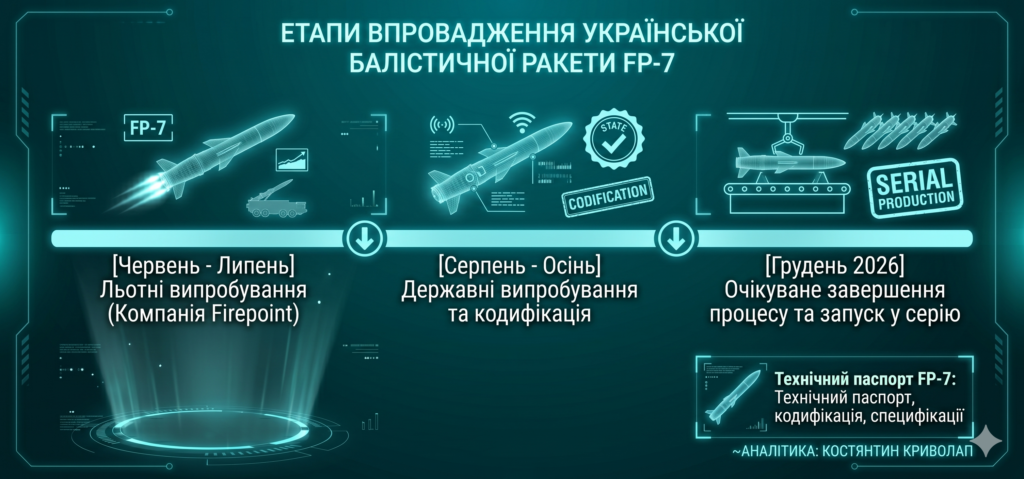
“In June, Firepoint began flight tests of the Ukrainian FP-7 ballistic missile. They will last two months. The prototype for it was a missile from the Russian S-400 system (which the enemy used to strike Kyiv in January 2023). But our missile is made of composite materials; it is significantly lighter, and the new high-energy solid fuel will allow it to fly not the 200 km claimed by the enemy, but approximately 300 km.”
Meanwhile, the first tests of the next domestic missile— the FP-9—are scheduled for August 2026, and these tests will be conducted directly on military facilities within the territory of the Russian Federation.
Therefore, experts agree that our main task is to systematically “strike” Russian factories that produce explosives and electronics. By developing its own missile program, Ukraine can increase its strike capabilities by 2–3 times, which will definitively thwart the Kremlin’s plans for air parity.
Read us on Telegram: important topics – without censorship