It’s Not Prices or Electricity: The Main Problem Facing Ukrainian Businesses Has Been Identified
19 June 14:29
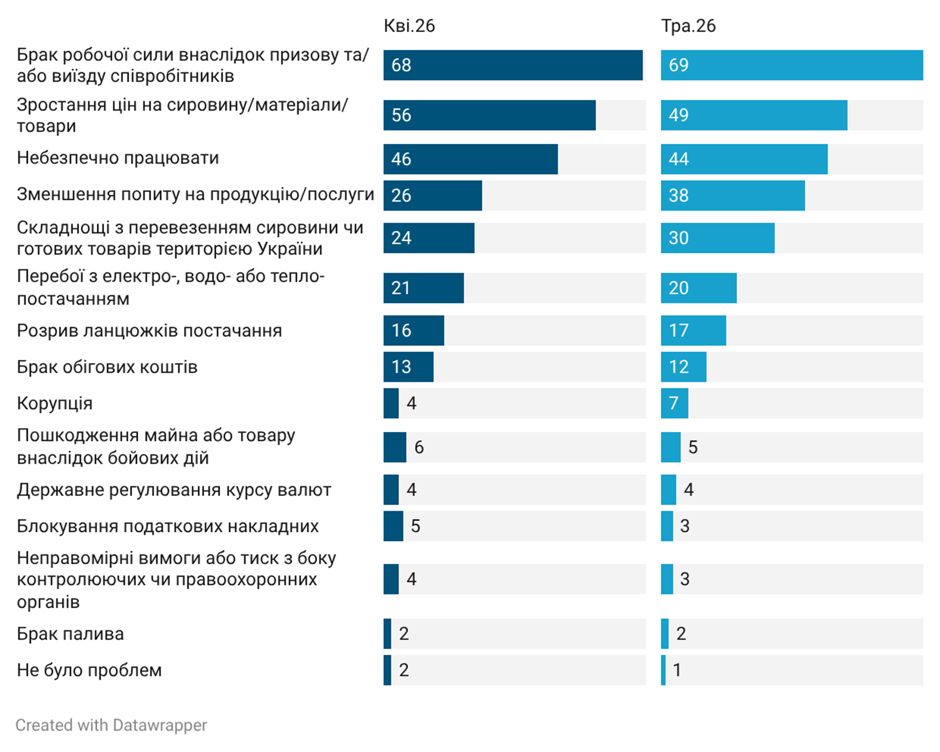
The labor shortage has become the most pressing problem for Ukrainian businesses during the war. In May 2026, a record 69% of surveyed industrial enterprises reported a shortage of workers. This is according to the results of the 49th monthly surveybythe Institute for Economic Research and Policy Consulting (IER), as reported by "Komersant Ukrainian"
A total of 469 industrial enterprises participated in the survey.
Labor shortages have become the number one problem for businesses
According to IER Senior Research Fellow Yevgen Angel, the problem of labor shortages has been steadily worsening over the past few months.
In May, the share of enterprises that cited labor shortages as an obstacle to their operations reached 69%.
By comparison, in April this figure stood at 68%, which was also a record high at the time.
Thus, the labor shortage has remained the main challenge for Ukrainian industry for over 18 months.
Qualified workers are the hardest to find
In May, the share of companies finding it difficult to recruit skilled workers decreased slightly.
The figure fell:
- from 62.3% in April;
- to 60.6% in May.
At the same time, the situation regarding the search for unskilled workers worsened.
In May, 38.4% of companies reported difficulties in hiring them. In April, this figure stood at 34.3%.
This indicates that the labor shortage extends not only to professionals with specialized training but also to blue-collar jobs that do not require high qualifications.
Businesses have almost no plans to increase employment
Despite the acute labor shortage, only a small proportion of companies plan to increase their workforce.
In the next three months:
- 2.4% of companies plan to increase their workforce;
- 5.1% may place employees on mandatory leave.
These figures may indicate that businesses are being cautious due to war-related risks, unstable demand, high costs, and uncertainty about the future economic situation.
Rising raw material prices remain the second-biggest challenge
Rising prices for raw materials, supplies, and goods rank as the second-biggest obstacle to doing business.
In May, 49% of businesses cited this problem.
In April, the figure was higher, at 56%.
Despite the decline, nearly half of businesses continue to feel pressure due to the high cost of resources needed for production.
Rising raw material costs affect production costs, force businesses to adjust their prices, and may reduce their competitiveness.
Security risks concern 44% of businesses
The third-biggest problem remains workplace safety.
In May, 44% of businesses cited safety risks as a concern. In April, that figure was 46%.
This issue has ranked third among obstacles for the fourth consecutive month.
Medium and large companies are more likely to report safety concerns:
- 48% of medium-sized companies;
- 47% of large enterprises.
The IED explains this by noting that large manufacturing facilities are more likely to be targeted by Russian missile and drone attacks.
In which regions are businesses most afraid to operate?
The security issue remains particularly acute in frontline and central regions.
According to the survey, more than 80% of companies cited the danger of operating as a significant obstacle in:
- Kyiv Oblast;
- Vinnytsia Oblast;
- Odesa Oblast;
- Zhytomyr Oblast;
- Zaporizhzhia Oblast;
- Dnipropetrovsk Oblast.
In the western regions, this problem is generally less acute. The Rivne region is an exception.
Businesses are increasingly complaining about a decline in demand
One of the problems that became most acute in May was a decline in demand for goods and services.
The share of businesses concerned about the drop in demand rose:
- from 26% in April;
- to 38% in May.
This may be due to a decline in purchasing power, a contraction of the domestic market, consumer caution, and general economic uncertainty.
For manufacturers, the drop in demand means fewer orders, a buildup of inventory, and the need to scale back production plans.
Watch us on YouTube: important topics – without censorship
Logistical problems have also intensified
In May, more companies reported difficulties transporting raw materials and finished goods across Ukraine.
The share of such businesses rose to
- from 24% in April;
- to 30% in May.
Logistics are affected by infrastructure damage, military risks, a shortage of drivers, traffic restrictions, and additional transportation costs.
The increase in logistical problems may raise production costs and extend delivery times.
Corruption was not included in the list of major problems
According to the survey results, corruption and pressure from law enforcement or regulatory agencies remain significantly less common responses than staffing, pricing, and security issues.
In May:
- 7% of companies cited corruption as an obstacle;
- 3% complained about unlawful demands or pressure from law enforcement and regulatory agencies.
At the same time, the low ranking of these issues does not mean they do not exist. For most industrial enterprises during the war, labor shortages, safety, and high production costs remain the most pressing issues.
The electricity problem has eased
The energy situation for businesses is gradually improving.
In May, 20% of enterprises cited power outages as a problem. This figure is significantly lower than during Russia’s winter attacks on Ukraine’s energy infrastructure.
In April, due to power outages:
- 31% of businesses temporarily suspended operations;
- 41% continued to operate without interruption;
- 28% experienced no outages at all.
A month earlier, only 20% of businesses operated without interruptions.
How much working time did businesses lose?
The average loss of working hours due to power outages in April was about 4%.
Micro and small businesses were hit hardest by the outages, as they have fewer opportunities to invest in their own power generation and backup power sources.
Among industries, the chemical industry recorded the greatest losses—about 6%.
By region, the following enterprises lost the most working hours:
- in Kyiv—13%;
- in the Sumy region — 9%.
How Businesses Assess the Government’s Economic Policy
Assessments of the government’s economic policy remain largely neutral.
In May:
- 64% of businesses gave a neutral assessment;
- 6% gave a positive assessment;
- 25% gave a negative assessment.
Thus, the share of negative assessments is more than four times higher than the number of positive ones.
This gap between positive and negative assessments has persisted since the summer of 2023.
Why Ukraine Is Facing a Labor Shortage
The labor shortage in Ukraine is caused by several factors at once.
Among them are:
- the mobilization of some workers;
- Ukrainians moving abroad;
- internal population displacement;
- a mismatch between candidates’ skills and business needs;
- competition among companies for employees;
- security risks in frontline regions;
- a decline in the working-age population.
The labor shortage is particularly acute in manufacturing, construction, transportation, agriculture, and blue-collar occupations.
How the labor shortage affects the economy
A shortage of workers can limit companies’ ability to increase production even when orders are available.
Due to the labor shortage, companies are forced to:
- raise wages;
- automate production;
- train inexperienced workers;
- recruit women for jobs that were previously considered predominantly male;
- reduce the number of shifts;
- turn down some orders.
In the long term, the labor shortage could hinder Ukraine’s economic recovery.
What We Know About the IED Survey
The new monthly IED business survey has been conducted since May 2022.
Up to 500 Ukrainian industrial enterprises from 21 regions of Ukraine participate in the survey.
The survey allows for an assessment of:
- the current state of business;
- production expectations;
- major obstacles;
- the labor situation;
- the impact of power outages;
- assessments of the government’s economic policy.
A total of 469 companies participated in the 49th survey.
Read us on Telegram: important topics – without censorship