The “eOselya” rules have been updated: what has changed and who will now have access to apartments
9 July 18:23 ANALYSIS FROM
Starting July 17, 2026, updated rules for the “eOselya” state affordable mortgage program will take effect in Ukraine. The Cabinet of Ministers has revised a number of conditions concerning both potential borrowers and the housing units that can be purchased under the program. The changes aim to make “eOselya” more accessible to families with children, war veterans, and other priority groups, as well as to expand the selection of apartments that meet the requirements for a government mortgage.
Ukrainian Prime Minister Yulia Svyrydenko announced the changes following the adoption of the relevant government resolution. Some of the new provisions will take effect as early as this month. Key changes include new standards for living space, an expanded pool of eligible participants who can receive a loan at 3% per annum, a revised approach to defining family composition, and new options for using housing vouchers. Find out exactly which changes will take effect on July 17 in the article below
The government has revised several provisions of the “eOselya” program—it remains one of the main tools for state support of Ukrainians planning to purchase their own homes. One of the most important changes concerns the size of the property that can be purchased under the program. Whereas previously the standards were the same for both a single person and a family of two, they will now take into account the actual family composition. In addition, the government has expanded the list of categories of Ukrainians eligible for a preferential loan at 3% per annum. This list now includes war veterans, combatants, individuals with war-related disabilities, war participants, as well as family members of deceased war veterans and fallen Defenders of Ukraine.
Another change concerns the definition of family composition. From now on, children under the age of 21 will be included in this calculation. Previously, the age limit was 18. This means that when calculating the permissible living space and assessing eligibility for the program, more family members will be taken into account—which is particularly relevant for families where adult children are still in school or living with their parents.
Watch us on YouTube: important topics – without censorship
The government has also allowed housing vouchers to be used as a down payment when applying for a mortgage. However, if a loan has already been taken out, it will not be possible to repay it using funds from a housing voucher. These changes are provided for in Cabinet of Ministers Resolution No. 794, adopted in June of this year, and they take effect on July 17.
Who Is Now Eligible for a Mortgage
The preferential interest rate of 3% per annum will, as before, apply for the first ten years of the loan, after which it will rise to 6%. In addition to military personnel, medical professionals, educators, and researchers, new categories of citizens will now also be eligible for this rate. Specifically, this includes war veterans, combatants, individuals with war-related disabilities, war participants, as well as family members of deceased war veterans and Defenders of Ukraine. For internally displaced persons, separate lending terms remain in effect at 7% per annum for the first ten years, with the rate subsequently increasing to 10%.
One of the most anticipated changes was the increase in the standard housing area that can be purchased under the program. Now, for apartments, the standard will be 52.5 square meters for a single person, 73.5 square meters for a family of two or three people, and an additional 21 square meters for each subsequent family member. The standards for single-family homes have also been increased. The standard is 62.5 square meters for a single person, 83.5 square meters for a family of two or three, with an additional 21 square meters added for each subsequent family member.
Previously, starting in February 2026, the standard was 52.5 square meters for both a single person and a family of two. Exceeding this area by more than 10% was not permitted, which made the choice of housing quite limited.
As explained in an exclusive comment "Komersant Ukrainian" Alina Stratiychuk, a real estate specialist and founder of the Progress ST agency, it was precisely this standard that created the most difficulties for buyers.
“In practice, this created quite a few difficulties. Young families don’t buy an apartment for just one or two years; they’re planning for the future. Most want to buy a full-fledged two-bedroom apartment right away so they won’t have to move again after having children,” the expert notes.
Another problem was that the primary market effectively lacked two-bedroom apartments with an area of up to 57.4 square meters—the maximum allowed under the old rules, taking into account a 10 percent allowance above the standard.
“Because of this, many high-quality options simply did not meet the program’s requirements, and people had to settle for one-bedroom apartments. Some families even refused to participate in ‘YeOselya’ altogether, even though they could have financially afforded a larger apartment,” explains Stratiychuk.
In her opinion, increasing the standard area will allow buyers to choose housing that meets not only their current needs but also their plans for the future.
“People will have greater freedom of choice and won’t be forced to compromise just because of the program’s restrictions,” says the real estate agent.
Another change is just as important—the inclusion of children under 21 as part of the family. This will allow more families to qualify for a larger standard living area and, accordingly, expand the selection of housing that meets the criteria for a government-backed mortgage. However, as experts note, increasing the living space alone does not solve all of “YeOselya’s” problems. Even after the new rules take effect, buyers may face a limited selection of apartments that both meet the program’s requirements and are affordable. It is this problem, according to experts, that will remain one of the main challenges for the state mortgage program.
The new rules have not solved the main problem—the shortage of suitable housing
Despite positive changes, the “eOselya” program still has one of its most significant limitations—the requirement regarding the year a building was commissioned. To qualify for a 3% loan in most regions of Ukraine, you can only purchase housing in buildings that were completed no more than three years ago. Exceptions were made only for the Chernihiv, Sumy, Kharkiv, Zaporizhzhia, and Kherson regions, where the purchase of housing up to 20 years old is permitted. Internally displaced persons participating in the 7% program are also permitted to purchase housing in buildings that were completed no more than 20 years ago. This requirement is currently one of the biggest barriers for buyers.
Expert Alina Stratiychuk explains that nearly the entire three-year period covered by the program’s requirements coincided with years of full-scale war.
“The pace of construction has slowed significantly, and the number of new buildings completed is quite limited. As a result, the selection of housing that meets the program’s requirements remains small,” the expert notes.
According to her, the problem lies not only in the number of new buildings but also in their specifications.
“There are very few affordable apartments on the market that also meet the ‘eOselya’ criteria. Furthermore, the vast majority of housing is sold without renovations. In Kyiv, only a few developers offer fully finished apartments,” says Stratiychuk.
As a result, the real estate agent explains, families are often forced to simultaneously make monthly mortgage payments, rent a place to live, and invest hundreds of thousands of hryvnias in renovating their new apartment.
“For many, this becomes a serious financial burden and one of the reasons why they postpone buying a home even when there is a favorable interest rate,” says the expert.
The situation is no less complicated in the resale market. According to the real estate agent, when considering apartments in buildings that were completed up to three years ago and have already been renovated, another problem arises. The price per square meter in such apartments often exceeds the price cap set by the program. Therefore, it is very difficult today to find housing that meets all of “YeOselya’s” requirements at the same time.
Another new development concerns housing vouchers, which the government provides to certain categories of citizens as compensation for lost housing. From now on, these vouchers can be used as a down payment when applying for a loan under the “eOselya” program. This should reduce the financial burden on buyers, since saving up for the down payment is often the biggest obstacle to obtaining a mortgage. At the same time, the government has imposed an important restriction: if a loan has already been taken out, it will not be possible to repay it using funds from a housing voucher. In other words, the voucher can only be used at the time of purchasing the property.
How Much Do Apartments Cost in Kyiv and the Suburbs
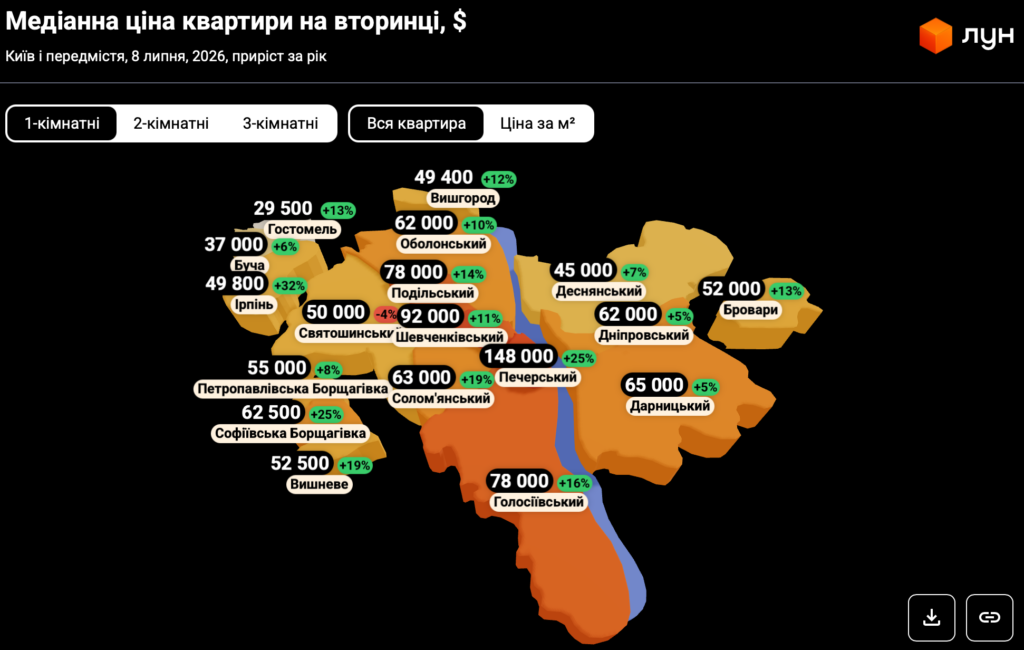
Despite the update to the “eOselya” program, the issue of housing costs remains one of the main concerns for potential buyers. According to data from the LUN Analytical Center, as of early July 2026, the median price of a one-bedroom apartment on Kyiv’s secondary market is $70,000, a two-bedroom apartment is $105,000, and a three-room apartment—$155,000. Over the past year, one-room apartments have risen in price by 7%, and two-room apartments by 5%, indicating a gradual recovery in demand in the capital’s housing market.
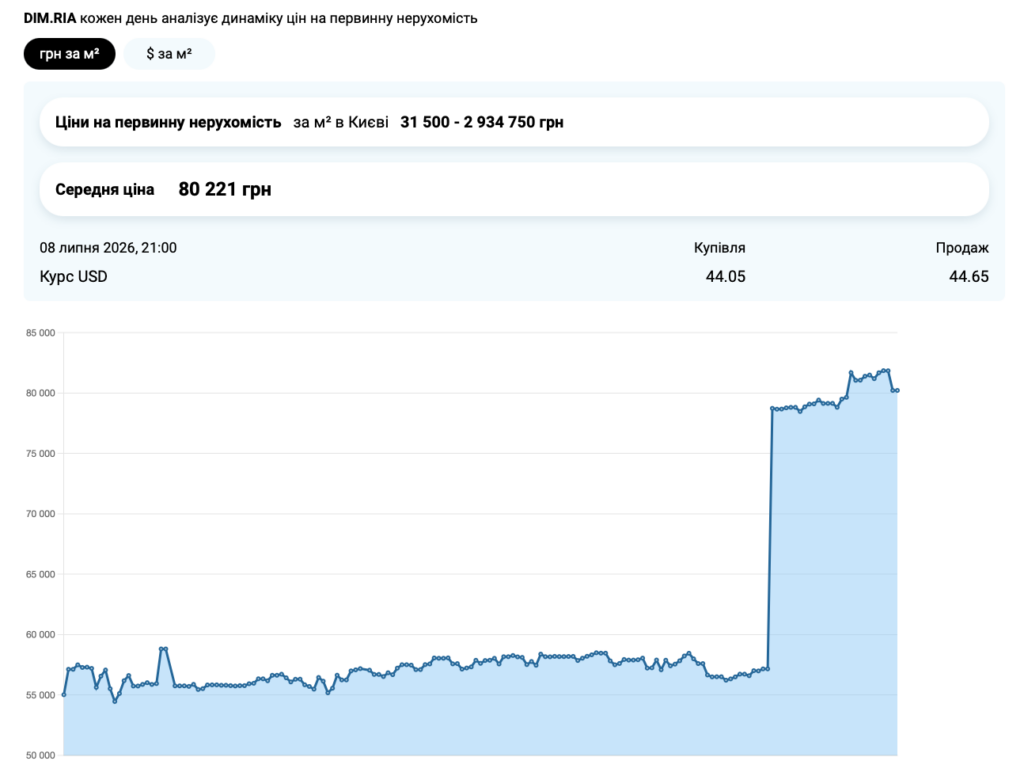
The new-construction market is also showing a gradual increase in prices. According to DIM.RIA, the average price of a one-bedroom apartment in new buildings in Kyiv exceeds 3.65 million hryvnias, a two-bedroom apartment—nearly 6 million hryvnias, and a three-bedroom apartment—over 8.1 million hryvnias. At the same time, apartment prices depend significantly on the class of the residential complex, the neighborhood, and the stage of construction.
That is why more and more buyers are turning their attention to the capital’s suburbs. According to Alina Stratiychuk, the highest demand today is observed in Sofiivska and Petropavlivska Borshchahivka, Vyshneve, Kryukivshchyna, Hatne, Irpin, Bucha, Brovary, and other settlements within a 15-kilometer radius of Kyiv.
“It is there that developers’ prices per square meter are more affordable than in the capital. However, even here, the number of new buildings that meet the program’s requirements is still limited,” says the real estate agent.
The expert notes that the construction market is gradually recovering, so supply should increase. At the same time, in her opinion, developers should be more proactive in offering apartments with at least basic renovations.
Nevertheless, the latest changes represent the most extensive revision of the program in recent times. They address several significant shortcomings that market participants have been pointing out for years: they increase the permissible living area, include children up to age 21 when determining family composition, expand the list of eligible categories, and allow housing vouchers to be used as a down payment.
However, the main challenge remains the same—the limited supply of housing that simultaneously meets the program’s requirements, is affordably priced, and is ready for occupancy.
Whether “YeOselya” truly becomes a widespread tool for providing Ukrainians with their own homes will depend on how quickly developers can increase the volume of new construction and how quickly the government can adapt the program’s conditions to the realities of wartime.
Read us on Telegram: important topics – without censorship