Average salaries in Europe: Which countries pay the most, and which are at the bottom of the list
16 May 07:22
In 2025, average wages in Europe varied significantly from country to country, and while this gap narrows when adjusted for purchasing power, it does not disappear. Euronews Business reports this, citing the OECD’s *Taxing Wages 2026* report, according to "Komersant Ukrainian"
Where are the highest wages in Europe?
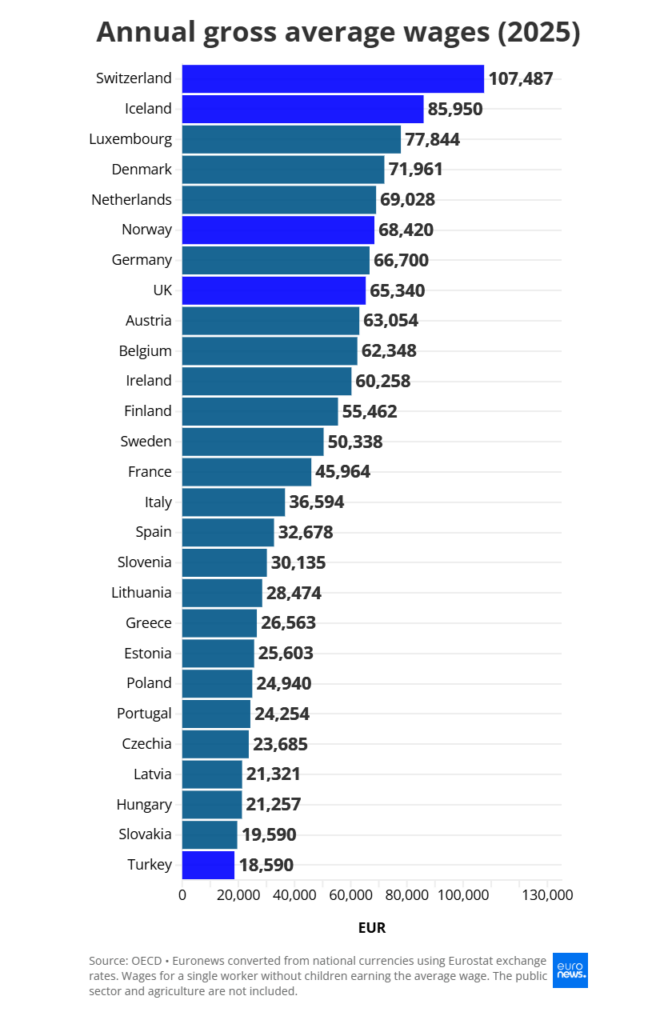
According to the OECD, the annual gross average salary in Europe ranges from €18,590 in Turkey to €107,487 in Switzerland.
Switzerland is the only country in Europe where the average annual gross salary exceeds €100,000.
Iceland ranks second with €85,950.
Luxembourg took third place with €77,844. It is the leader among European Union countries.
The top five also included:
- Denmark — €71,961;
- theNetherlands — €69,028;
- Norway — €68,420.
Salaries in Europe’s Largest Economies
Among Europe’s five largest economies, Germany has the highest average salary— €66,700 per year.
The United Kingdom is nearly at the same level— €65,340.
Other major economies have significantly lower figures:
| Country | Annual gross average salary |
|---|---|
| Germany | €66,700 |
| United Kingdom | €65,340 |
| France | 45,964 euros |
| Italy | 36,594 euros |
| Spain | €32,678 |
The average salary in Germany and the United Kingdom is more than twice that of Spain.
Which EU countries have the lowest salaries
Among European Union countries, the lowest average annual salary is recorded in Slovakia — €19,590.
In total, nine of the 22 EU countries in the sample have an average salary below 30,000 euros per year.
The following countries fell below €25,000:
- Hungary — €21,257;
- Latvia — €21,321;
- Czech Republic — €23,685;
- Portugal — €24,254;
- Poland — €24,490.
Just above this threshold, but still below 30,000 euros, are:
- Estonia — €25,603;
- Greece — €26,563;
- Lithuania — €28,474.
Why do salaries in Europe vary so much?
Experts from the International Labour Organization, interviewed by Euronews Business, cited three main reasons for the wage gap between European countries.
1. Productivity and economic structure
Countries with developed sectors that generate high added value typically pay higher wages. This primarily refers to finance, technology, manufacturing, engineering, and professional services.
This is why countries in Northern and Western Europe are predominantly at the top of the rankings.
2. Labor market institutions
Wage levels are influenced by strong labor unions, collective bargaining agreements, and worker protection systems.
In countries where workers have stronger representation in the labor market, average wages are often higher.
3. Cost of living
In countries with higher prices, nominal wages are usually higher as well.
Therefore, high wages in Switzerland, Iceland, or Denmark do not always mean the same high real purchasing power as it might seem at first glance.
What affects purchasing power
When adjusted for purchasing power parity, the gap between countries narrows. This indicator takes into account not only nominal wages but also how many goods and services can actually be purchased with that money in a specific country.
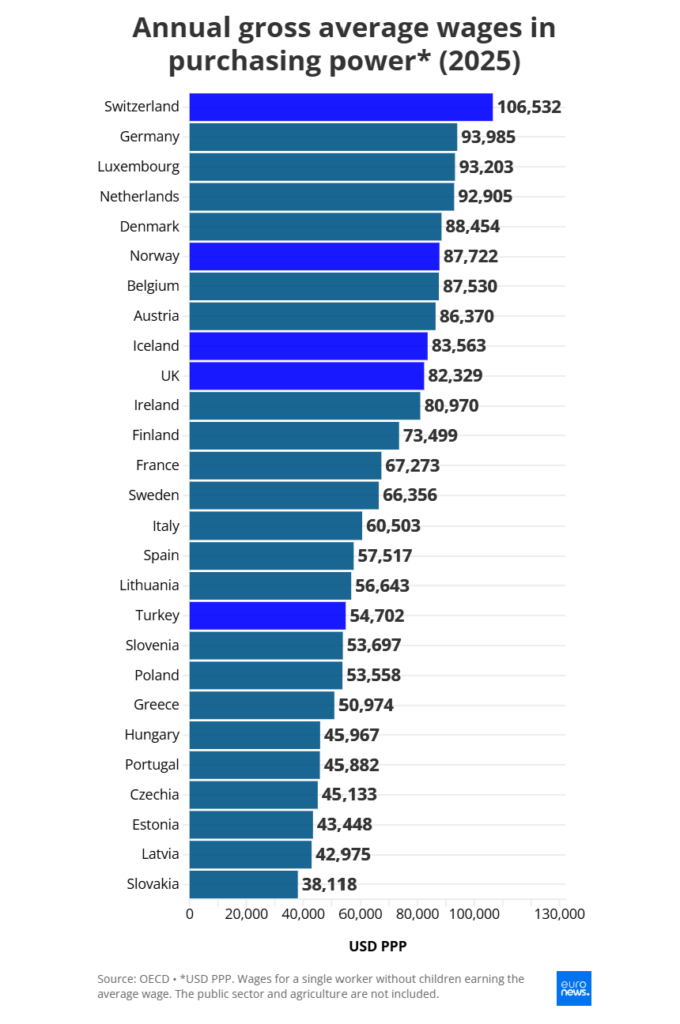
When adjusted for purchasing power, the annual gross average wage ranges from 38,118 in Slovakia to 106,532 in Switzerland.
More than 90,000 in this measure are earned in:
- Switzerland — 106,532;
- Germany — 93,985;
- Luxembourg — 93,203;
- the Netherlands — 92,905.
Next are Denmark — 88,454 and Norway — 87,722.
How the ranking changes after adjustment
After the recalculation based on purchasing power, Turkey rose the most. In the nominal ranking, it was last, but in the PPP ranking, it jumped nine spots at once—to 18th place.
Germany also significantly improved its position, rising from seventh to second place.
The biggest losers were:
- Iceland —dropped from 2nd to 9th place;
- Estonia — fell from 20th to 25th place.
This shows that nominal wages do not always fully reflect the actual level of well-being.
What the European salary ranking shows
In nominal terms, the leaders remain the countries of Northern and Western Europe. That is where the highest wages are found, but also the highest cost of living.
Southern and Eastern Europe are predominantly concentrated at the bottom of the ranking. However, after accounting for purchasing power, some countries improve their positions because lower wages there are partially offset by lower prices.
What You Should Know About the Methodology
Average salary estimates apply to full-time employees in specific sectors of the economy.
The sample primarily includes the following sectors:
- manufacturing;
- construction;
- retail trade;
- transportation;
- finance;
- business services.
However, the data does not include agriculture, public administration, education, and healthcare.
What is known as of now
According to OECD data, in 2025, Switzerland had the highest average salary in Europe— €107,487 per year. The lowest figure was in Turkey — €18,590.
Among EU countries, Luxembourg led the way at €77,844, while Slovakia had the lowest figure at €19,590.
After adjusting for purchasing power, the gap between countries narrows, but Switzerland, Germany, Luxembourg, and the Netherlands remain among the top leaders.