Tusk refuses to meet with Zelenskyy at the border
22 February 2024 15:09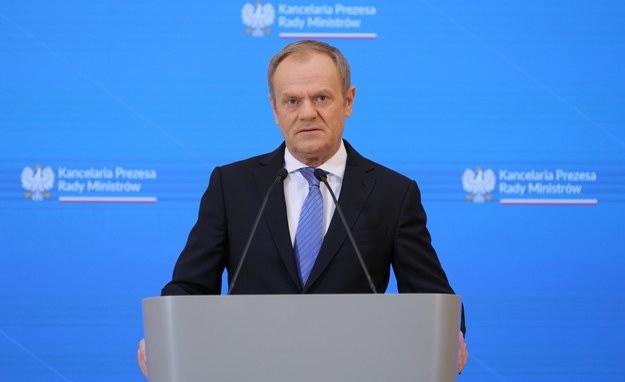
Polish Prime Minister Donald Tusk has refused to meet with Ukrainian President Volodymyr Zelenskyy at the Ukrainian-Polish border. He said this at a press conference today, according to  citing RMF24.
Yesterday, President of Ukraine Volodymyr Zelenskyy called on Polish leaders to meet with him and a Ukrainian delegation at the border to resolve the situation with the blocking of Ukrainian exports. The Polish prime minister avoided a direct response to Zelenskyy. Instead, he said that a meeting had already been arranged. And it should take place in more than a month:
“Back in Kyiv, I agreed that a meeting of the governments of Poland and Ukraine would take place in Warsaw on 28 March.”
At the same time, Tusk stressed that he would protect the rights of “Polish farmers”.
“We will look for protective solutions for Polish farmers, both internally, through the use of national funds, and through further negotiations with Ukraine and European institutions, so that the negative effects of trade liberalisation with Ukraine are less serious and eliminated as much as possible. Polish farmers can count on me here,”
– said the Polish Prime Minister.
According to him, the government wants to establish a line of compromise and agreements with the protesting farmers that would suit them and allow them to stop the protests.
Tusk also stressed that the agrarian issue and defence aid to Ukraine should be very clearly separated. The border should allow everything related to defence to pass through, the Polish prime minister said:
“[We have to] guarantee 100 per cent that military aid, equipment, ammunition, humanitarian and medical aid will reach the Ukrainian side without delay. We will include the checkpoints with Ukraine and these sections of roads and railways in the list of critical infrastructure. This is a matter of the next few hours.”
Border blockade
on 9 February 2024, Polish farmers launched a new nationwide strike and blockade of the border with Ukraine, which will last until 10 March. The initiator was the independent farmers’ trade union Solidarity. Starting from 12 February, they plan to block all checkpoints. The main demand of the protesters is to cancel the preferential trade regime with Ukraine and return the permit system for importing goods into Poland.
Problems at the border began on 6 November 2023, when Polish transport companies began blocking truck traffic at three major checkpoints on the Ukrainian border: “Korczowa-Krakowiec, Hrebenne-Rava-Ruska, and Dorohusk-Yagodyn. One of the requirements was to reinstate the permits for Ukrainian carriers that had been cancelled under the agreement with the EU by 30 June 2024.
On6 January, truck traffic to the Medyka-Shehyni border crossingin Poland resumed. Three other border crossing points were opened on 17 January, namely Dorohusk – Yagodyn, Hrebenne – Rava-Ruska, and Korczowa – Krakivets.
In Romania, on 13 and 14 January, local farmers blocked the movement of Ukrainian trucks through the Siret checkpoint, and on 15 January, they began blocking the Vicovu de Sus checkpoint. on 18 January, Romanian farmers began blocking the Dyakove-Halmeu checkpoint. However, as of 20 January, these checkpoints were opened.
Currently, the blockade of the border continues – “Polish farmers” have blocked truck traffic at six checkpoints. According to the State Border Guard Service, there are more than 2,500 trucks in the queues.
Meanwhile, Poland has already imposed an embargo on Ukrainian grain, according to Polish Deputy Agriculture Minister Michal Kolodziejczak.
Polish Minister of Development and Technology Krzysztof Hetman, in turn, said that Poland could impose an embargo on all Ukrainian agricultural products.
The preferential trade regime and its opponents
Many EU members did not like the quota-free imports of Ukrainian products to the EU, which was in effect in 2022-2023. In particular, a number of Eastern European countries demanded that the EU impose import duties on Ukrainian goods, citing unfair competition. The ministers of agriculture of Bulgaria, Poland, Hungary, Romania and Slovakia sent a letter to the European Commission asking for action, stating that cheaper agricultural products from Ukraine were eating into their export markets.
The Ukrainian side tried to reach an agreement with the ‘problematic’ countries.” In particular, on 26 January, the Cabinet of Ministers adopted a resolution that improves the rules for exporting certain types of agricultural products. According to the resolution, a company may be excluded from the list of verified agricultural entities if it violates these rules.
At the end of January 2024, the European Commission effectively reintroduced quotas for some Ukrainian goods. It extended the special preferential regime with Ukraine for a year, but set special conditions and safeguards for some goods.
In particular, in order to “stabilise imports at the level of average volumes in 2022-2023”, the EU has come up with an “emergency braking” mechanism for three products: poultry, eggs and sugar.
In practice, this means setting a quota at the level of the average export volume in 2022-2023, exceeding which will automatically result in an import tariff being applied to the products.
Thus, the EC’s decision effectively brings back quotas for some Ukrainian products, even if at the average level of Ukrainian exports. However, even this compromise solution does not suit the Polish farmers’ union.
Thedecision was approved by the EU ambassadors. Now it is the turn of the European Parliament.