A magnetic storm has hit Ukraine: What will the activity be like on July 1 and 2?
30 June 12:45
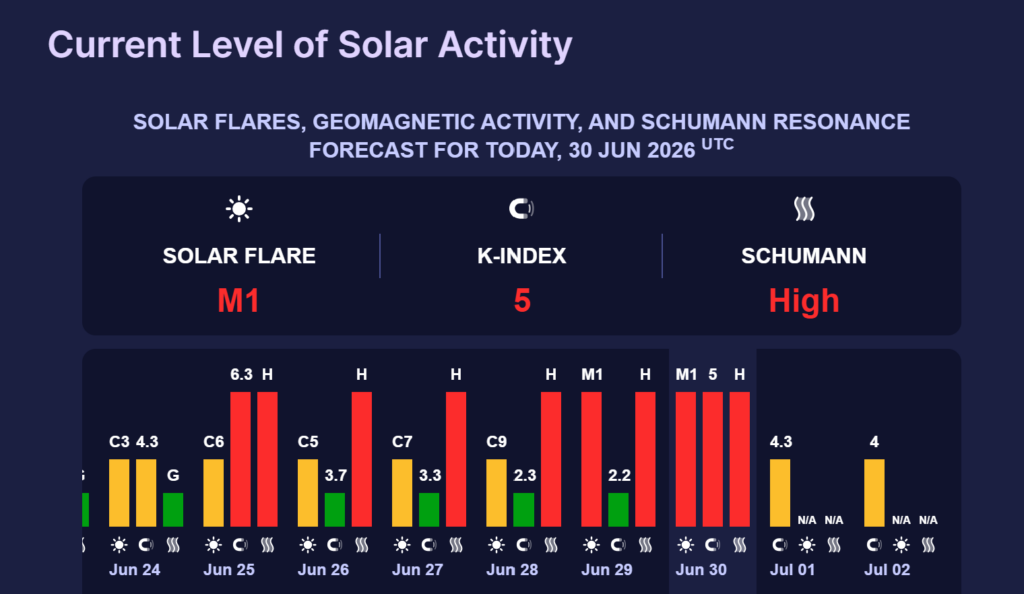
On Tuesday, June 30, 2026, geomagnetic activity increased sharply. According to the Meteoagent service, its intensity reached 5 points, which corresponds to the initial level of a magnetic storm, reports "Komersant Ukrainian".
According to scientists, 11 Class C solar flares have been recorded on the Sun over the past 24 hours. Also, on June 30, there is a 50% probability of more powerful Class M flares and an approximately 10% probability of Class X flares. Currently, 86 sunspots are visible on the Sun’s surface.
This heightened activity will not subside in a single day. According to preliminary forecasts, the index will drop to 4 on July 1 and 2, but Earth’s magnetosphere will remain agitated.
At the same time, data from different forecasting centers may vary. The U.S. National Oceanic and Atmospheric Administration (NOAA) Space Weather Prediction Center expects mostly quiet or unstable geomagnetic conditions in early July, with no prolonged severe storms.
The Magnetic Storm on June 30: How Strong Did It Get?
After several days of relatively low geomagnetic activity, readings rose sharply on June 30.
According to Meteoagent’s forecast, the intensity of the fluctuations reached 5 points.
A Kp index of 5 corresponds to a G1 level on the NOAA scale—a weak geomagnetic storm.
At this level, the following are possible:
- minor fluctuations in power grids;
- minimal impact on satellite operations;
- short-term changes in navigation accuracy;
- the appearance of the aurora borealis at high latitudes.
The NOAA space weather scale page states that at Kp 5, only weak fluctuations in power grids and a minor impact on satellite operations are possible.
What Will the Magnetic Storm Be Like on July 1?
On Wednesday, July 1, Meteoagent forecasts a decrease in geomagnetic activity to 4 on the scale.
This level is usually characterized as an elevated or excited magnetosphere, but technically it does not yet reach the threshold for a G1-class magnetic storm.
Therefore, on July 1, we can expect:
- weaker activity than on June 30;
- continued geomagnetic fluctuations;
- the possibility of brief periods of intensification;
- a gradual stabilization of the Earth’s magnetic field.
The forecast may change depending on the speed of the solar wind and the direction of the interplanetary magnetic field.
Forecast for July 2
On Thursday, July 2, geomagnetic activity, according to Meteoagent’s preliminary assessment, will also remain at level 4.
This means that no significant deterioration is expected compared to June 30, but a full return to calm levels may not yet occur.
The preliminary three-day forecast is as follows:
- June 30 — 5 points, mild magnetic storm;
- July 1 — 4 points, elevated geomagnetic activity;
- July 2 — 4 points, elevated geomagnetic activity.
Meteoagent notes that its forecast is updated as data becomes available from satellites and research laboratories.
What the NOAA forecast shows for July 1–2
NOAA’s data is somewhat calmer.
The U.S. Space Weather Prediction Center’s long-term forecast for July 1–2 calls for mostly quiet or unstable geomagnetic conditions.
Why do magnetic storm forecasts differ?
Different websites may show varying values due to differences in methodologies, data sources, and update times.
Some services use:
- the Kp planetary index;
- local magnetometers;
- solar wind models;
- satellite observations;
- their own color or point scales.
For this reason, a rating of “4 points” on one service does not always have the same meaning as a G1 or G2 level on another.
The official international scale for geomagnetic storms used by NOAA is as follows:
- G1 — weak storm, Kp 5;
- G2 — moderate, Kp 6;
- G3 — strong, Kp 7;
- G4 — very strong, Kp 8;
- G5 — extreme, Kp 9.
Therefore, an activity level of 4 does not yet constitute a magnetic storm according to this classification.
What Happens on the Sun
Geomagnetic disturbances do not occur directly during every solar flare.
The Earth’s magnetic field can be affected by:
- coronal mass ejections;
- fast solar wind streams;
- coronal holes;
- changes in the interplanetary magnetic field.
Even a powerful solar flare does not always cause a storm on Earth. For this to happen, the ejected solar material must be moving toward our planet.
Similarly, a weaker solar flare may be accompanied by an ejection that will reach Earth in a few days and intensify geomagnetic activity.
What Do Class C, M, and X Flares Mean?
Solar flares are classified based on the intensity of their X-ray radiation.
The main classes are:
- C — weak flares that usually do not cause serious consequences for Earth;
- M — medium-intensity flares capable of causing brief disruptions to radio communications;
- X — the most powerful flares, which can affect communications, navigation, and satellites.
Each successive class is approximately ten times more powerful than the previous one.
The number of flares alone does not allow for an accurate prediction of a geomagnetic storm. What matters is their location on the Sun and the presence of a coronal mass ejection directed toward Earth.
Do Magnetic Storms Affect Health?
In popular publications, magnetic storms are often blamed for headaches, weakness, insomnia, blood pressure fluctuations, and joint pain.
However, scientific evidence of a direct and significant impact of weak geomagnetic storms on the health of most people remains inconclusive.
People’s well-being is much more likely to be affected by:
- heat;
- lack of sleep;
- dehydration;
- stress;
- sudden changes in atmospheric pressure;
- skipping meals;
- exacerbation of a chronic illness.
Do not attribute dangerous symptoms solely to a geomagnetic storm or delay seeing a doctor.
Watch us on YouTube: important topics – without censorship
Symptoms You Should Not Ignore
The following require immediate medical attention:
- sudden, severe chest pain;
- difficulty breathing;
- loss of consciousness;
- speech difficulties;
- weakness or numbness in part of the body;
- sudden vision loss;
- an unusually severe, unusual headache.
How to Stay Healthy on July 1–2
There is no specific treatment for a geomagnetic storm.
To stay feeling well, it’s helpful to:
- stick to your usual sleep schedule;
- drink plenty of water;
- not skip meals;
- limit excessive caffeine intake;
- avoid overexertion;
- take breaks during work;
- take medications prescribed by your doctor as usual;
- Do not change your medication dosage on your own.
Due to the summer heat, it is especially important to avoid dehydration and prolonged exposure to direct sunlight.
When will geomagnetic activity subside?
According to the Meteoagent forecast, activity is expected to subside after peaking on June 30.
It is expected that:
- on July 1, the index will drop to 4 points;
- on July 2, it will remain at 4 points;
- thereafter, the situation will depend on new solar eruptions.
Accurate forecasts beyond a few days are unreliable, as the speed and direction of the solar wind can change.
The most accurate updates are those provided 24–72 hours before the expected event.
Read us on Telegram: important topics – without censorship