Scientists discover a dinosaur with meter-long spikes in Morocco: show how it looked like
2 September 2025 21:36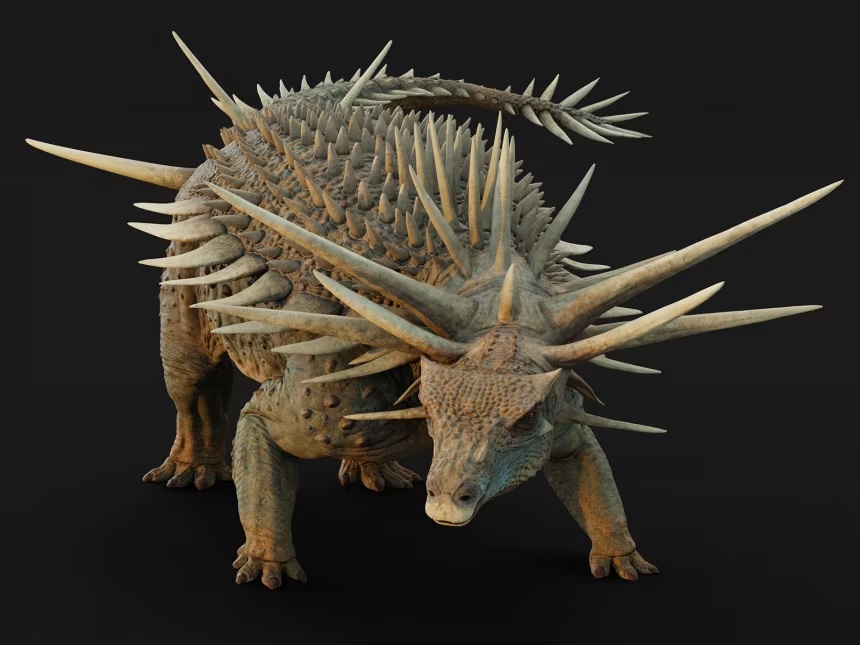
Paleontologists have discovered a unique dinosaur covered in armor with long spines, some of which were almost a meter long. This ancient lizard lived on the territory of modern Morocco about 165 million years ago, in the middle of the Jurassic period. This was reported by CNN, according to "Komersant Ukrainian".
The discovery was made in the Atlas Mountains in 2021-2023. Although the fossils did not preserve a complete skeleton, scientists received enough data to recreate the creature’s appearance. The dinosaur was named Spicomellus, and it belongs to the family of ankylosaurs, herbivorous, slow, massive lizards covered with bone armor.
Uniqueness of the discovery
- Africa’s first ankylosaur: Until now, the remains of these dinosaurs have been found mainly in North America, Europe, and Asia.
- The oldest representative of the group: Spicomellus became the oldest known ankylosaurus.
- Dimensions: body length – about 4 meters, weight – from 1 to 2 tons.
Special attention of scientists was drawn to the animal’s armor. It had short spikes on its back, its ribs had spines on the outside, and its neck was reinforced with a bone “collar” with plates and two pairs of large spikes – one of them reached 87 cm. There were also spikes and a shield on the hips.
The researchers suggest that the tail limb could have ended in a mace or additional spikes, like later ankylosaurs.
Why did it need such armor?
The study’s co-leader, Professor Richard Butler, noted that Spicomellus’s armor was “amazingly complex,” even more so than its later relatives. This contradicts the usual evolutionary trend, when early species usually have a simpler structure.
According to one version, the spikes had a dual function:
- protection from predators that lived in Africa at the time;
- attracting mates, just as modern animals have developed horns or lush feathers.
Scientist Suzanne Maidment, lead author of the paper, explains:
“Such structures in animals are rarely purely defensive. They are often associated with sexual selection. Spicomellus could have used the spines during courtship rituals or in fights for a female.”
At the same time, the researchers recognize that such bulky armor could have prevented the dinosaur from moving in dense vegetation, so a decorative function was no less likely than a defensive one.