Patriot Production in Ukraine: What Are the Chances of Launching Production of These Hard-to-Find Air Defense Systems “Right Here, Right Now”?
7 July 17:24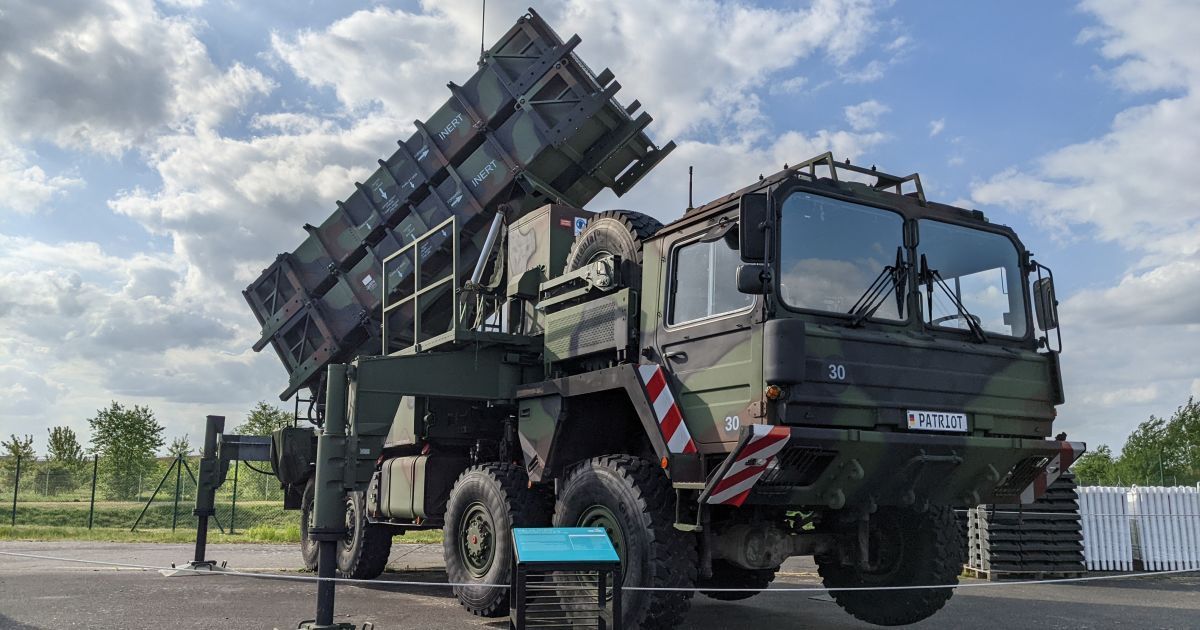 ANALYSIS
Yet another massive shelling of Ukrainian cities has confirmed that the Kremlin has definitively opted for ballistic terror. Despite the high effectiveness of air defense systems against drones and cruise missiles, intercepting ballistic missiles remains the most difficult challenge. In response to the attack, Volodymyr Zelenskyy once again publicly called on partners to strengthen air defense, emphasizing that Russia has run out of other arguments in the war. Ukraine is counting on a positive response from Donald Trump regarding a license to manufacture Patriot systems in Ukraine or in cooperation with its European neighbors. How realistic is this plan, and are American air defense systems capable of stopping Russian missiles? Find out in this article
Current global production volumes of Patriot air defense systems are insufficient to provide protection against ballistic missiles, so Ukraine is discussing with the U.S. the possibility of obtaining a license to manufacture these systems domestically. Ukrainian President Volodymyr Zelenskyy made this statement during a speech at a defense forum held as part of the NATO summit in Ankara.
The head of state called on allies to support this initiative and to step up efforts to develop European missile defense systems.
“Europe needs affordable, mass-produced missile defense systems as soon as possible—in fact, starting today,” Zelenskyy emphasized.
The President of Ukraine stressed that this issue cannot wait until 2030.
Ukraine’s efforts to obtain licenses to manufacture American Patriot air defense missile systems are a strategically sound move, despite the technological nuances and the length of the process. This opinion was expressed in a comment "Komersant Ukrainian" by Grigory Tamar, a reserve officer in the IDF. However, launching such production is not a matter of days or months.
“Such issues aren’t resolved quickly; it doesn’t happen overnight. But given that Ukraine will have to transform itself into a major military power over many years and decades—since there is simply no other civilizational path of development—you will need to create one of the world’s best defense industries. Accordingly, the strategy must be built for the long term,” Tamar noted.
Watch us on YouTube: important topics – without censorship
A Proven Air Defense Classic: The Pros and Cons of the Patriot
Analyzing the effectiveness of the American system, the IDF reserve officer noted that, technologically speaking, the Patriot is no longer a groundbreaking innovation in air defense, but it remains a reliable pillar of defense.
According to the expert, , Patriot systems are no longer used in Israel, as the country has transitioned to its own, more advanced designs. In particular, the third-generation Patriot is, in terms of its technical characteristics, roughly analogous to the Israeli “David’s Sling” system.
“An old horse doesn’t spoil the furrow. I’m not saying that the Patriot is a bad system. It’s a solid, proven weapon that has its pros and cons, and which could currently address and resolve many issues in Ukraine,” Tamar emphasized.
Despite the debate over the advisability of launching production of these specific systems, the expert believes that for Ukraine, this may be the only realistic and feasible option “right here, right now.”
“For Ukraine, all deadlines have already passed. Domestic production or weapons were needed ‘yesterday.’ Therefore, if such an opportunity exists today, it must be seized,” Tamar is convinced.
Where should production be localized?
Grigory Tamar suggests that under current conditions, components could be manufactured or systems assembled directly in Ukraine, as experience has proven the resilience of the Ukrainian defense industry even under attack. Neighboring NATO countries could be considered as an alternative or as a partner in cooperation.
“If not in Ukraine, then there’s the Czech Republic and Poland. I think that all the political disagreements that have arisen recently will ultimately be overcome. Reality will force us to come to terms. You have far too many common goals and a formidable common enemy, so historically, there is simply no other choice,” Tamar concluded.
How many Patriot systems are there in the world?
Patriot systems are a scarce and extremely expensive “commodity” on the global defense market. When discussing the availability of Patriots, they are counted in batteries (one fire unit: command post, radar, up to 8 launchers, and support vehicles), while the interceptor missiles themselves (for example, the modern PAC-3 MSE) are counted individually.
As of 2026, approximately 170 to 180 MIM-104 Patriot batteries (anti-aircraft missile systems) are deployed and in operation worldwide. No one can cite an exact figure from open sources due to the secrecy surrounding air defense forces, but an analysis of data from FMS (Foreign Military Sales) contracts and military think tanks (notably Defense Express and the IISS) indicates that the United States remains the largest operator of the system. The U.S. Army has about 60 Patriot batteries in service (organized into 15 divisions/battalions). The Pentagon keeps some of the systems on combat duty within the country, while others are deployed at overseas bases (Germany, South Korea, Japan, and the Middle East).
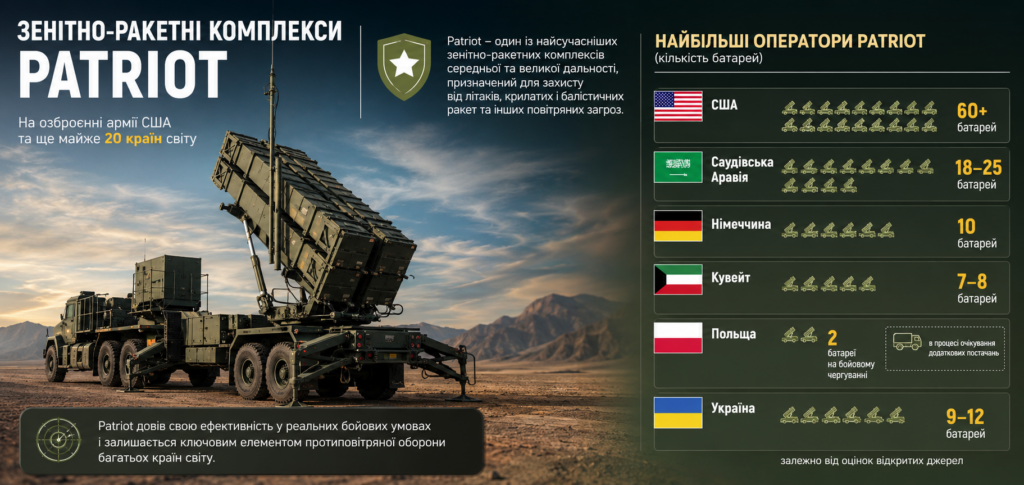
There is a severe shortage in Europe, as a significant portion of the systems have been contracted but not yet manufactured. For example, Poland, Romania, and Sweden are in the process of deployment. Only 2–3 batteries in each of these countries are fully operational and on duty; the rest are awaiting delivery by 2027–2029.
According to estimates by specialized monitoring agencies, taking into account all direct deliveries from the U.S., Germany, and the Netherlands, as well as the integration of former Israeli components (PAC-2) through complex trilateral agreements, as of the summer of 2026, Ukraine will operate a pool equivalent to between 6 and 14.5 systems (depending on whether one counts full-fledged batteries or individual fire units/divisions deployed to defend cities).
Consequently, according to various estimates, the waiting list for purchasing Patriot systems and missiles is scheduled 5–7 years in advance. That is precisely why it is critically important for Ukraine not simply to purchase or request ready-made systems, but to obtain a license and blueprints from the U.S. to establish its own production of components in Europe or on its own territory—this is the only way to join this exclusive club without waiting in line.
Read us on Telegram: important topics – without censorship