The threat from the north is real: Syrsky and a military expert assess the risks of an invasion from Belarus
20 May 09:34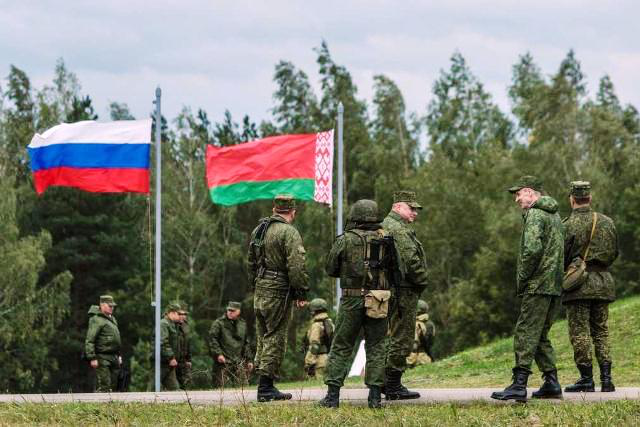 ANALYSIS
The Russian Federation continues to view Belarusian territory as a springboard for a potential expansion of the front line. Against the backdrop of statements by Ukraine’s military leadership, experts are analyzing possible scenarios for enemy strikes, the degree of Minsk’s political autonomy, and the readiness of the Defense Forces for any turn of events. What are the two main scenarios for an offensive from the north that Russia is considering? Will the occupiers advance on Kyiv again via the Chernihiv region? What role is assigned to Alexander Lukashenko, and what does passport issuance in the PMR have to do with this?
Commander-in-Chief of the Armed Forces of Ukraine Oleksandr Syrskyi confirmed in a comment to “Military” that intelligence data regarding the threat of a renewed offensive from Belarusian territory is entirely real. Currently, the enemy holds a significant numerical advantage.
“Possible operations in the north are a real possibility; we have information that the Russian General Staff is currently actively calculating and planning operations,” the Commander-in-Chief emphasized.
According to Syrsky, Russia currently outnumbers Ukraine two to one in terms of brigades and regiments. The main risk lies in a further extension of the front line, which already stretches about 1,200 kilometers.
Enemy activity on the Belarusian border was recorded as early as the beginning of spring, after which Ukrainian President Volodymyr Zelenskyy ordered a significant reinforcement of this strategic sector.
It should be recalled that from the very first days of the full-scale invasion, Minsk provided its territory to the occupiers’ ground forces, and now continues to open its airspace to Russian strike drones.
Does Lukashenko have a choice?
Military expert, SBU reserve colonel, and military counterintelligence specialist Mykhailo Prytula in an interview
- Lack of control: The Kremlin disregards the position of Belarus’s self-proclaimed president. Russian troops and special forces use the country’s infrastructure at their own discretion.
- Analogy with Ukraine under Yanukovych: Belarus’s security apparatus is effectively run by FSB officers today—just as it was in Ukraine before 2014.
- Obedience for survival: Lukashenko is caught in a vise between pressure from Russia, the West, the domestic opposition, and the threat of physical elimination. As long as he demonstrates loyalty, the Kremlin leaves him in power. If he is removed, Belarus will finally lose even its nominal statehood and will be completely occupied.
“Does anyone ask him? Russia doesn’t ask him. Putin will simply send troops wherever he wants. The only power Lukashenko has is to warn the world, one way or another, through hints that a strike is being prepared,” notes Mykhailo Prytula.
The expert ironically calls Lukashenko the “chief partisan,” who fully understands how this adventure will end and is secretly waiting for Russia’s disintegration and collapse, a view he expressed analytically as early as the beginning of 2020.
Possible directions of attack
Scenario 1 – A strike to cut off the West and link up with Transnistria
This plan involves an attempt to cut through Ukraine’s territory at its narrowest point to block logistics routes and reach the Kremlin-controlled territory of Moldova.
“Once, Budanov showed a map; this was in November 2021, that is, a few months before the attack… He showed a map on which there was another direction of attack, specifically from Belarus, from the direction of Mozyr, toward Berdychiv, Zhytomyr, then Vinnytsia, Kryzhopil, and to link up with PMR troops… One strike from the PMR, a second strike coming from Mozyr. That is, Ukraine’s width there is only 360 km. And such a strike would theoretically cut across two supply routes,” says Prytula.
The expert emphasizes that this plan could only have a chance of success if it were carried out with the element of surprise at the start of a full-scale invasion. Today, the situation is radically different.
“If they had done this, let’s say, in February-March 2022, one could argue that perhaps they might have succeeded. It would have been much harder for us. But now—it’s an outdated (futile) attempt,” noted Mykhailo Prytula.
Scenario 2 – A direct assault on Kyiv via Chernihiv Oblast
Another theoretical option is an attempt to launch a second assault on the capital from the north, where the distance to Kyiv is minimal.
“Could an attack on Kyiv come from the Chernihiv region? Absolutely, because the distance to Kyiv is less than 100 kilometers. There is a vacuum there—that is, an evacuated zone—and they could use that to… But they would also encounter quite challenging terrain; in other words, they would have to pass, to put it mildly, through the Desna training ground in that direction, and they would be moving through sparsely populated areas,” explained Mykhailo Prytula.
The main problem for the Russians on this route is the complete lack of conditions for moving heavy equipment and providing logistics.
“There’s no logistics there, and they’d just have to walk through the forests—on foot, just like they’re used to doing in a bayonet charge. That’s the only thing they could possibly do. I mean, how effective would that be from a military standpoint? Well, I’m sure it wouldn’t be effective at all… They would need a very, very large army to advance from the north toward Kyiv,” Mykhailo Prytula believes.
Related provocations: the Transnistria factor
In parallel with the Belarusian track, Russia is attempting to artificially escalate tensions around the so-called “PMR.” Putin’s simplification of the procedure for issuing Russian passports to local residents is laying the groundwork for potentially drawing the region into the war.
However, according to Prytula, an attempt to incite Transnistria to storm the Ukrainian borders is unlikely to succeed, as the local elites and the population have no desire to fight:
“An offensive toward the PMR depends on whether the PMR will allow its sons-in-law to launch some kind of offensive in some kind of war, instead of living a peaceful life off several sources of income in Transnistria… The attempt to drag Belarus into the war and the simplified procedure for issuing PMR passports are one and the same. If we look at a map of Ukraine, they have this option: to open a second front.”
However, modern technological warfare dictates its own terms. Ukraine’s defense forces, particularly its unmanned aerial vehicle units (such as the “Madyar Birds”), fully control the airspace and the movement of military equipment near the borders. Should they receive clear intelligence regarding the formation of a strike force, Ukrainian forces are ready to deliver preemptive, high-precision strikes against Russian troops on Belarusian territory.
Neither the mythical “Belarusian flag” nor the nuclear weapons transferred by Russia (which are fully controlled by Russian officers, not Minsk) will protect the occupiers from retaliation.