Zelenskyy reported that Russia has cut oil refining by at least 10%: what other economic losses has the aggressor suffered?
18 May 19:02
Ukraine’s Foreign Intelligence Service has obtained new Russian documents containing an internal assessment of the aggressor country’s war losses. This was announced by Volodymyr Zelenskyy following a briefing by FIS Director Oleg Lugovskyi, according "Komersant Ukrainian".
“Our Foreign Intelligence Service of Ukraine has obtained new Russian documents containing an assessment of the aggressor country’s war losses. And it is important that this is specifically a Russian internal assessment, which they are trying to hide from both the world and the Russian domestic audience,” the president said.
The first significant indicator, the president noted, is the reduction in active oil wells. Just one Russian oil company—and not even the largest one—has already been forced to shut down about 400 wells. Given the specifics of Russian oil production, these are significant losses, as restarting wells in Russia is much more difficult than in other oil-producing countries.
The second indicator is a reduction in oil refining by at least 10% in just a few months this year.
“We see that our far-reaching sanctions against Ukraine are indeed working, and we will continue to ramp up this aspect of our active efforts. The data on the banking crisis in Russia also looks quite convincing: specifically, 11 financial institutions are preparing for complete liquidation due to problems that cannot be resolved otherwise, and another eight banking institutions have accumulated critical problems that cannot be resolved without attracting external resources,” Zelenskyy said.
In addition, the Russian Federation’s federal budget deficit in May has already reached nearly $80 billion, against the backdrop of the bankruptcy of a significant portion of Russian regional budgets.
Zelenskyy also instructed the head of the Security Service of Ukraine, Oleg Lugovskyi, to disseminate the information obtained regarding Russia’s attempts to involve global companies in resolving the financial crisis and schemes to circumvent sanctions.
“In particular, we have, unfortunately, documented attempts to organize grain exports from the temporarily occupied territory of Crimea, as well as other forms of economic exploitation of the peninsula involving entities from the United States. We will inform our partners. We are also documenting attempts to bring investments and technologies from democratic countries into Russian Arctic oil and gas projects. We know how to counteract this,” the president said.
According to foreign media reports, the Kremlin is deliberately distorting economic statistics. Official figures do not reflect the true state of Russia’s economy, making it difficult to assess its actual losses from sanctions and the war.
At the same time, global oil prices have surged amid the escalating conflict between the U.S. and Iran. This has allowed Russia to increase its energy export revenues to the highest level since the start of the full-scale war against Ukraine.
However, Bloomberg analysts believe that even high oil prices cannot save the Russian economy from a slowdown. According to the agency’s estimates, Russia’s GDP may have contracted in the first quarter of 2026, and high interest rates, investment problems, and the economy’s reorientation toward military spending continue to exacerbate the crisis.
Watch us on YouTube: important topics – without censorship
Strikes on Russia’s Oil Industry
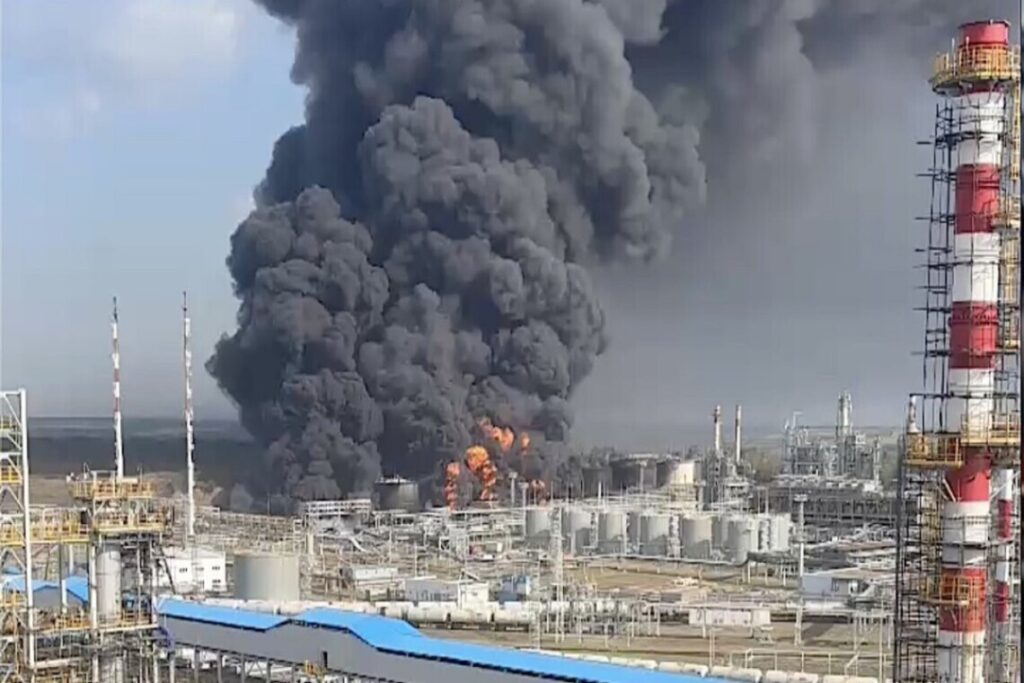
On the night of May 15, drones attacked Ryazan, causing one of Russia’s largest oil refineries to catch fire. Explosions began around 2 a.m., with local residents reporting a “swarm of drones,” explosions, and bright flashes in the sky, followed by a massive fire.
It was also reported that Ukrainian drones “shut down” one of Russia’s largest oil refineries. This refers to the Perm Oil Refinery, which in 2024 processed approximately 12.6 million tons, or 250,000 barrels of oil per day. The refinery produced 2 million tons of gasoline, 5.3 million tons of diesel fuel, 700,000 tons of coke, and 200,000 tons of fuel oil. The Perm Oil Refinery in Russia sustained significant damage following drone attacks that took place on May 7. As a result, the plant completely halted operations, and repairs are currently underway, which may take several weeks.
On the night of April 30, a fire broke out at the Tuapse seaport terminal following an attack by Ukrainian drones. Prior to this, Ukrainian UAVs had struck oil facilities in Tuapse three times—on the nights of April 16, April 20, and April 28.
Earlier, Reuters reported that Ukraine has doubled its strikes on Russian oil refineries this year.
“These strikes, which also hit oil pipelines and storage facilities, have led to a reduction in oil production in Russia—the world’s third-largest producer after the U.S. and Saudi Arabia — which has increased pressure on Moscow’s federal budget, where oil and gas taxes account for about a quarter of revenues,” the report notes.
In particular, the International Energy Agency reported on Wednesday that crude oil production in Russia in April fell by 460,000 barrels per day compared to last year—to about 8.8 million barrels per day.
According to Reuters calculations, as a result of Ukrainian drone attacks from January to May, oil refining capacity of about 700,000 barrels per day was taken out of service at 16 refineries
The International Energy Agency stated that Russia’s exports of petroleum products in April fell by 340,000 barrels per day compared to March, reaching 2.2 million barrels per day—the lowest level in recorded history.
On Wednesday, May 13, a fire broke out at the Nurlino LPS—a line production and dispatch station that is part of Transneft’s main oil pipeline system—in the Russian region of Bashkortostan.
The incident in Bashkortostan occurred amid a series of fires and explosions at Russian oil infrastructure facilities. On the night of May 13, there were also reports of drone attacks in the Krasnodar Krai of the Russian Federation and fires near port infrastructure.
Read us on Telegram: important topics – without censorship