Where Are Europe’s Richest Young People? In Which Countries Do People Under 35 Accumulate the Most Wealth?
10 July 09:56
Young Europeans are increasingly facing high housing prices, expensive rent, and a rising cost of living. However, the level of well-being among young people varies significantly across European countries. While in some countries people have already accumulated significant wealth by the age of 35, in others young people are just beginning to build a financial cushion.
This is reported by "Komersant Ukrainian", citing the Household Finance and Consumption Survey (HFCS) published by the European Central Bank and a report by Euronews Business.
What Are the Wealth Levels of Young People in Europe?
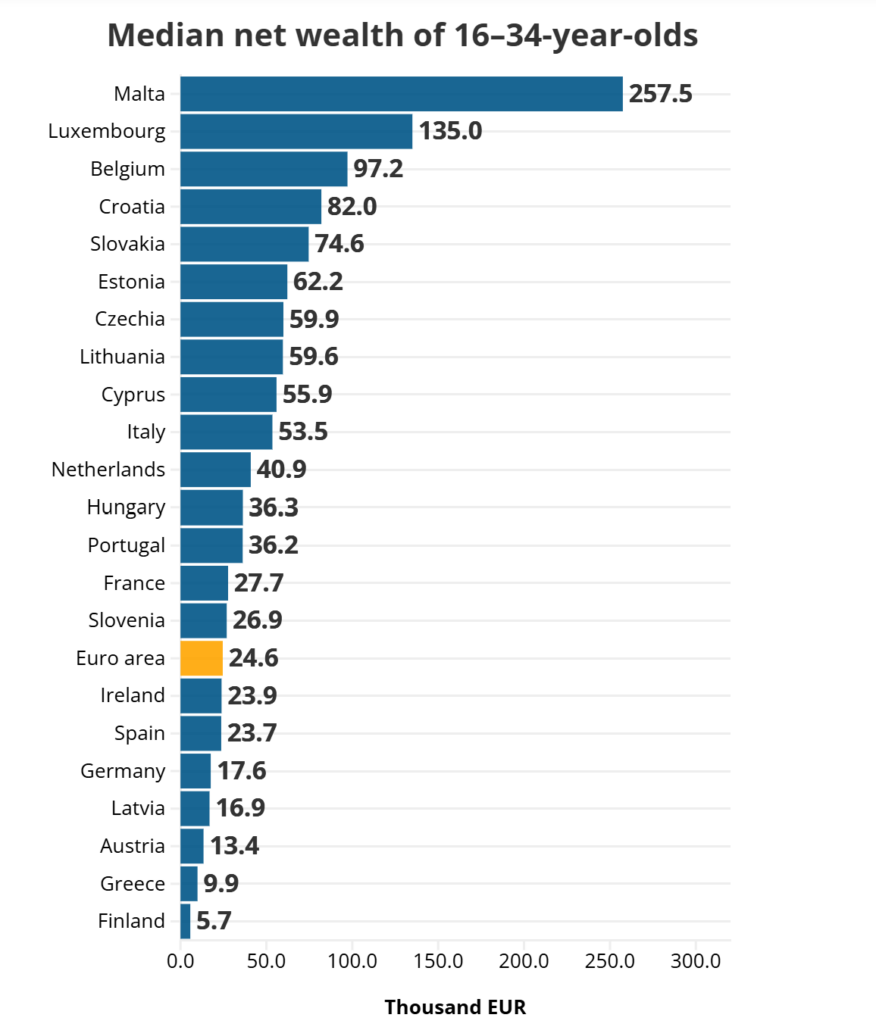
According to the study, the median net wealth of eurozone residents aged 16 to 34 is 24,600 euros.
By comparison, the median net wealth of all eurozone households is 140,100 euros. Thus, young people possess only about 18% of the average level of accumulated capital.
Experts attribute this to the fact that people under 35 have not yet had enough time to accumulate assets from their own income.
Where Do Europe’s Wealthiest Young People Live?
Among the 22 countries included in the study, the difference in wealth levels turned out to be enormous.
Top 10 countries by median net worth of young people:
| Country | Median net worth |
|---|---|
| Malta | 257,500 euros |
| Luxembourg | 135,000 euros |
| Belgium | 97,200 euros |
| Croatia | 82,000 euros |
| Slovakia | 74,600 euros |
| Estonia | 62,200 euros |
| Czech Republic | 59,900 euros |
| Lithuania | 59,600 euros |
| Italy | 53,500 euros |
| Netherlands | 40,900 euros |
Malta stands out in particular, as it is more than twice as high as its closest competitor.
Watch us on YouTube: important topics – without censorship
Young Italians are wealthier than Germans
Among the European Union’s largest economies, Italy has the highest level of wealth among young people.
The figures are as follows:
- Italy — 53,500 euros;
- France — 27,700 euros;
- Spain — 23,700 euros;
- Germany — 17,600 euros.
Thus, young Italians have accumulated nearly three times as much wealth as their peers in Germany.
High wealth despite low incomes
Croatia has a figure of 82,000 euros. This is a surprisingly high level, given the country’s ranking in terms of net annual income. According to Eurostat, in 2025, the annual net income of a single person without children in Croatia was 17,256 euros.
This is the national average, not just for the 16–34 age group.
The median net income among 16- to 34-year-olds is also high in Slovakia (74,600 euros), Estonia (€62,200), the Czech Republic (€59,900), and Lithuania (€59,600), even though the annual net income in these countries is significantly lower than the EU average.
Where young people have the lowest wealth
The lowest figures were recorded in:
- Finland— 5,700 euros;
- Greece — 9,900 euros;
- Austria — 13,400 euros;
- Latvia — 16,900 euros;
- Germany — 17,600 euros.
The following figures are also below the average:
- Ireland — 23,900 euros;
- Portugal — 36,200 euros;
- Hungary — 36,300 euros.
Why is there such a difference?
Fabian Pfeffer, a professor at the University of Munich, explains that young people’s well-being is determined by more than just their salary.
The following factors have the greatest influence on wealth accumulation:
- parental support;
- inheritance;
- real estate gifts;
- access to mortgages;
- housing prices;
- level of debt;
- the ability to purchase one’s own home at a young age.
It is family capital that often becomes the main advantage for starting adult life.
“Therefore, when we see significant wealth among young households, it’s important not to view it solely as the result of personal financial discipline,” he added.
Read us on Telegram: important topics – without censorship