Two Survival Strategies: How the War Has Changed Ukrainians’ Consumption Habits
28 April 21:23
In the fifth year of full-scale war, Ukrainian consumer behavior has become noticeably polarized: some people are adopting a more rational and cautious approach to spending, while others are consciously maintaining their usual level of consumption.
This is evidenced by the latest wave of the annual study on Ukrainian consumer habits, presented at the 19th Ukrainian Marketing Forum, reports "Komersant Ukrainian".
The study notes that consumer expectations of brands are also changing: expectations and perceptions of advertising are increasingly aligned with the real-life context, daily challenges, and emotional state of consumers.
How consumers are segmented
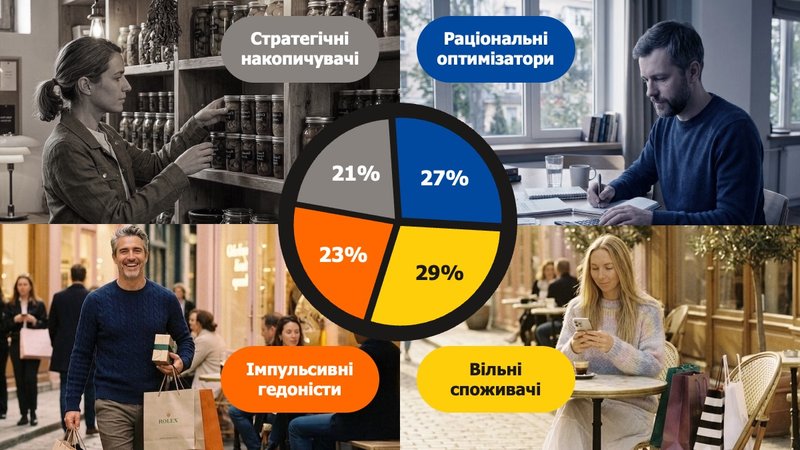
According to the study’s findings, Ukrainians today fall into four key segments, each with its own decision-making logic and consumption approaches.
Thus, 21% of the audience follows a savings-oriented behavior model: these consumers save money, carefully plan their expenses, and build up reserves “for the future.”
At the same time, 27% choose a strategy of rational optimization —they also control their spending, but do so without making significant changes to their usual lifestyle.
23% of Ukrainians surveyed are impulsive hedonists who focus on emotions and “here and now” gratification, without putting off life for later.
And 29% are respondents with a strategy of free spending: they are not inclined to save and strive to maintain their usual level of spending, regardless of external circumstances.
Watch us on YouTube: important topics – without censorship
At the same time, none of the segments is dominant.
Ukrainians’ behavior can also be described through a hypothetical pyramid of needs, which reflects the logic behind the choice of goods and brands.
Pragmatism prevails: price, discounts, and special offers remain the key triggers for choice.
The second level is shaped by convenience and care: a simple customer journey, ready-made solutions, and time savings.
A third of consumers pay attention to emotionality and empathy: they expect honest, open communication and positive emotions from their interaction with the brand.
A quarter of respondents expect support for people, the country, and social initiatives.
Consumers want to see positivity in advertising that is grounded in reality
The demand for brands can be summarized as a need for “good news from the real world.”
Against the backdrop of the war, Ukrainians have become significantly more sensitive to the tone and content of communications. They react strongly to insincerity and inappropriateness, expecting brands to understand the context in which society lives.
In particular, only 9% of consumers view ads with an “idealized” portrayal of life positively. Instead, messages that combine positivity with reality—without ignoring difficult topics and daily challenges—are becoming relevant.
Read us on Telegram: important topics – without censorship
“The Ukrainian consumer is already living in a new reality: on the one hand, more pragmatic and price-sensitive; on the other, with a clear need for small pleasures that help maintain well-being and avoid putting life on hold. In this context, the role of the brand is also changing: its importance isn’t fading, but consumers are looking for it in a new, more affordable price category. For brands, this presents a new challenge—to remain relevant not through image, but by precisely aligning with the context of people’s lives,” summarizes Yevheniia Blyzniuk, sociologist, founder, and CEO of the research company Gradus.
READ ALSO: Challenges for marketing leaders: a study reveals marketers’ biggest problems