NATO and the Fear of Escalation with Russia: What the UN Security Council Statements Mean
23 September 2025 15:02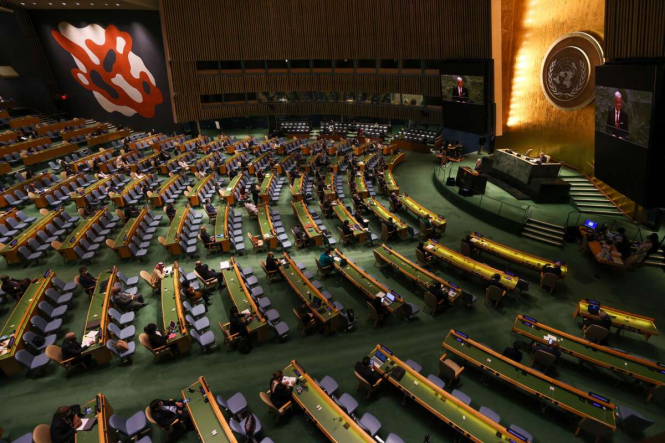
Military and political experts point out the contradictory nature of NATO’s actions to protect against Russia’s provocations. After the latest statements by Polish officials and consultations in the UN Security Council, the situation in Europe looks alarming.
The duality of NATO’s decisions
Military expert Oleg Zhdanov in a commentary
The expert draws attention to the internal divergence in the positions of NATO countries. For example, when Polish Foreign Minister Radoslaw Sikorski declares his readiness to shoot down Russian objects that violate airspace, Prime Minister Donald Tusk denies the possibility of such actions. This inconsistency demonstrates the lack of a unified strategy in the Alliance.
“You know, it’s a shame that the right hand doesn’t know what the left hand is doing. This is the problem. The problem is that when Sikorsky, a very good thing, I liked it, said that we will shoot down everything that flies into Polish airspace, at the same time Donald Tusk, the Prime Minister of Poland, said that no one will shoot down anything. Do you understand?” Zhdanov said.
Putin can destroy NATO in 24 hours
This situation could have serious consequences, as Putin, according to the expert, is able to use this weakness to undermine NATO’s unity.
“By the way, I’ve always said that Putin can destroy NATO in 24 hours. He did it. He just had to attack one of the NATO member states. By activating Article 4 of the charter, they are in complete disarray. And this is actually the collapse of NATO,” the expert believes.
NATO is afraid of escalation
Zhdanov emphasizes that NATO countries are avoiding active actions out of fear of a direct confrontation with Russia.
“They are afraid. But Putin has said that whoever shoots down our missile or shakedown, we will consider it as entering the war on the side of Ukraine. And this country will become a legitimate target for Russia. That’s why they are very afraid.”
The UN Security Council is also not coming to any concrete decisions. The discussions boil down to the fact that it is “impossible and unnecessary” to shoot down Russian targets.
“In the UN Security Council, yes, they spoke very nicely, very nicely, but the consultations all boil down to the fact that it is impossible and unnecessary to shoot down. That’s the problem, you see, they are very afraid of Putin. Very much,” Zhdanov said.
Instead of taking active steps, NATO resorts to expensive but ineffective measures, such as deploying air defense systems that only accompany targets, not destroy them.
“They will supply air defense systems, they will spend millions of euros on airplanes that will take to the skies. They will intercept these planes. Well, intercepting them is not opening warning fire towards the violator, but the pilot making visual contact, waving and signaling that “turn on the radio and listen to what I have to say,” Zhdanov explained.
Russia’s reaction: ignoring tactics
Zhdanov also draws attention to the tactics of Russian pilots who turn off communication to avoid responsibility for ignoring warnings. This makes it difficult to prove a violation.
“What are the Russians doing? They hit you in the face with a brick and cut off communication. By the way, they turn off communication so that it cannot be proved later that there was radio contact and that they ignored the warnings of their Western partners,” Zhdanov states.
The expert adds that the multimillion-dollar spending on air defense and escorting offenders is more of a symbolic step than a real deterrence strategy.
“They will deploy air defense, expensive air defense. We may not even get some of it. But they will. Eventually, they will build, they have the money, a frontal multi-echelon air defense system, but believe me, they will observe and escort. Nothing more,” the military expert summarized.
Why NATO warnings do not work
Political analyst Oleh Lisnyi in a commentary
“The right approach is a comprehensive one. That is, one that combines two things – to shoot down their own and to help us. But we see that they evaluate everything through the prism of their own security and unwillingness to escalate, as they say. Therefore, they believe that if they warn, the opponent or counterpart must listen to it and not do it again. That is, they want to warn in a civilized way.”
This approach, according to the political scientist, is wrong. Warnings without real action are perceived by Russia as weakness. Lisnyi believes that Putin is deliberately provoking the West, and without decisive steps, the attacks will continue.
“I think it’s inappropriate and it won’t work, because Putin will see such statements as an element of weakness if there is no action behind these statements, and he will continue to attack the way he does, deliberately. Because there are no random moments there,” the political scientist summarized.
Fear of escalation and risks for Europe
Experts agree that the fear of a direct conflict with Russia and conflicting signals from the allies pose risks to stability in Europe.
Formal interceptions and escorts of airspace violators do not stop real attacks.
Warnings without action can be perceived as weakness.
NATO’s comprehensive approach, which combines its own defense and support for Ukraine, remains key to ensuring the security of the region.