Underground bunkers instead of cities: how Israel stores ammunition, and whether this would help Vyshneve
13 July 07:16 ANALYSIS
Locating a large ammunition depot in a residential area is, at the very least, criminal negligence—if not deliberate sabotage—which counterintelligence must now investigate. This is how Grigory Tamar, a reserve officer of the IDF and military expert, commented on the tragedy in Vyshneve, Kyiv Oblast, where a Russian strike caused an arsenal belonging to one of Ukroboronprom’s enterprises to explode. According to the expert, such an approach to security is unacceptable in Israel, since even during wartime, civilian neighborhoods and military depots there are separated by hundreds of meters of underground bunkers. How exactly Israel protects its arsenals from enemy missiles and why the Vyshneve incident should immediately prompt changes to Ukrainian military regulations—read more in this article "Komersant Ukrainian".
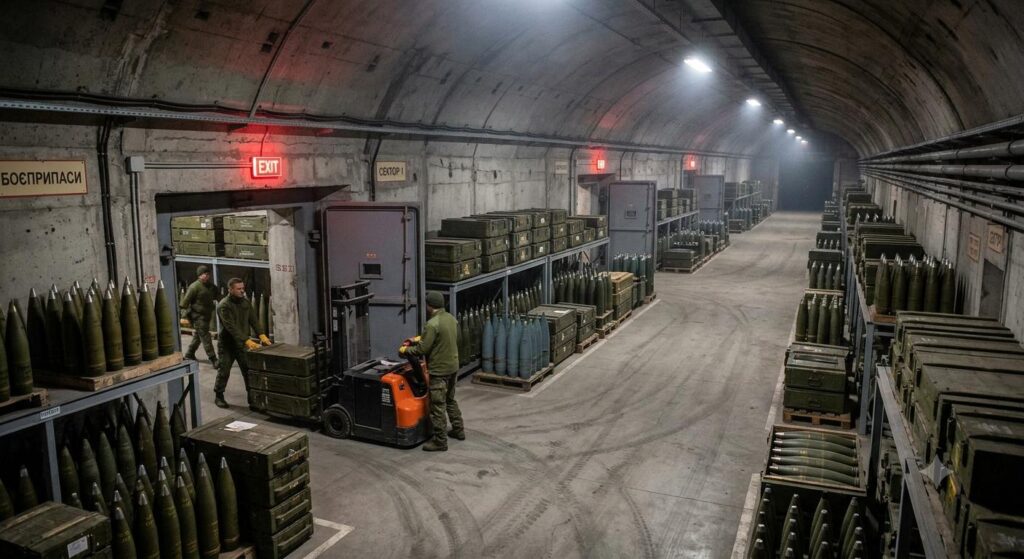
Russia’s massive combined strike on Ukrainian territory, which took place on the night of July 6, led to tragic consequences in the Kyiv region. In addition to the destruction caused directly by enemy missiles and drones, the country was shaken by news of a massive explosion at an ammunition depot in the town of Vyshneve. The depot belonged to one of the enterprises of the Ukroboronprom concern and was located virtually within a residential neighborhood. As a result of the strike on the facility and a secondary explosion, 9 people were killed, 58 were injured, and authorities were forced to urgently evacuate nearly 500 local residents due to the threat of further explosions.
Ukrainian President Volodymyr Zelenskyy called the situation “absolutely horrific,” confirming that the Security Service of Ukraine (SBU), the Ministry of Internal Affairs (MIA), and the Office of the Prosecutor General are already investigating the criminal case, and that the leadership of the defense sector faces severe personnel and organizational consequences, including dismissals.
“Criminal negligence, if not worse”
Grigory Tamar, a reserve officer of the Israel Defense Forces (IDF) and military expert, asserts that the very fact of the long-term storage of a large arsenal of ammunition in a densely populated area is unacceptable for a regular army. According to him, the Armed Forces of Ukraine are a large, official, and deeply bureaucratic structure, not “Makhno’s army,” where decisions are made chaotically at the whim of a single individual.
“Storing a large quantity of ammunition in a residential area is, at the very least, criminal negligence, if not worse. This is clearly a systemic decision that went through the chain of command. Such actions should be investigated by the military prosecutor’s office. Counterintelligence must thoroughly investigate whether this was a tragic mistake and negligence, or a deliberate act of sabotage, in which such a target was intentionally ‘set up’ for the enemy,” says Tamar.
How Israel Stores Its Arsenals: The Tactics of Dispersal and Underground Bunkers
When asked whether a similar incident could occur in Israel, Grigory Tamar noted that human stupidity and mistakes happen everywhere, but the IDF has a strict security system in place that has been tested over decades. Although Israel has a massive army relative to its size (larger than the armed forces of many European countries, including the United Kingdom), large depots and arsenals are kept isolated from the public. The main strategic weapons reserves are located in uninhabited desert areas of the country.
Watch us on YouTube: important topics – without censorship
From the principle of a remote bunker to an autonomous underground infrastructure.
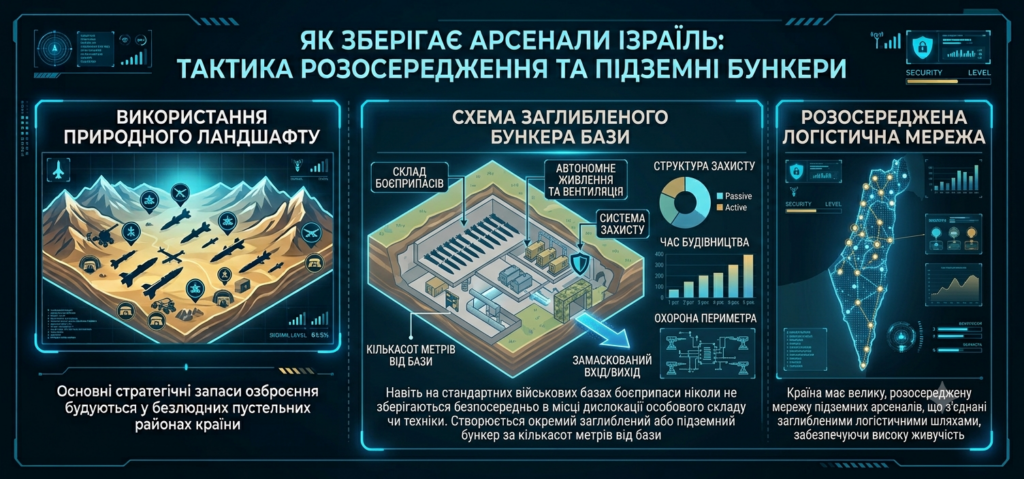
“If, for any reason—whether due to an accident, sabotage, or an incoming enemy missile—the ammunition detonates, the explosion will occur off-site. It will not destroy the military base itself or harm the civilian population,” the expert shares, recalling that he personally participated in guarding such facilities during his service in the IDF.
Industrial Giants in the Crosshairs: The Haifa Case
At the same time, Tamar acknowledges that even in technologically advanced Israel, there are infrastructure problems that cannot be solved instantly. A striking example is the large port and industrial city of Haifa, home to the country’s largest oil refinery.
In recent years, during fierce clashes with Hezbollah and Iranian attacks on Haifa, dozens of ballistic and cruise missiles, as well as kamikaze drones, have been launched. Despite the effectiveness of Israel’s air defense system, several hits were recorded, resulting in casualties and damage to the plant’s infrastructure.
“In the case of Haifa, there is no criminal intent or negligence: the plant was built long before the current missile threats emerged. Israel has now developed a strategic plan to relocate this industrial hub, although this is an extremely complex and time-consuming logistical and economic operation,” says Tamar.
What should Ukraine do right now?
The tragedy in Vyshneve demonstrated that, in the context of a full-scale war with Russia, the old Soviet standards of logistics and the practice of maintaining defense enterprises within city limits are deadly dangerous.
According to Grigory Tamar, the Ukrainian military leadership must act immediately on several fronts.
“It is necessary to urgently review the regulatory framework and military regulations if they do not yet clearly stipulate strict criteria and distances for storing explosive materials away from civilian buildings,” says Tamar.
At the same time, Ukraine already has a vast database of its own and experience from this war, which, together with Israel’s practices, should form the basis of a new logistical security doctrine.
Counterintelligence and law enforcement agencies, for their part, must bring the Vyshneve case to its logical conclusion — the public punishment of all those responsible (from the perpetrators to the officials at “Ukroboronprom”)—to set a precedent of zero tolerance for negligence during wartime, concludes the IDF reserve officer.
War does not forgive mistakes, and the Vyshneve case must become a point of no return, after which the safety of civilians and the preservation of scarce ammunition will become an unconditional priority in defense planning.
Read us on Telegram: important topics – without censorship