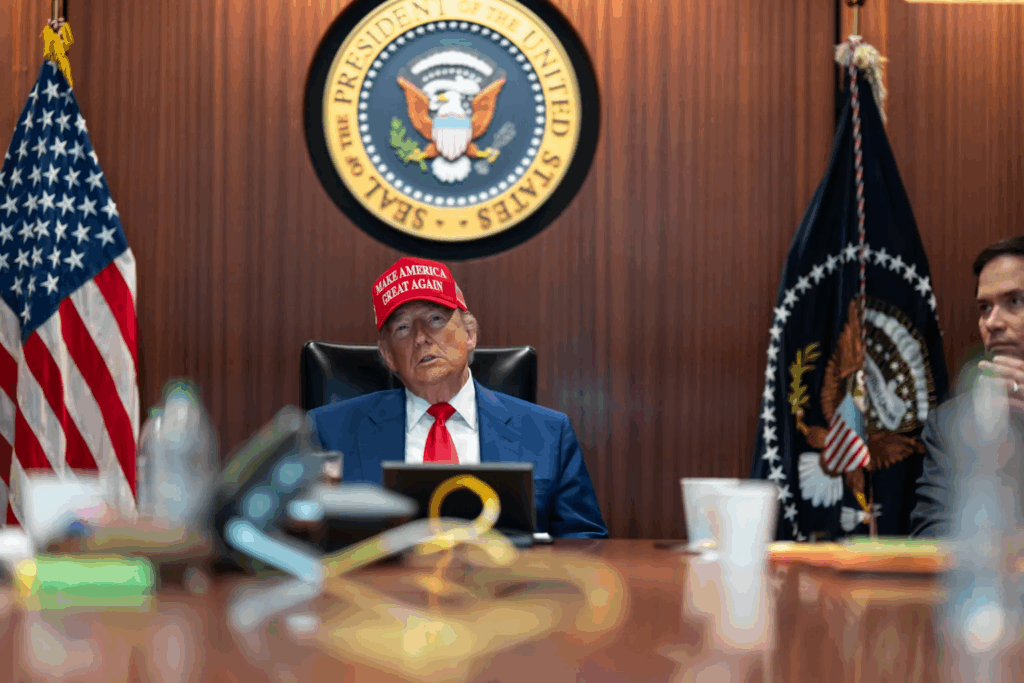
One year and one day: A look back at the 365 days of Trump’s second presidential term
21 January 20:09 РОЗБІР ВІД
Donald Trump’s second presidential term was an event that immediately transcended the usual political cycle. The politician’s return to the White House signified not merely a change in administration, but a return to a course that had previously shattered the established rules of American and global politics. While many viewed Trump’s first term as an exception or a political experiment, his second term finally dispelled these illusions, transforming “Trumpism” into a systemic phenomenon.
From the very first days of the new presidency, the U.S. faced drastic decisions in domestic policy, aggressive foreign rhetoric, and a reevaluation of America’s role in the world. Allies found themselves under pressure, adversaries gained unexpected opportunities, and the United States itself increasingly acted according to the logic of situational advantage rather than long-term principles.
"Komersant Ukrainian" summarized the first year of Donald Trump’s second term and analyzed how his decisions, conflicts, and ambitions are changing not only America but also the global order, the consequences of which the world will feel for many years to come.
Territorial ambitions, voiced as early as the inauguration
Donald Trump’s second presidential term began with high-profile statements about a possible expansion of the United States’ borders. In his inaugural address on January 20, 2025, he announced the beginning of “America’s golden age” and effectively formulated a new foreign policy concept—the so-called “Donro Doctrine.” It was a modern reinterpretation of the Monroe Doctrine and envisioned unchallenged U.S. dominance in the Western Hemisphere.
Trump spoke not only of the country’s abstract greatness: he openly declared his intention to restore American control over the Panama Canal, citing “unfair tariffs” for the U.S. At the same time, the president did not rule out even a military scenario.
From the very first days, it was clear: the Trump administration had no intention of treating existing borders as inviolable when it came to economic gain or “national interests.” This set the general tone for the year, during which territorial claims in an openly imperial, almost “Putin-like” style became one of the key themes of White House policy.
A Row in the Oval Office
One of the most high-profile diplomatic incidents was Donald Trump’s meeting with Ukrainian President Volodymyr Zelenskyy on February 28, 2025. The talks in the Oval Office, which were broadcast live, quickly escalated into a sharp and public conflict. Trump, along with Vice President J.D. Vance, put intense pressure on the Ukrainian leader, insisting on an immediate ceasefire and the start of negotiations with Russia.
The Ukrainian delegation responded just as sharply, which also went beyond established diplomatic norms. The tension was preceded by a statement from Trump, who shortly before the meeting called Zelenskyy a “dictator without elections,” citing the impossibility of holding a vote during wartime.
The consequences of the conflict were swift: the White House immediately froze military and intelligence aid to Ukraine, making a ceasefire a condition for its resumption. Although some support was formally restored after Kyiv agreed to a 30-day ceasefire, the level of trust between the parties had effectively been destroyed. Trump made it unambiguously clear: further support for Ukraine is possible only on the condition of full compliance with his demands.
Global Tariff Confrontation
In April 2025, Trump proclaimed the so-called “America’s Freedom Day.” Behind this name lay a massive tariff campaign that sent shockwaves through the global economy. Invoking the IEEPA, the president imposed a blanket 10% tariff on all imports, as well as additional tariffs against countries with the largest trade imbalances with the U.S.
Even Washington’s traditional allies were hit: for the European Union, the average tariff rate rose to approximately 20%. The decision caused turbulence in financial markets and led to higher prices for goods within the United States itself.
Despite economists’ warnings about inflation and recession, Trump insisted that the tariffs would force foreign corporations to move production to the U.S. and ultimately “make America great again.” Throughout the year, tariffs remained a key tool of political pressure: the president repeatedly threatened Brazil, India, Denmark, France, and other partners with new restrictions, demanding concessions.
Trump effectively set out to dismantle Russia
At the same time, Taras Zagorodniy, managing partner of the National Anti-Crisis Group and a political expert, urges caution in making final assessments of Donald Trump’s second term. According to him, one year of presidency is still too short a period.
“It’s hard to say for sure yet, since only a year has passed. Some things are working out for him, others aren’t. But the overall trends are positive for us,” the expert notes.
Zagorodniy emphasizes that a year ago he predicted that Donald Trump would eventually put pressure on Russia, but the scale of the American president’s actions has exceeded expectations.
“I said that Trump would ultimately defeat Russia. But I didn’t expect him to actually set about its elimination,” he emphasizes.
The expert cites U.S. policy in the oil market as the key factor.
“What he is doing with the oil market is establishing complete control. In this configuration, there is simply no place for a country like Russia. This means the disintegration of Russia, and they have no way out of it,” explains Zagorodniy.
According to him, Trump is acting primarily in the interests of American oil companies and will not be able to stop this process even if he wanted to.
Separately, the expert draws attention to a shift in Europe’s behavior, which, in his view, is a consequence of Trump’s tough policies.
“I didn’t expect them to take Europe so seriously. But Europe is starting to move in the right direction. There, excuse me, they’ve knocked some of the fat off,” says Zagorodniy.
He emphasizes that European countries have finally found the resources to support Ukraine.
“They’ve found the money for Ukraine. They’re starting to move in the right direction to really help Ukraine. This makes Europe more proactive,” the expert adds.
Taras Zagorodniy also believes that the Trump administration is systematically working to dismantle the so-called “axis of evil.”
“Trump is dismantling this military-political bloc that existed: Iran, Russia, Venezuela, and partly China. These are no longer just words, but concrete actions,” he notes.
Ukraine’s Strategic Initiative
In conclusion, the expert emphasizes that current U.S. policy creates new opportunities for Ukraine.
“I believe this is a very positive trend for us. It allows us to say that Ukraine has seized the strategic initiative. The U.S. is not opposed to this,” Zagorodniy emphasizes.
According to him, Ukraine has gained the space to realize its own military potential.
“Ukraine is realizing its military potential directly on the territory of the Russian Federation,” the expert concludes.
Public Break with Elon Musk
One of the most dramatic stories of the year was the collapse of the alliance between Donald Trump and his ally and donor, Elon Musk. After the inauguration, Musk gained unprecedented influence by heading the newly created Department of Government Efficiency (DOGE), designed to cut government spending.
However, by June 2025, the partnership had fallen apart due to disputes over Trump’s key legislative proposal, the “One Big Beautiful Bill.” Musk publicly called the bill “a disgusting abomination” and accused it of leading the U.S. toward financial disaster.
The president’s response was extremely aggressive: Trump mocked the billionaire, claiming he had “gone mad” after the cancellation of electric vehicle subsidies, and threatened to review government contracts with SpaceX and Starlink. He even raised the possibility of deporting Musk, despite his U.S. citizenship.
In response, Musk spoke of creating his own “American Party” and openly hinted at having compromising information on Trump regarding the Epstein case. It wasn’t until the fall that the conflict gradually fizzled out, and both sides began moving toward reconciliation.
Anchorage: Putin’s Symbolic Return
On August 15, 2025, a landmark meeting between Donald Trump and Vladimir Putin took place in Anchorage, Alaska. The Russian president was received with extraordinary honors: a red carpet at the airbase, a flyover by F-22 fighters and B-2 bombers, as well as a joint ride for the leaders in a presidential armored limousine during a closed-door conversation.
Trump demonstrated exceptional affection for Putin, calling him a “wonderful neighbor” and claiming that agreements had allegedly been reached on most issues. However, the summit yielded no practical results: neither peace nor even a ceasefire in Ukraine. Instead, the meeting signaled the U.S.’s willingness to symbolically bring the Russian leader out of international isolation.
This gesture epitomized the Trump administration’s new approach, under which personal sympathies toward authoritarian leaders take precedence over international rules, collective security, and basic common sense.
Operation “Midnight Hammer” and Strikes on Iran
In June 2025, the Middle East once again found itself on the brink of a large-scale conflict. The U.S., in conjunction with Israel, launched Operation Midnight Hammer, delivering massive airstrikes on Iranian nuclear facilities. Trump later claimed on social media that Iran’s nuclear program had been “completely destroyed,” although intelligence data indicated only partial damage.
The escalation was accompanied by Washington’s unconditional support for Israel. In late 2025 and early 2026, Trump also openly addressed the Iranian people, calling for the overthrow of the regime during mass protests and promising support from the U.S. He repeatedly emphasized that American troops were on full combat alert and threatened new, even harsher strikes.
However, as of January 20, 2026, these threats had not gone beyond loud rhetoric.
Venezuela
This Latin American nation has been a key focus of Donald Trump’s foreign policy. Washington has consistently refused to recognize Nicolás Maduro as the legitimate head of Venezuela, accusing his regime of collaborating with international drug cartels and facilitating drug trafficking.
Under the banner of combating drug trafficking, in August 2025 the U.S. launched military operations against Latin American groups transporting cocaine through the Caribbean. Soon, these operations escalated into a large-scale military campaign, in which the United States effectively imposed a naval blockade on Venezuela.
For several months, the U.S. military stopped and detained ships and oil tankers leaving Venezuelan ports. By the end of the year, the conflict had reached its peak: the U.S. carried out a series of airstrikes on targets within the country. In early 2026, the conflict reached its climax—Nicholas Maduro was captured by a U.S. special forces unit directly at his residence and secretly transported to the United States, where a trial is planned.
However, contrary to the expectations of the Venezuelan opposition, Washington’s actions did not lead to the regime’s collapse and likely never intended to do so. Instead, the Trump administration focused on weakening the old ruling elites linked to Maduro. At the same time, the U.S. president made no secret of the true motive behind American activity—Venezuela’s colossal oil reserves remain the key interest.
Canada and Greenland
Although Donald Trump regularly criticized traditional U.S. allies, certain countries came under particularly close scrutiny from the White House. In the spring of 2024, the U.S. president publicly voiced a series of grievances against Canada regarding trade relations, immigration policy, and security issues.
At the same time, Trump and his inner circle actively promoted the idea of Canada potentially joining the U.S. as the “51st state.” This rhetoric gained such momentum that it prompted an official response from Ottawa. Relations between the two countries cooled sharply. Subsequently, the White House backed away from overt territorial claims, but the diplomatic damage was already evident.
Over time, Greenland also came into Trump’s focus, and he began to view it as a potential target for “annexation.” The president justified this stance on the grounds of U.S. national security.
After a brief pause, interest in the island flared up again with renewed vigor as early as the beginning of 2026. Trump resumed public pressure, openly questioning Denmark’s sovereignty over Greenland and threatening European states with trade sanctions should they resist the American course.
Thus, the aggressive territorial rhetoric that the U.S. administration systematically employed throughout the year seriously undermined trust in Washington as a pillar of the international order. American allies are increasingly forced to distance themselves from Trump’s unpredictable policies and seek alternative centers of partnership.
Donald Trump’s first year in office left behind more questions than answers. He demonstrated a willingness to make tough and uncompromising decisions—both in domestic policy and on the international stage—regardless of the stance of partners and allies.
His crackdown on immigration has gradually escalated into an assault on the powers of individual states, which form the foundation of the American federal system.
However, the most striking changes concern the United States’ foreign policy role. The new administration has made it clear that it is willing to engage with authoritarian regimes for short-term gains. At the same time, traditional U.S. allies have faced trade restrictions and baseless territorial claims. This approach undermines Western solidarity and erodes the very principles upon which the Western community was built.
Although Donald Trump has held the presidency for only a year, the scale of his actions and statements already gives reason to assert that the consequences of this presidency will be felt long after it ends. And ahead lie three more years that the United States and the entire world will have to live through in a reality shaped by Trump’s policies.