The Rift Between Kyiv and Warsaw: How a Diplomatic Standoff Is Paving the Way for a Russian “Warsaw in Three Days”
22 June 16:41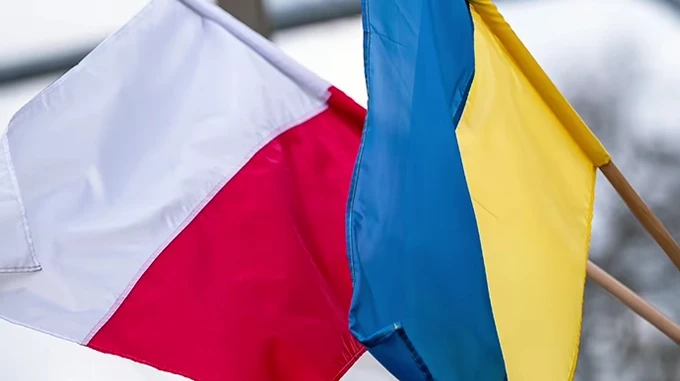 ANALYSIS
The past few days have been marked by an unprecedented diplomatic spat between Kyiv and Warsaw. The exchange of “courtesies” has reached a critical point: the revocation of Volodymyr Zelenskyy’s Order of the White Eagle, followed by the Ukrainian president and the head of the Main Intelligence Directorate, Kyrylo Budanov, demonstratively returning Polish state awards. However, while politicians on both sides trade barbs, Moscow is making no secret of its satisfaction. Russian propaganda is already rubbing its hands in glee. If this continues, instead of a joint defense strategy, we will very soon hear the Kremlin’s new favorite narrative: “Warsaw in three days.” Read more in the article "Komersant Ukrainian".
An Artificial Crisis and Political Adventurism
This scandal is categorically not in the interest of either Ukraine or Poland. This was noted by historian and IDF reserve officer Grigory Tamar in a comment for “Kommersant Ukrainian.” He says the current cooling of relations has no fundamental geopolitical causes—it is entirely artificial.
“This crisis has been provoked by reckless political adventurism on both sides. Your political leadership is also to blame for this. This whole business with Melnik’s reburial, in my personal opinion, was an unnecessary political provocation at this stage. At the same time, there are quite a few political forces in Poland that are trying to capitalize on this conflict,” Tamar notes.
The issue of the withdrawal and return of awards is a trivial matter that is out of place during a major war. The Polish side’s move was foolish, and Tamar describes the reaction of Ukrainian high-ranking officials—in particular, Kirill Budanov—as an understandable gesture of solidarity by an officer with his President. However, on a broader scale, these insults only play into the hands of the common enemy.
What They’re Saying in Russia: A Propaganda Triumph and Medvedev’s Reaction
For the Russian regime, the diplomatic crisis between Kyiv and Warsaw was a real gift—one they hadn’t even dared to hope for. Federal TV channels, propaganda Telegram channels, and top Russian officials immediately seized on this news hook, hyping it up as “proof of the inevitable collapse of Ukraine’s coalition of allies.”
The chief mouthpiece of Kremlin absurdity, Deputy Chairman of the Russian Security Council Dmitry Medvedev, promptly reacted to Polish President Karol Nawrocki’s decision to revoke the Order of the White Eagle from Volodymyr Zelenskyy, as well as to subsequent refusals by Ukrainian officials (notably Kyrylo Budanov and Andriy Sybiga) to accept Polish awards.
Dmitry Medvedev, Deputy Chairman of the Russian Security Council, in his usual crude manner, praised the Polish president for revoking Volodymyr Zelenskyy’s order. He cynically quipped that now there was room on the Ukrainian leader’s “green uniform” for Hitler’s Nazi awards, and he called the very act of Ukrainian officials—who demonstratively returned Poland’s orders—a “direct admission of 100% Nazism.”
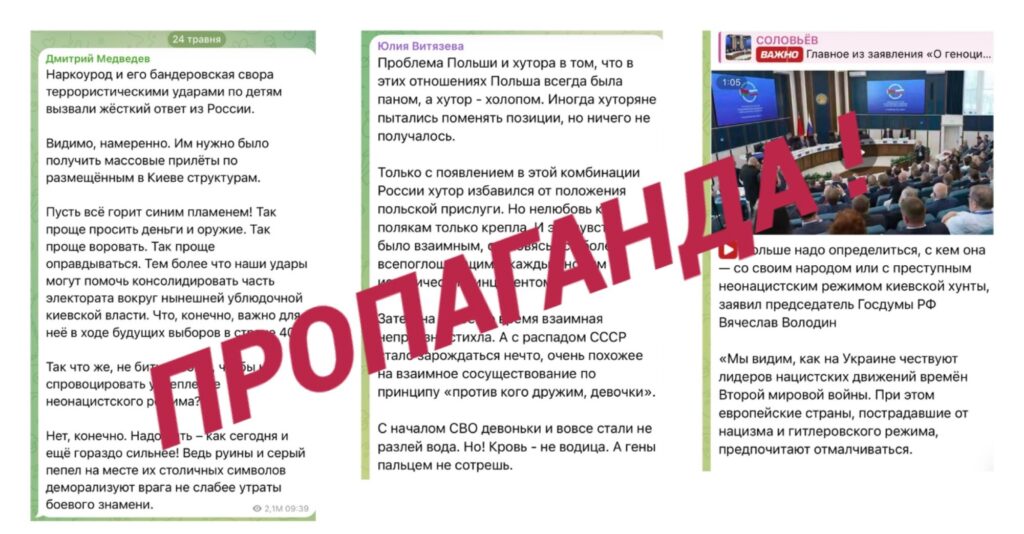
Propagandist Yulia Vityazeva, in her trademark condescending style, attempted to reduce the complex geopolitical relations between two sovereign states to banal insults and primitive chauvinism. She traditionally refers to Ukraine as a “backwater” and considers the alliance with Poland to be a situational one based on the principle of “whoever we’re against, girls.” Vityazeva blatantly manipulates history, attempting to prove that Ukrainians and Poles are “genetically incompatible” in an equal partnership.
Vyacheslav Volodin, the speaker of the Russian State Duma, did not remain on the sidelines either. He decided to play the role of “defender of Polish memory” and issued an ultimatum to Warsaw, exploiting the sensitive topics of historical reburials and the Volhynia tragedy. Volodin openly calls on Poland to betray Ukraine and break off the coalition.
Watch us on YouTube: important topics – without censorship
Is Poland ready to go to war, and how much time does Putin need?
Amid the media scandal, poll data began to emerge showing that only 15% of Poles are ready to defend their country with arms in hand, and that the public does not know where to find bomb shelters. A new report from the IBRiS think tank has documented significant shifts in the mood of Polish society—and they are clearly not for the better. From 2023 to 2026, indicators of citizens’ readiness to defend the state have fallen by half.
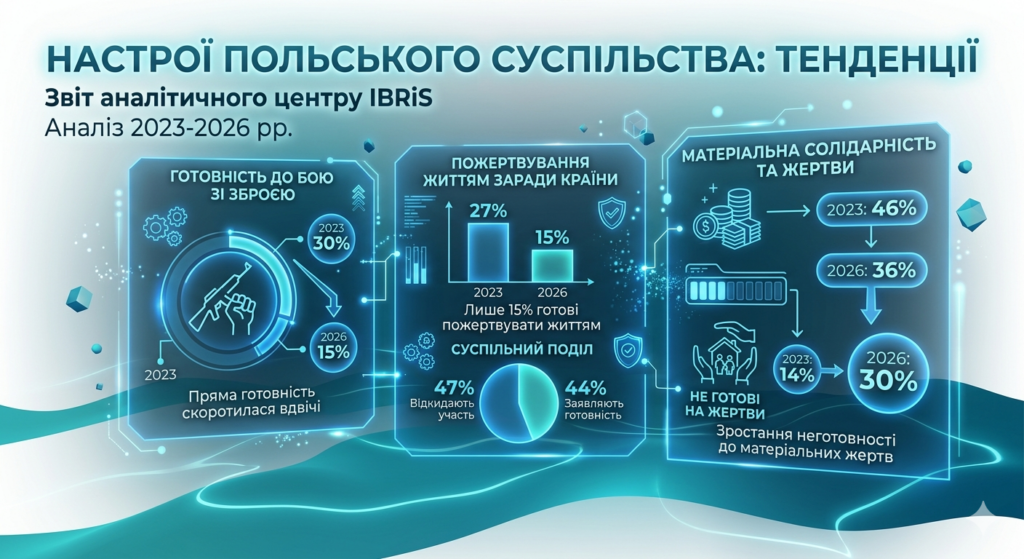
This raises an alarming question: if the war in Ukraine ends, how long would it take Putin to reach Warsaw? Grigory Tamar urges people not to underestimate Poland’s defense capabilities due to temporary internal fluctuations. He notes that Poland is the world’s 20th-largest economy, which has been investing enormous material resources in military development over the past three years.
“As for Poland’s readiness for war, over the past three years Poland has been making significant efforts to rebuild, establish, and restore its armed forces. And it is one of the few countries in Europe that is building—or frantically trying to build—a combat-ready army,” says Tamar
However, the expert emphasizes that in today’s reality, the security of Poland and Ukraine is intertwined, and the notion of “going it alone” without cooperation is flawed. On the contrary, he stresses:
“As of today… you [Ukraine] need Poland more than Poland needs you. But you also need Poland,” says Tamar
Therefore, to minimize risks and survive, Grigory Tamar calls for setting aside political differences and immediately launching a direct professional dialogue between security experts from Ukraine and Poland, as the historical commonality of both countries’ goals is evident.
Read us on Telegram: important topics – without censorship