
The business landscape in Ukraine has changed: where are companies opening up the most?
24 April 14:29
In the first quarter of 2026, Ukrainian businesses continued to adapt to the war, security risks, and changes in the economic structure. New companies were most often established in major business centers and relatively safe regions where infrastructure, financing, and sales markets are available. This was reported by "Komersant Ukrainian", citing data from the YC.Market analytics system.
Which regions led in new company registrations
The largest number of new companies in January–March 2026 was registered in Kyiv—2,600. The capital traditionally retained its status as the country’s main business center.
Lviv Oblast took second place, with 674 new companies established, while Dnipropetrovsk Oblast came in third with 647 new registrations.
The top five also included Kyiv Oblast—526—and Odesa Oblast—397 new companies.
The study shows that the composition of the leading regions has not changed compared to the first quarter of 2025. Moreover, almost all of these regions increased the number of new registrations.
Kyiv grew from 2,242 to 2,600, Lviv Oblast from 576 to 674, Dnipropetrovsk Oblast from 539 to 647, and Kyiv Oblast from 466 to 526.
The only exception was Odesa Oblast, where the number of new companies decreased from 447 to 397, although this did not prevent it from remaining in the top 5.
Analysts attribute the leadership of these regions to entirely logical reasons.
“Kyiv traditionally concentrates the largest share of business activity, capital, service infrastructure, and corporate headquarters; Lviv Oblast remains one of the key business hubs in the western part of the country, where businesses have relocated and continue to gravitate; Dnipropetrovsk Oblast remains in the top ranks thanks to its large market and strong industrial and commercial base; Kyiv Oblast benefits from its proximity to the capital, the development of logistics, warehouses, manufacturing, and suburbs; Odesa Oblast, meanwhile, maintains its high position thanks to its large regional center, trade, logistics, and entrepreneurial activity in the southern region,” the study states.
Read us on Telegram: important topics – without censorship
Where the fewest new companies are opening
The lowest activity in the first quarter of 2026 was recorded in regions closest to the hostilities or the border with Russia. The fewest new companies were registered in:
- Luhansk Oblast — 7
- Donetsk Oblast — 13
- Kherson Oblast — 29
- Sumy Oblast — 54
- Chernihiv Oblast — 71.
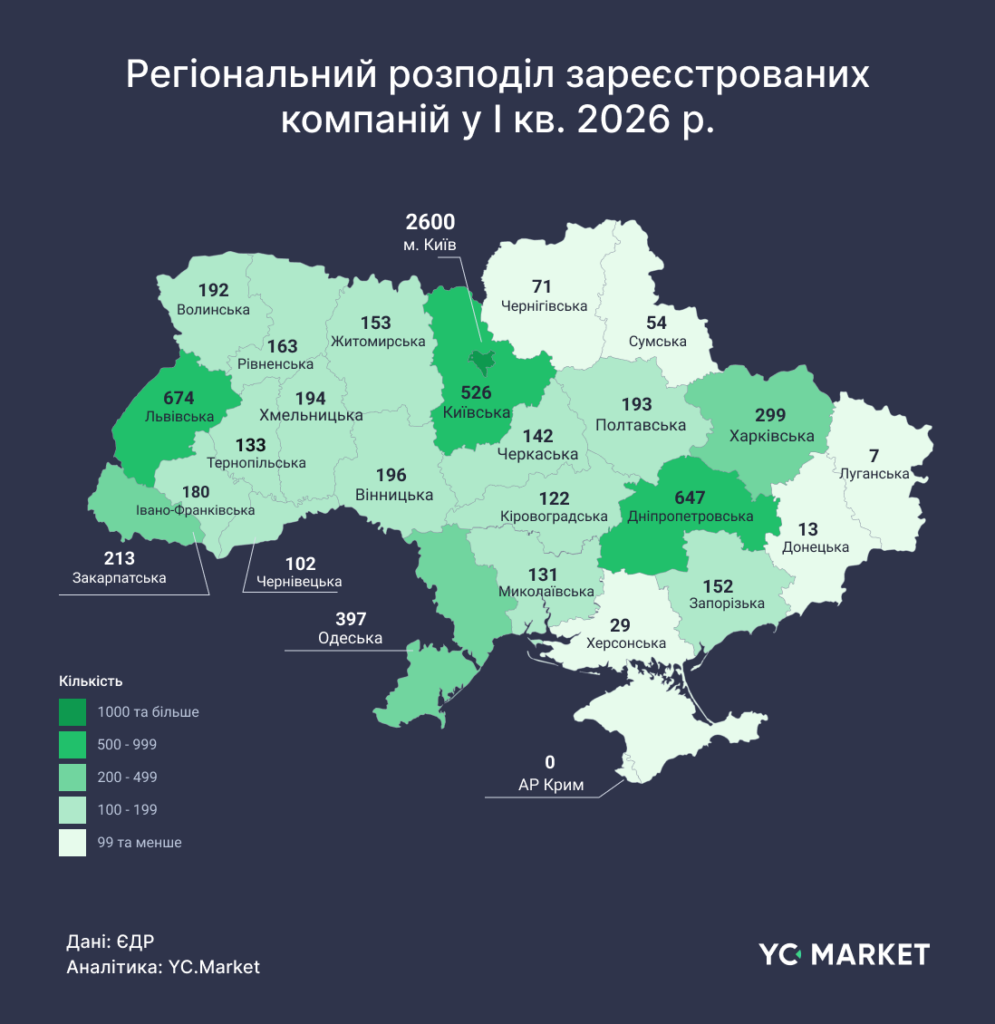
The study explicitly states that the reasons for the weak dynamics include security risks, proximity to the front lines, the threat of shelling, the occupation of parts of the territory, and general uncertainty for investors and entrepreneurs.
For the Sumy and Chernihiv regions, border risks remain a separate constraining factor.
Which sectors became drivers of new business
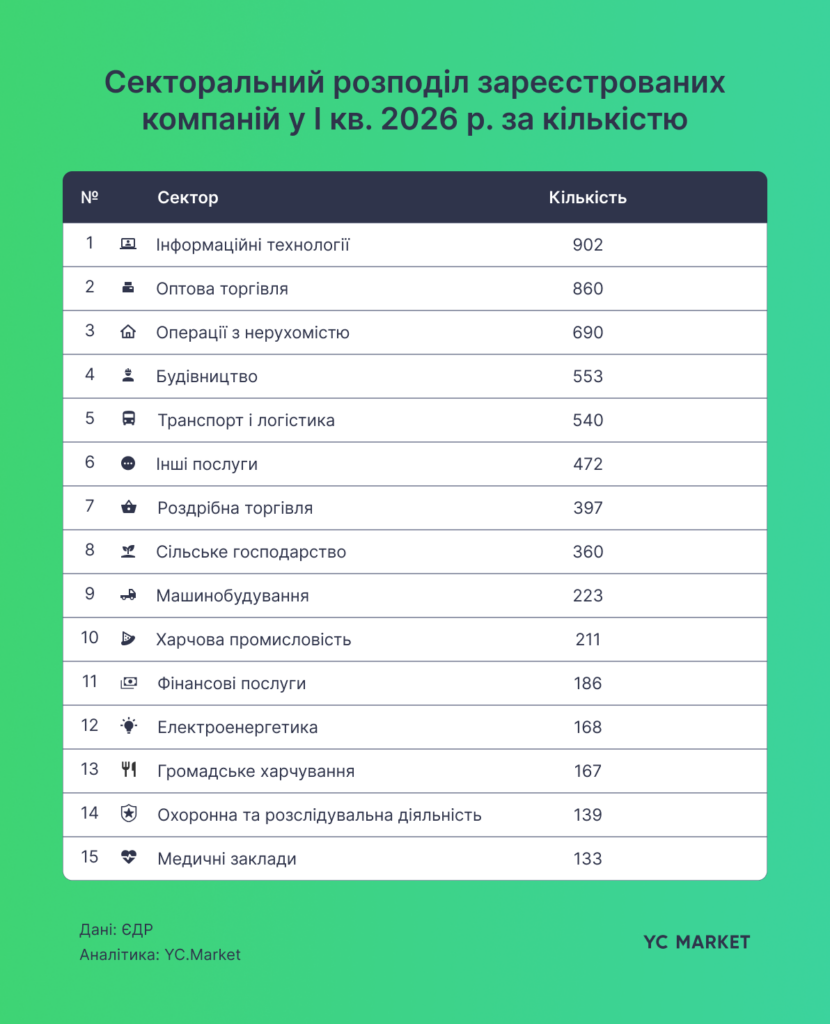
The largest number of new companies in the first quarter of 2026 were established in the information technology sector—902 companies, which is 89% more than a year earlier. YC.Market identified IT as the main driver of today’s business environment.
Wholesale trade took second place—860 new companies, although a decline of nearly 6% was recorded here.
Third place went to the real estate sector—690 companies, with growth reaching 24%.
Next were construction—553 companies—and transportation and logistics—540, though both sectors saw a slight decline.
At the same time, other services grew quite significantly—to 472 companies (47%)—and retail trade—to 397 (26%).
Among sectors with moderate registration volumes, agriculture (360) stands out, having recorded the largest decline among major sectors—-24%.
In contrast, mechanical engineering (223) showed moderate growth of just over 6%, while the food industry (211) declined by 8%.
Sectors where the number of new company registrations is still low but growth rates are very high deserve special attention.
Specifically, financial services grew to 186 companies (79%), electric power to 168 (17%), and medical facilities to 133 (19%).
Security and investigative services showed the highest relative growth: 139 new company registrations, which is 190% more than last year.
The food service sector remained virtually unchanged—167 companies and only 0.6% year-over-year.
At the same time, the study specifically highlights the revival of the real estate sector, where the growth in new companies reached 243% compared to the same period last year. This may indicate either increased investment or speculative market expectations.
Watch us on YouTube: important topics – without censorship
Where the Most Companies Are Closing
Kyiv emerged as the leader in the study not only in terms of new registrations but also in the number of business closures.
In the first quarter of 2026, the highest number of company closures was recorded in:
- Kyiv — 89
- Lviv Oblast — 65
- Zaporizhzhia Oblast — 53
- Odesa Oblast — 43
- Khmelnytskyi Oblast — 41.
Analysts emphasize that high rates of business closures in major economic centers do not necessarily indicate a worsening situation. Often, this is a sign of a vibrant market, where more new companies are being registered at the same time and more businesses are ceasing operations.
At the same time, the presence of Zaporizhzhia Oblast on this list may also indicate additional pressure from security factors.
Sectors with the highest number of business closures
The highest number of business closures was recorded in the wholesale trade sector—69 companies—though this is 30% less than in the first quarter of 2025.
Next are real estate transactions—55 suspended companies, corresponding to zero year-over-year growth—and construction—52 companies, where, conversely, a 58% increase was recorded.
Among sectors with a significant number of closures, agriculture (44) stands out, unchanged from last year, and transportation and logistics (42), where the number of closed companies jumped by 147%.
The food industry also showed growth—to 40 companies (21%), and healthcare facilities—to 37 (48%).
At the same time, the other services sector had 37 companies that ceased operations, which is 5.13% fewer than last year.
Declines were also seen in retail trade—29 companies (-27%), information technology—17 (-19%), scientific research—14 (-18%), and the woodworking industry—12 (-8%).
In light industry, the number of dissolved companies reached 14 (100%), in tourism—12 (100%), and in manufacturing—13.
Overall, the sectoral breakdown of companies that ceased operations in the first quarter of 2026 presents a mixed picture: in major sectors such as wholesale and retail trade, as well as IT, the number of closures decreased, while in construction, transportation and logistics, healthcare, manufacturing, and light industry, it increased significantly compared to the same period last year.
What the map of new businesses in Ukraine shows
YC.Market’s research confirms that new businesses in Ukraine in 2026 most often emerge where security, infrastructure, a large market, and the ability to launch quickly converge.
That is why Kyiv, major regional centers, and regions with robust logistics remain the leaders. In contrast, frontline regions remain in a zone of depressed business activity.
Separately, the study also highlights the transformation of the economy itself: IT, services, real estate, the financial sector, and retail are becoming the main drivers, while the agricultural sector, construction, and parts of manufacturing are under greater pressure.
Read us on Telegram: important topics – without censorship












