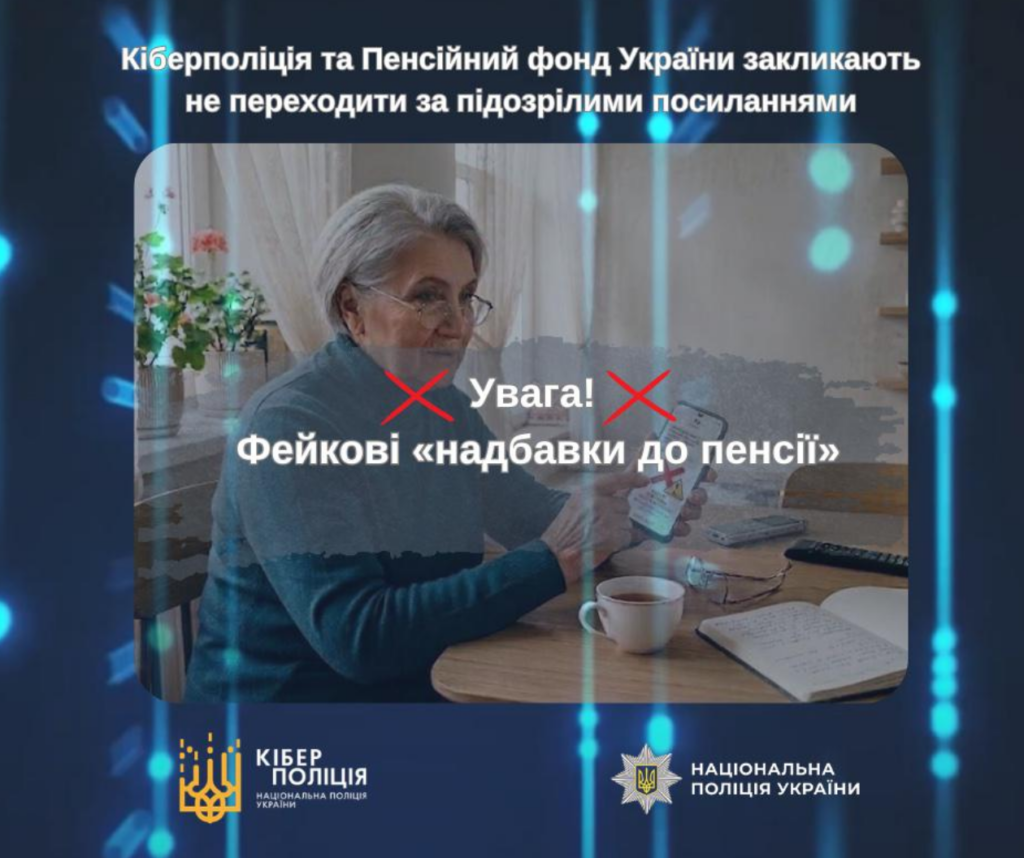
Scammers have come up with a new pension scam: how to avoid losing your money and personal information
26 May 05:46
Fraudsters have become more active in Ukraine, using the topics of pensions, government benefits, and alleged new cash payments as a cover. Ukrainians are being warned about fake messages in which scammers promise pensioners additional assistance but are actually trying to steal their personal and banking information.
The Cyber Police of Ukraine reported on this new wave of fraudulent activity, according to "Komersant Ukrainian"
According to law enforcement, scammers are disguising their messages as official communications from the Pension Fund of Ukraine, using the institution’s name, logo, and similar visual style.
Ukrainians are promised “assistance” ranging from 3,200 to 5,300 hryvnias
Recently, messages have begun circulating online about alleged new financial assistance for pensioners. In the fake announcements, scammers claim that Ukrainians can receive between 3,200 and 5,300 hryvnias.
The amount of this “payment,” according to the scammers, supposedly depends on the region of residence and length of service. To receive the money, people are asked to click a button, follow a link, and “confirm” their region of residence.
A particular danger lies in the fact that scammers actively use psychological pressure. Messages often include phrases like “limited application time,” “urgent confirmation,” or “last chance to receive the payment.”
This is exactly how scammers try to force people to act quickly without verifying the information on official sources.
Scammers also invent “mandatory identification” for pensioners
According to the Cyber Police, criminals may use another scheme as well. Under the guise of supposedly mandatory identification of pensioners, they send links for “urgent identity verification.”
Such messages may claim that without completing the identification process, a person risks losing their pension or not receiving future payments.
The Pension Fund of Ukraine emphasizes: such information is false. Official government agencies do not send suspicious links via messaging apps and do not require you to enter banking details on unknown websites.
What is the danger of such messages
The cyber police warn that such messages exhibit signs of phishing. This is one of the most common forms of online fraud, where attackers create fake websites or forms that resemble official resources.
The goal of these schemes is to trick people into:
- click on a phishing link;
- enter personal information;
- disclose banking information;
- log in to a fake website;
- grant access to an account or financial services.
Most often, scammers exploit topics that evoke strong emotions in people: pensions, social benefits, government assistance, compensation, subsidies, and allowances.
Elderly people, who may trust messages bearing government symbols or struggle to distinguish a genuine website from a fake one, are particularly vulnerable to such schemes.
How to spot a scam
Fake messages about “payments” and “pension supplements” often have several telltale signs.
First and foremost, scammers promise quick access to money without an official application to a government agency. They may also use catchy phrases like “get your assistance today,” “only a few hours left,” or “verify your identity to avoid losing your pension.”
Another red flag is links to unknown websites. Even if the page looks similar to the Pension Fund’s website or another government agency’s site, you should carefully check the URL.
If a website asks you to enter your bank card number, CVV code, passwords, SMS codes, or online banking login credentials—it’s almost certainly a scam.
How to avoid becoming a victim of scammers
To avoid losing money and sharing personal information with scammers, Ukrainians are advised to be cautious about any messages regarding “urgent payments.”
Information about pensions, supplements, social benefits, or government assistance should only be verified on official government websites. Do not open suspicious links received via messaging apps, social media, or from unknown individuals.
Also, do not enter banking details on questionable websites. No official institution asks citizens to provide their CVV code, online banking passwords, or SMS verification codes.
If a message raises doubts, it is better not to click the link, but to visit the official website of the Pension Fund of Ukraine yourself or contact the institution through verified communication channels.
What to do if you receive a suspicious message
If you receive a message about alleged financial assistance, a pension supplement, or the need for urgent verification, do not rush to follow the instructions.
You should verify the source of the information, do not open the link, and do not enter any personal data. If suspicious resources or messages are detected, citizens are urged to report them to the Cyber Police.
Law enforcement officials emphasize: scammers are constantly changing their schemes, but their main goal remains the same—to gain access to citizens’ money, documents, or accounts.
Therefore, any messages about “easy money,” “new payments,” or “urgent pension supplements” should be viewed with skepticism and verified only through official sources.