“A ‘holy’ volunteer” or “an agent of Bankova”: why there are diametrically opposed views on the Berlin scandal
26 April 18:07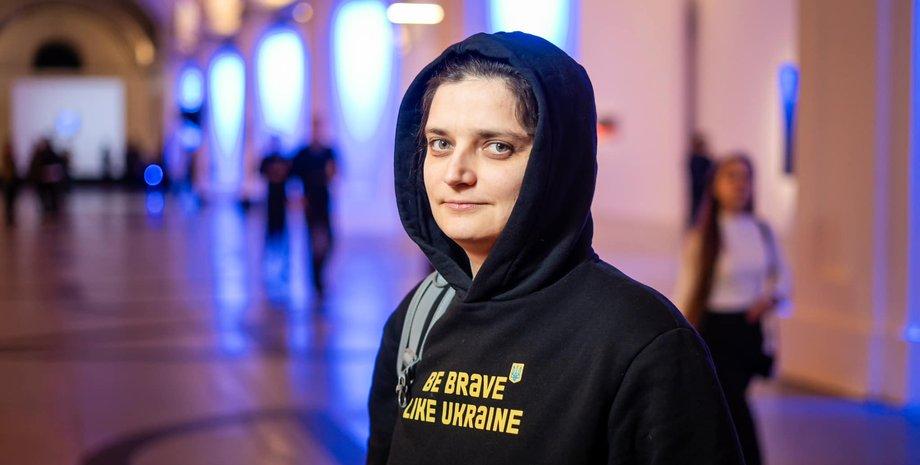 ANALYSIS FROM
A new media scandal has erupted surrounding the joint investigation by NABU and the SAPO into the “Midas” case. Former prosecutor Stanislav Bronevitsky has released transcripts of alleged conversations between businessman Timur Mindich and former officials of the Ministry of Defense. The materials mention a person named “Masha,” who allegedly received funds from the budget for lobbying interests in the field of defense procurement. The accusations against Maria Berlinska, director of the Aerial Reconnaissance Support Center, sparked a heated debate in political and military circles. Former officials of the Presidential Administration, members of parliament, and active-duty military personnel have joined the discussion.
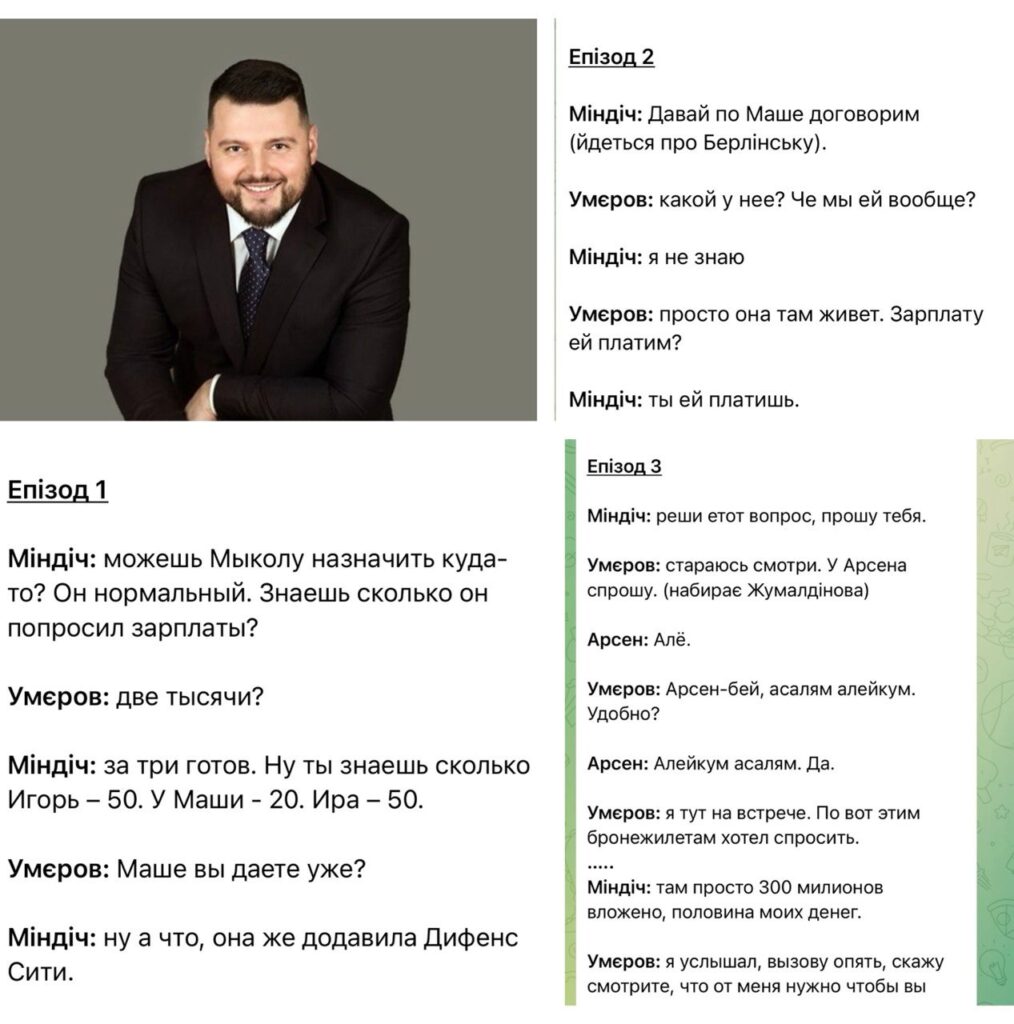
Stanislav Bronevitsky, a former prosecutor with the Specialized Anti-Corruption Prosecutor’s Office (SAPO), has released new transcripts that may relate to the high-profile “Midas” case. According to him, the materials obtained from sources within law enforcement agencies contain dialogues between businessman Timur Mindich, then-Defense Minister Rustem Umerov, and the head of the Defense Procurement Agency, Arsen Zhumadilov.
What do the conversations cover?
According to the published data, the conversations date back to early July 2025. The key topics of the new episodes are financial dealings with volunteer Maria Berlinska and lobbying for interests in the procurement of body armor. The following dialogue emerges from the text of the published transcripts:
“Let’s make a deal about Masha… you’ll pay her.” Umerov: “I don’t know… she just lives there. Are we paying her a salary?” Mindich: “You’ll pay her,” – Mindich.
The materials indicate that “Masha” allegedly receives “20” (the currency and exact amount are not specified, but it is assumed that this refers to thousands of dollars). At the same time, Mindich asks Umerov to hire another person— “Nikolai”—who, compared to the aforementioned sums, “will ask for only three.”
Watch us on YouTube: important topics – without censorship
As a reminder, “Operation Midas” is a joint investigation by NABU and SAPO concerning possible corruption and abuse of influence in the defense and energy sectors. Earlier, Maria Berlinska had already refuted similar allegations, calling them an “information attack” and emphasizing the absence of published original audio recordings. She also stressed that she had always taken a critical stance toward the officials in question.
What does Berlinska say?
Volunteer and director of the Aerial Reconnaissance Support Center Maria Berlinska has claimed that a coordinated information attack has been launched against her. The trigger was the online publication of text “transcripts” of audio recordings in the “Midas” case, where her name is allegedly mentioned in the context of cooperation with businessman Timur Mindich and former Defense Minister Rustem Umerov. Berlinska called these accusations absurd, reiterating her public stance.
“Some trash is spreading a very comical story: that Umerov personally paid Berlin, along with Mindich… The whole country knows my attitude toward Umerov; it’s easy to Google. In a nutshell—I harshly criticized and demanded the resignation of this minister… I personally demanded justice for the Mindichgate suspects from the very beginning and personally defended the anti-corruption agencies at protests,” says Berlinska.
Berlinska also questioned the authenticity of these materials. She argues that the tapes themselves are nowhere to be found.
“If they exist—where can I listen to the actual recordings instead of looking at photoshopped images? That’s right, nowhere… Stanislav Bronevitsky—I’m waiting for at least some evidence from you that your images are actually about me. Not your fantasies, but facts. I guarantee you won’t provide them. I propose we make a bet on Mavic!) If these tapes actually exist—I’m eagerly awaiting a release from NABU and SAPO—please publish the materials,” says Berlinska.
The volunteer also pointed out inaccuracies: in the recordings, she is referred to as an “anti-corruption activist” and “Masha,” although she does not engage in anti-corruption work professionally and does not use that form of her name.
According to Berlinska, her name was woven into the scandal to discredit future real revelations in the “Midas” case, which may involve high-ranking officials.
Who supported Berlin and who criticized her?
The media storm surrounding the released “Mindich tapes” and the accusations against Maria Berlinska, director of the Aerial Reconnaissance Support Center, has caused a rift in society. While some accuse the veteran of working for the Office of the President and having corrupt ties, others call this a large-scale disinformation campaign aimed at destroying the volunteer movement. We have compiled the key lines of argument that have divided the media landscape into two irreconcilable camps.
The most radical accusations came from former Head of the Presidential Administration Andriy Bohdan. He directly linked Berlinska’s loyalty to the authorities with the tragedy in Chernihiv:
“Maria Berlinska agreed to an agent agreement with the SBU to avoid responsibility for directing enemy shelling in Chernihiv… She became a mouthpiece for the authorities for three biblical silver coins,” Bogdan writes.
MP Mariana Bezuhla also expressed doubt about the volunteer’s independence, calling her “a puppet” and accusing her of conformism.
“The fact that she has long been loyal to certain factions of the Opposition Platform is a fact. Perhaps someone is pulling her strings. Perhaps it’s her own political ambitions. But nothing justifies her role as a cover-up for the real state of affairs,” Bezuhla writes.
The most emotional post came from Yuriy Kasyanov, a military serviceman and UAV designer, who called Berlinska his personal enemy. He accused her of incompetence and involvement in the disbandment of his unit, which had attacked Moscow.
“The leak from the NABU tapes sounds very much like the truth. Because you are a person of the Office… You are not a queen, you are a pawn. I am sure that you are just as much a part of the looters’ team… on the payroll,” writes Kasyanov
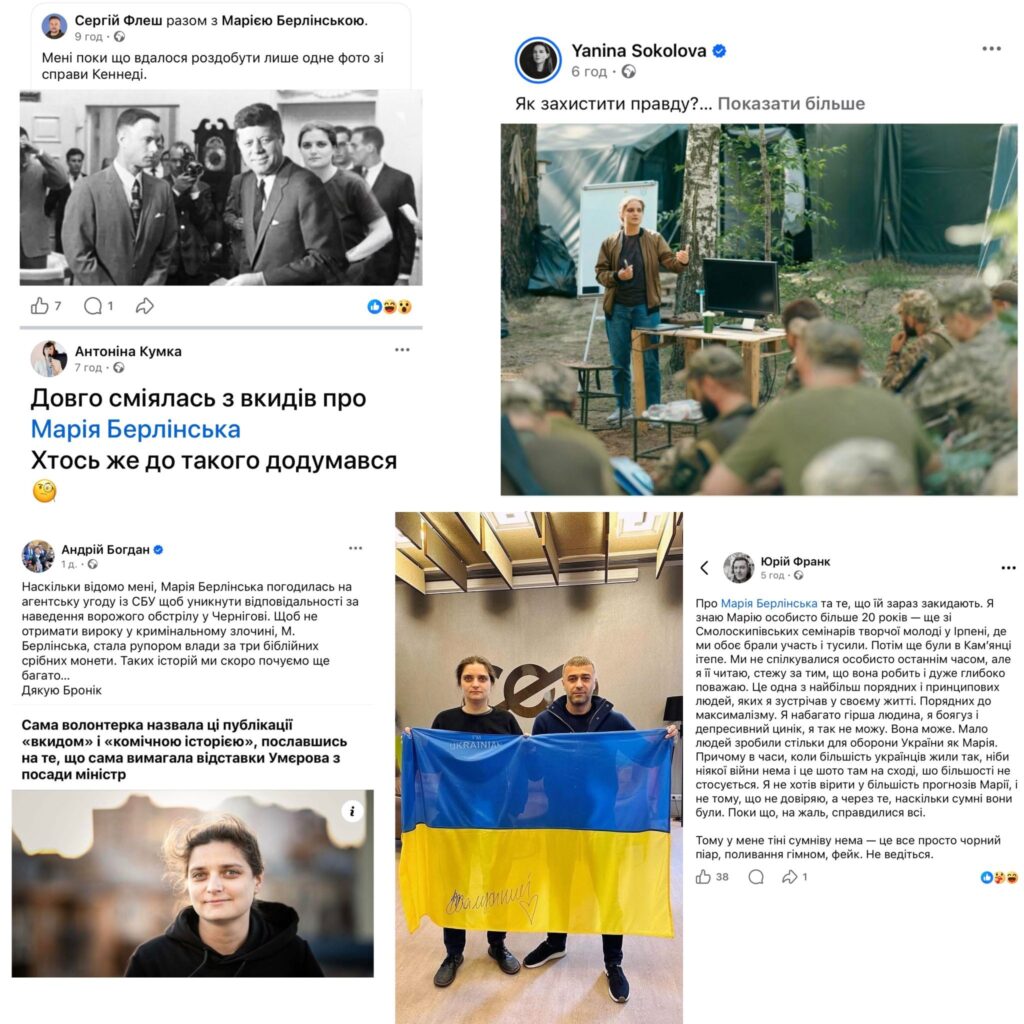
A group of businesspeople, journalists, and military officials came to Berlinska’s defense, emphasizing her long-standing contribution to technological development. CEO Club founder Serhiy Haidaichuk urged people to look at results rather than rumors.
“There are people who comment on the war. And there are those who change the course of events. Maria is among the latter… The more you do, the more mud they throw at you,” – Serhiy Haidaichuk.
Journalist Yanina Sokolova and Smoloskyp founder Yuriy Franak emphasize the manipulative nature of the accusations, in which Berlinska’s last name isn’t even mentioned.
“To clarify: Berlinska’s last name wasn’t there at all. There was only the word ‘Masha.’ That’s it. Did this concern the former SAPO prosecutor or the former head of the Presidential Office?.. Quick, superficial thinking killed the analysis,” notes Sokolova.
Military officer Ihor Lutsenko chose an original way to refute the volunteer’s “wealth.” He recounted that as recently as last winter, Berlinska was riding the subway, and she borrowed 17,000 hryvnias from him to repair her old car (in which rats had made a nest):
“She literally just recently paid me back. Until recently, she was just riding the subway,” notes Lutsenko.
Military blogger Oleksiy Petrov and veteran Serhiy Poznyak are certain: the attack on Maria is an attempt by the enemy or political opponents to “take out” the most effective players in the defense effort.
“The Berlin case is telling. Mud is often slung by people hiding from the war. The goal is to knock out key players in the volunteer and military movements,” Poznyak writes.
Defense Minister Advisor Serhiy Flesh urged people to wait for official evidence before branding someone:
“If there is evidence regarding this entire story, she will be held accountable to all of us… Until there is confirmation, one cannot accuse a person of anything,” wrote Serhiy Beskresnov.
Thus, society once again finds itself at a crossroads: to believe in the “conspiracy theory” about bribed opinion leaders or to defend the institution of volunteering from potential discredit. One thing is clear—law enforcement agencies must put an end to this story by releasing the original sources of the recordings.
The Price of Internal Discord
In recent weeks, the Ukrainian information landscape has resembled a battlefield. High-profile scandals, mutual accusations, and the search for “internal enemies” among volunteers, military personnel, and politicians are increasingly causing deep divisions. However, the history and experience of countries that have been fighting for survival for decades show that internal strife is the surest path to defeat.
IDF Reserve Officer Grigory Tamar in a comment
“On October 7, we had very serious political problems within the country. But the people united and stood as a united front against external enemies. We in Israel know how to distinguish between internal political strife and the need for consolidation in the face of an external threat,” Tamar noted.
According to the officer, Ukrainians and Israelis are similar in many ways—both nations are spirited, have a sharp sense of humor, and have endured many trials. But it is precisely the ability to “set aside” emotions and pool resources at a critical moment that is the key to survival.
“Constant internal debates are a normal trait of southern peoples who have endured many trials over the past centuries. However, the key to our success lies in uniting our efforts against common external enemies,” says Tamar.
So, emotions are a natural reaction to war, but when it comes to national security, they become the enemy’s ally. Division within society is exactly what the aggressor is counting on. Every hour spent on internal strife is an hour stolen from our preparations to repel an external enemy. This means that criticism must be constructive, accusations must be proven in court, and reactions must be measured.
Read us on Telegram: important topics – without censorship