No TikTok During Recess: Will Schoolchildren Really Have Their Phones Confiscated?
14 April 15:01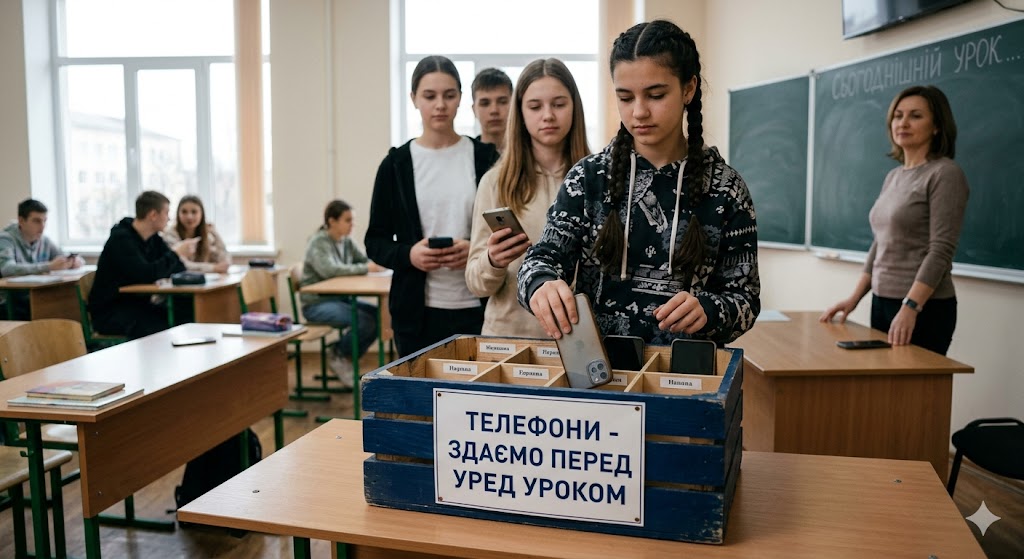 ANALYSIS FROM
Social media has been abuzz with news of a possible ban on the use of smartphones and tablets in schools. Bill No. 10153 has become a real “digital flashpoint” in parent chat groups and among educators. Opinions are divided. Some speak of a return to “Soviet” methods of control, while others see it as an attempt to save the cognitive abilities of a generation and a necessary step.
First and foremost, Mykola Gunko, a human rights activist and assistant-advisor to MP Georgiy Mazurashu —who was directly involved in developing the initiative—stated in an exclusive comment
Smartphones—for safety, not for TikTok
The developers’ main message: no one is going to take away children’s personal property. Mykola Gunko emphasizes that, in wartime, communication with parents is critically important.
“There are many comments on social media claiming that someone is supposed to collect phones and put them in some kind of boxes. That’s not true; there’s nothing like that in the bill. A phone, especially during wartime, should be with the child,” notes human rights activist Gunko.
The main goal of the changes is not to combat technology itself, but rather the misuse of devices. This refers to browsing social media, playing games, and watching entertainment content, which distracts students from their studies.
The issue of using e-readers and tablets as educational tools raised particular concern. Mykola Gunko reassures us: any gadgets that aid in the educational process remain permissible.
- E-books: No restrictions. If a child is reading a textbook or a work of fiction as part of the curriculum, it is considered part of the learning process.
- Educational needs: Using smartphones to search for information during class (at the teacher’s instruction) or to complete assignments is permitted.
- Medical needs: Devices necessary for monitoring health remain freely accessible.

Teacher Authority and the Problem of “Digital Habits”
According to Mykola Gunko, the bill is the first step toward restoring the teacher’s authority and bringing focus back to the classroom.
“A child cannot do two things at once: absorb the material and scroll through social media. If they’re on their phone, they simply aren’t taking in what the teacher is saying. This is a matter of respect—both for the teacher and for oneself,” comments Gunko.
He also highlights a deeper social problem—“digital addiction”—which is becoming a destructive habit for many students. The legislative initiative should send a clear signal: school is a place for acquiring knowledge.
What’s next: Sanctions or self-regulation?
Currently, the bill establishes the state’s position on gadget use. However, the human rights advocate acknowledges that the enforcement mechanism still needs refinement.
- Stage 1: Official recognition that the educational process must take place without distraction from social media.
- Stage 2: Possible introduction of sanctions for violating these rules.
“We are already thinking about how to implement this in practice. Perhaps it would be worth specifying certain sanctions for distractions caused by games or TikTok. But that will be the next step, as it requires amendments to other laws, in particular the Code of Administrative Offenses,” says Gunko
So, the bill is not “repressive.” It is an attempt to draw a line between a child’s personal entertainment space and their responsibilities as a student. The main goal is to ensure that gadgets in school serve as tools for education, not obstacles to it.
Is there support for the bill in the Verkhovna Rada?
The Verkhovna Rada is urging against imposing a strict ban on gadgets in schools. In particular, the “Servant of the People” party emphasizes the role of schools and parents in setting rules and the importance of children’s safety during wartime.
“I don’t think there is currently a need to ban the use of gadgets in educational institutions at the legislative level, since every school board has the ability to make decisions independently, with the involvement of parents, regarding children’s use of gadgets at school. At the same time, I am convinced that we must foster a culture of gadget use and, more broadly, a culture of how children behave in the digital environment,” said Yulia Grishina.
Incidentally, the idea of restricting smartphones in schools is not new: as far back as 2020, parliament proposed banning their use during classes to improve students’ concentration and reduce the influence of social media. The proposal was submitted by Oleksiy Honcharenko, a member of parliament from the “European Solidarity” party. In his view, this should help children focus in class, learn to communicate with one another, and reduce the number of cyberbullying incidents.
What do educators say?
Ihor Likarchuk, former director of the Ukrainian Center for Educational Quality Assessment, believes that the fight against cell phones is a “lost battle” that merely masks the school’s inability to engage modern children.
“The discussionis lively, with references to Europe… It sounds convincing. Almost scientific. But almost no one thinks about the fact that during every lesson, almost all teachers also have a cell phone on their desk. So, perhaps, let’s set an example: let’s collect all the teachers’ cell phones into one box, and return them at the end of the workday? We must lead by example,” – Ihor Likarchuk.
Lykarchuk emphasizes that a ban is the path of least resistance, allowing teachers to avoid asking themselves uncomfortable questions about the content of education.
“By saying ‘don’t let them play,’ you’re admitting one thing: the school has lost the battle for the child’s attention. Instead of changing the nature of the educational process, revising teaching methods, or using the phone as a tool, the suggestion is simply to take it away. Because that’s easier,” says Likarchuk.
Olga Ragulina , head of the school library in the village of Huty in the Kharkiv region, views the situation from the perspective of resource availability and the psychology of information perception. In a comment
“I believe that banning gadgets in class will have a positive impact on the library’s work. Students’ attention will be focused on the lesson topic. Our library provides 100% of the textbooks for the children. Paper textbooks are always used more actively in our lyceum than electronic ones, although interest in the latter is growing slowly,” says Olga Ragulina.
Therefore, the school library director welcomes the potential approval of the bill, seeing it as a mechanism for a return to deep reading.
“Interest in paper publications will always be high because books have illustrations and their own charm. E-books lack the weight and value of a physical object. We are prepared for an increase in demand for textbooks and welcome this situation. It is important that children know how to use both print and electronic sources as complementary tools, without favoring just one,” concludes Olga Ragulina.

At the same time, activist and educator Iryna Levandovska raises the issue of legal ethics and psychological pressure on students, comparing the forced confiscation of phones to Soviet-era control methods.
“This reminds me very much of how my mom was forced to take off her earrings and give them to the teacher at a Soviet-era school because they were ‘distracting.’ No matter where it happens, this is a lack of respect for private property and privacy. Photos of children, family videos, a child’s bank card—none of this should be taken away or forcibly left in a locker,” says Levandovska.
According to Levandovska, a total ban will only teach children to lie and hide better. After all, nothing will stop a child from pretending they don’t bring a phone to school.
What are people saying on social media?
There are also arguments “for” and “against” the new bill on social media. Many parents support the idea of restricting gadgets at school. They are convinced that phones distract children from their studies and negatively affect their concentration.
“Phones are a problem, especially for kids. So, yes,” writes one participant in the discussion.
Others add that the restrictions should be even stricter—extending all the way to middle school. They cite the experience of other countries where students hand in their phones at the start of the school day or before classes. The idea of a compromise is also popular: not a complete ban, but organized storage of devices during class—for example, in special boxes or lockers in the classroom.
However, a significant number of parents are categorically opposed. The main argument is children’s safety, especially during wartime.
“In our city, there are air raid alerts 3–5 times a day. Who will make sure the child gets home safely?” notes one mother.
Parents emphasize that a phone in a backpack doesn’t interfere with learning but provides a means of immediate communication. In crisis situations—during air raid alerts, evacuations, or other emergencies—this can be critically important.
Some participants in the discussion suggest more flexible approaches. For example, allowing children to have phones for communication but restricting their use specifically during class.
“A phone is only for safety. But in class, it’s obviously a distraction,” social media users note.
There is also a view that instead of a blanket ban, clear rules for gadget use at school should be implemented, agreed upon by teachers and parents.
Thus, the debate over cell phones in schools highlights a deeper issue: how to strike a balance between discipline, educational quality, and children’s safety. On the one hand, restricting gadgets can indeed improve students’ concentration. On the other hand, a complete ban seems controversial in today’s Ukrainian reality.
Experience from other countries
While Ukraine is still debating the issue, Europe is already implementing strict measures. Interestingly, one of the world’s most technologically advanced countries— Sweden—has taken the lead in this process. In 2026, the country officially banned smartphones in elementary and secondary schools. The Swedish government allocated millions of kronor to purchase paper textbooks, acknowledging that tablets had impaired reading and writing skills.
French schools are testing a “digital break” even during recess, and in the UK, a phone-free environment has been a mandatory standard since 2026, enforced by government inspections. The UK government has introduced a complete ban on the use of mobile phones in English schools to reduce distractions during lessons and improve discipline. The ban applies to the entire school day, including breaks. Schools use various methods: from requiring students to leave their devices at home to handing them in at the entrance.
The West’s main argument is not a fight against progress, but a fight for cognitive abilities. Studies show that the brain absorbs information better from paper, and the absence of screens during breaks sharply reduces the level of cyberbullying.
Thus, the debate surrounding the “anti-smartphone” law has exposed a much deeper problem than simply playing games during class. Ukraine finds itself at a crossroads. On one hand, there is the European trend toward a “digital break, ” driven by declining educational quality. On the other— the harsh Ukrainian reality, where a phone is the only lifeline between parents and a child amid air raid alerts. The main conclusion is clear: a ban won’t replace an engaging lesson. You can take away the device, but you can’t force attention if the teaching process isn’t keeping up. However, establishing clear ground rules—where the smartphone is a tool for learning, not a gateway to TikTok—is the bare minimum the state must establish today. The main thing is that, in the pursuit of discipline, we do not lose the child’s trust or respect for their private property.