Community-Based Businesses During the War: How Economic Activity Has Changed at the Regional Level
14 July 15:52
Economic activity in Ukraine is largely concentrated in the traditionally major economic centers (Kyiv, Kharkiv, Odesa), which dominate in terms of the number of companies and revenue. This is according to a study by YC.Market from YouControl, as reported by "Komersant Ukrainian".
“The insights gained provide a more accurate understanding of the structural changes in Ukraine’s economy at the sectoral and regional levels, triggered by the full-scale invasion. The analysis utilized company microdata, which made it possible to see how the full-scale war has affected economic activity at the local level—from major cities to rural communities,” the report states.
Business Concentration: The Dominance of Major Cities
Analysts note that economic activity in Ukraine is largely concentrated in traditionally major economic centers such as Kyiv, Kharkiv, and Odesa, which dominate in terms of the number of companies and revenue, while smaller communities, with a few exceptions, exhibit significantly less business activity. Although rural and small-town communities account for two-thirds of all communities in Ukraine, they accounted for only about 11% of registered companies in 2025.
In contrast, large urban centers concentrate a significant portion of economic activity. For example, Kharkiv and Odesa together generate roughly as much business revenue as all of Ukraine’s small-town communities combined.
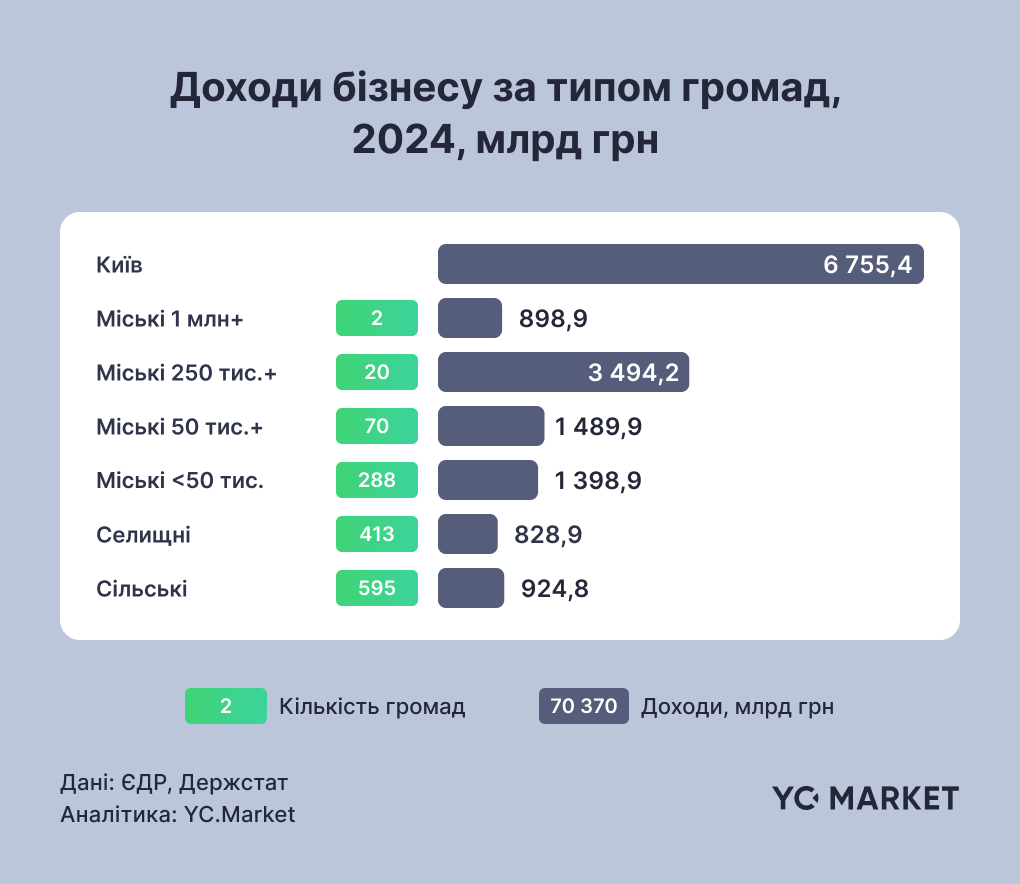
“This imbalance means that communities of different types entered a full-scale war with very different starting conditions for economic development. It also points to significant structural imbalances in access to resources and financing for businesses in less urbanized communities,” the study states.
How Businesses Recovered After the 2022 Shock: Regional Differences
As analysts note, the full-scale invasion triggered a sharp economic downturn in 2022, but in subsequent years, companies demonstrated considerable resilience. Starting in 2024 , all types of communities recorded nominal revenue growth compared to 2021, which was partly due to high inflation.
At the same time, the impact of the war varied significantly by region:
- the east and south experienced the sharpest decline in income in 2022;
- the western regions showed the greatest resilience and maintained positive median income growth even in the first year of full-scale war;
- central regions also demonstrated relatively stable trends.
Watch us on YouTube: important topics – without censorship
Who Began to Recover Faster
According to the study, indicators of business economic recovery depend significantly on geography and community type.
“Businesses in the western and central macroregions of Ukraine are showing greater resilience in terms of recovery indicators in 2023–2024, while the eastern and southern regions are feeling the economic consequences of the war much more acutely,” analysts report.
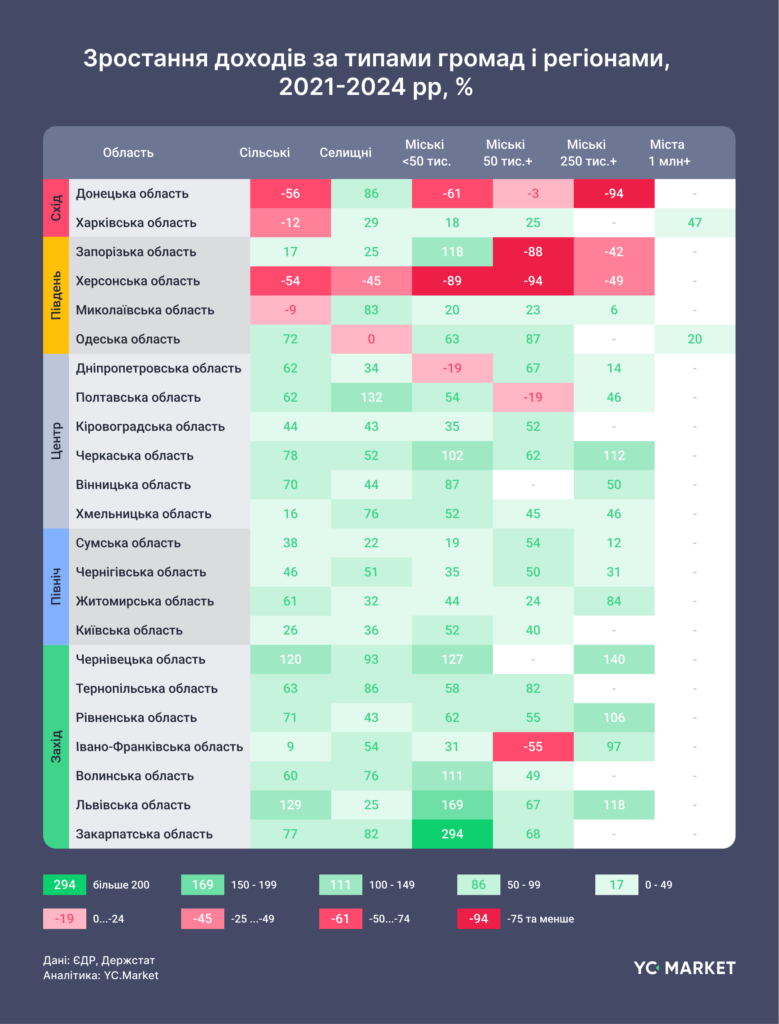
At the same time, rural communities, small towns, and towns are showing fairly strong growth in business revenue. The fact that smaller communities have shown relatively stronger rates of economic recovery is likely due to two factors:
- lower intensity of shelling compared to large industrial centers;
- a larger share of trade and service sectors, which recovered more quickly thanks to steady consumer demand amid macrofinancial stabilization.
Asymmetric Sectoral Responses to the War Shock
“The war caused uneven changes in the sectoral structure: industries linked to consumer demand and defense production grew, while parts of the manufacturing sector contracted. One of the most notable trends was the growth in retail revenue, particularly in small communities. This was due to both increased consumer demand and the entry of new retail companies into these markets,” the report states.
At the same time, the war-induced shock gave rise to other important trends:
- an increase in the production of machinery and equipment, largely due to demand from the defense sector;
- a decline in revenues in the metallurgy sector, which was concentrated in the regions hardest hit by the invasion;
- a nominal decline in revenues in the construction sector, indicating that large-scale reconstruction was still in its early stages.
Business profitability is gradually recovering
Despite a significant initial shock, companies were able to partially restore profitability, indicating their adaptation to the new conditions. Measured by the Net Profit Margin (NPM), many sectors saw a moderate increase in median profitability in the years following the start of the full-scale invasion.
“In 2024, median profitability in the six sectors studied remained positive across all types of communities. The energy and agriculture sectors posted the highest net profit margins,” analysts note.
Bank loans remain a limited source of financing
As the researchers point out, the level of bank lending among companies remains low. Of the approximately 228,000 companies in the sample , only 14,200 had active bank loans, accounting for about 6% of businesses. In small communities, the share of bank financing is relatively higher, as it was often the only available source of external debt financing.
“However, overall, access to financing was limited by the underdeveloped corporate bond market, which in developed countries serves as a significant alternative and a substantial complement to bank lending. An additional barrier to the development of lending is the insufficient number of so-called ‘bankable’ projects and companies—that is, those that are financially viable and ready to attract financing—which also limited the demand for formal financing,” the study states.
Concentration of Employment in Major Cities
An analysis of the labor market also revealed a strong territorial concentration.
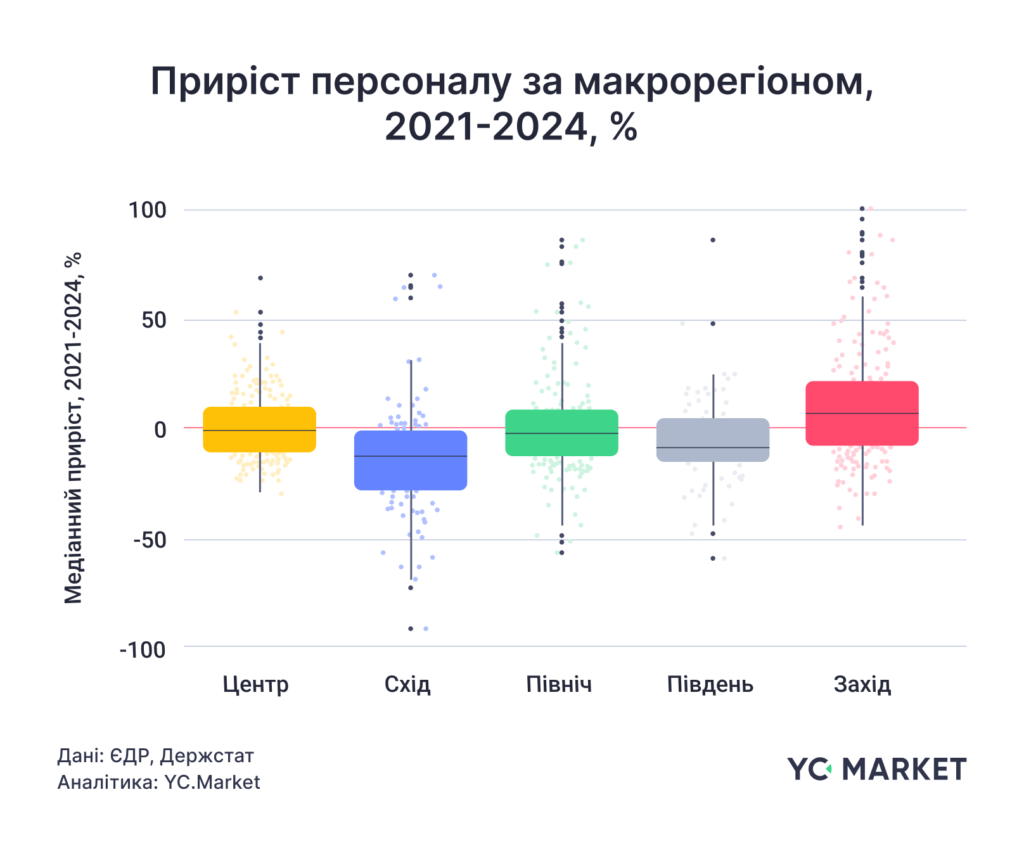
“Companies in 20 major cities with populations exceeding 250,000 provided nearly as many jobs as 378 small and medium-sized cities combined,” the study states.
As analysts note, the largest decline in employment was observed in the eastern regions, which was directly linked to hostilities and the destruction of economic infrastructure.
Conclusions Based on the Study’s Findings
The study’s results revealed several important structural trends in the local economy.
First, economic activity remains highly concentrated both geographically and across community types. Large urban centers dominated in terms of the number of companies, revenue, and employment.
Second, economic recovery has been uneven. Communities in the western and central regions demonstrated the greatest resilience in the first three years following the full-scale invasion, while the east and south continued to suffer the greatest losses.
Third, small communities in a number of cases demonstrated a fairly dynamic recovery, particularly in the trade and services sectors.
Fourth, access to financing is a key constraint on business development. Only a small proportion of companies use bank loans, and the limited number of bankable projects remains a significant challenge.
At the same time, the economic situation continues to evolve. The recent release of financial data for 2025, as well as further shifts in economic activity in early 2026, indicate the emergence of new trends in business development at the local level. That is why the authors are currently working on an updated version of the study, which will allow them to analyze more current dynamics and compare them with the trends of the initial impact of the full-scale war on community businesses, as recorded in 2022–2024.
The study of Ukrainian business development dynamics by territorial community, conducted using YouControl’s YC.Market tool, was carried out by Roman Korniyuk, a financial analyst at YouControl and professor at the Kyiv National Economic University (KNEU), and Anna Korniyuk, an associate professor in the Department of Applied Economics and Business at the Ukrainian Catholic University (UCU).
Read us on Telegram: important topics – without censorship