Ukraine’s public debt is growing. What does it consist of and why is it growing
2 May 2025 12:07
As of March 31, 2025, the state and state-guaranteed debt in the hryvnia equivalent amounted to UAH 7,123.3 billion, and in the foreign currency equivalent – USD 171.7 billion. This was announced by Danylo Hetmantsev, Chairman of the Verkhovna Rada Committee on Finance, Taxation and Customs Policy, citing data from the Ministry of Finance, according to
What are the dynamics of debt growth?
In the first quarter of 2025, the amount of public debt in hryvnia terms increased by 2% (plus UAH 142.3 billion), and in foreign currency terms – by 3.4% (plus $ 5.7 billion).
Almost all of the increase in public debt over the 3 months since the beginning of the year in foreign currency terms is due to an increase in debt to the EU in the amount of USD 5.7 billion.
On the last day of the quarter, Ukraine also attracted a USD 0.4 billion tranche from the IMF, but taking into account repayments, the amount of growth in debt to the Fund since the beginning of the year is insignificant.
What else influenced the amount of debt
Since the beginning of the year, the euro has strengthened against the dollar, which has led to a revaluation of the dollar equivalent of the debt.
It is also worth remembering that the funds received from the EU under the ERA mechanism are treated as contingent liabilities.
At the same time, as Danylo Hetmantsev will remind you, according to the Budget Code and the agreement with the EU, they are serviced and repaid not from the budget, but from the proceeds of immobilized Russian assets. The creditor, i.e. the EU, has a limited right to demand repayment of such a loan, in particular in the case of reparations for damage caused by the war on the part of Russia.
Due to the slowdown in the volume of auction placements of domestic government bonds, the domestic public debt declined in the first quarter. In hryvnia terms, it decreased by 1.5% (minus UAH 27.5 billion).
What is the structure of the public debt?
As of March 31 this year, Ukraine’s public debt had the following structure:
– 73.2% – external debt, 26.8% – domestic debt;
– 75.2% – debt in foreign currency (foreign currency government bonds), 24.8% – debt in hryvnia
– 66.5% – fixed rate debt, 33.5% – variable rate debt.
Danylo Hetmantsev states that in April, the public debt continued to grow, primarily due to the attraction of conditional commitments from the EU under the ERA mechanism (plus EUR 1 billion), and concessional loans from the EU under the Ukraine Facility (plus EUR 3.5 billion).
How much money should be received under the ERA program
The ERA mechanism provides for the transfer of funds received from the proceeds of frozen assets to the Russian Federation.
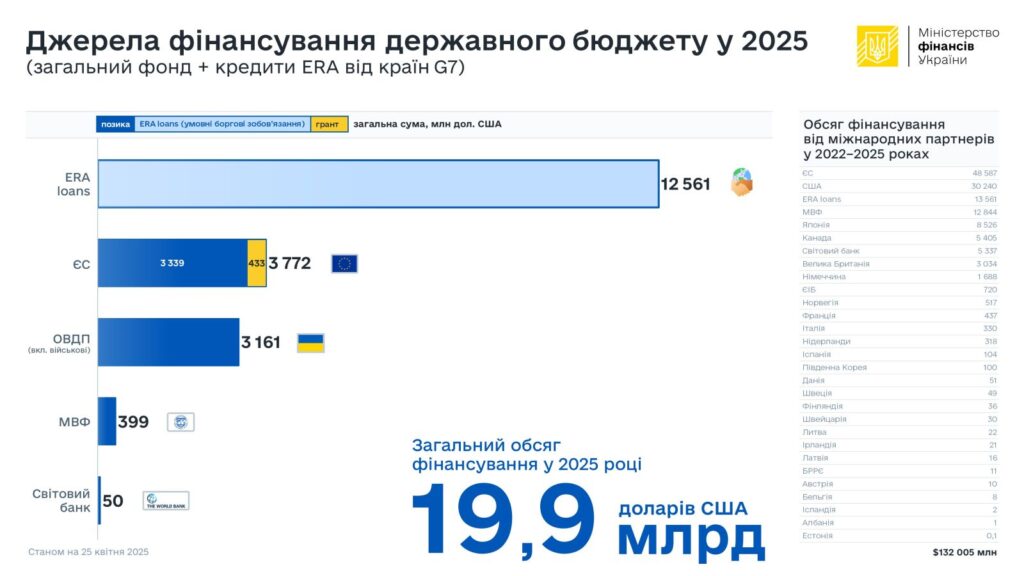
At the moment, this mechanism is expected to receive a total of $44.1 billion in the period up to the first quarter of 2027. The total announced amount reaches $50 billion.
Last year, Ukraine already received $1 billion, this year it will receive $39.4 billion, next year – $2.4 billion, and in 2027 – $1.3 billion.
How will increased international financial support help?
As noted in the NBU’s latest inflation report, this year Ukraine may receive more significant than previously expected amounts of international financial assistance due to the faster transfer of tranches under the ERA Loans mechanism. These funds will be sufficient not only to finance this year’s budget deficit, but also to create a reserve for public finances for next year, when the volume of foreign aid is likely to decline.
This year’s significant revenues will also allow Ukraine to increase its international reserves to USD 58 billion in 2015. In 2025, the NBU expects to keep them at a high level over the next few years, and thus maintain the stability of the foreign exchange market.
The NBU forecasts an increase in public and publicly guaranteed debt to 94% of GDP over the forecast horizon. However, part of this debt will be formed by funds received under the ERA19 mechanism, which will be repaid exclusively from the proceeds of the Russian Federation’s immobilized assets. These funds will not be taken into account when assessing external debt sustainability. In addition, the preferential terms of loans from international partners and the increased efficiency of domestic public debt management (in particular, through the auctions for the exchange of domestic government bonds) will help to reduce the burden on expenditures and free up resources to finance budgetary needs.