Shuffling the “Oiled Deck”: Why Putin Is Replacing Generals and What to Expect on the Front Lines
6 August 17:55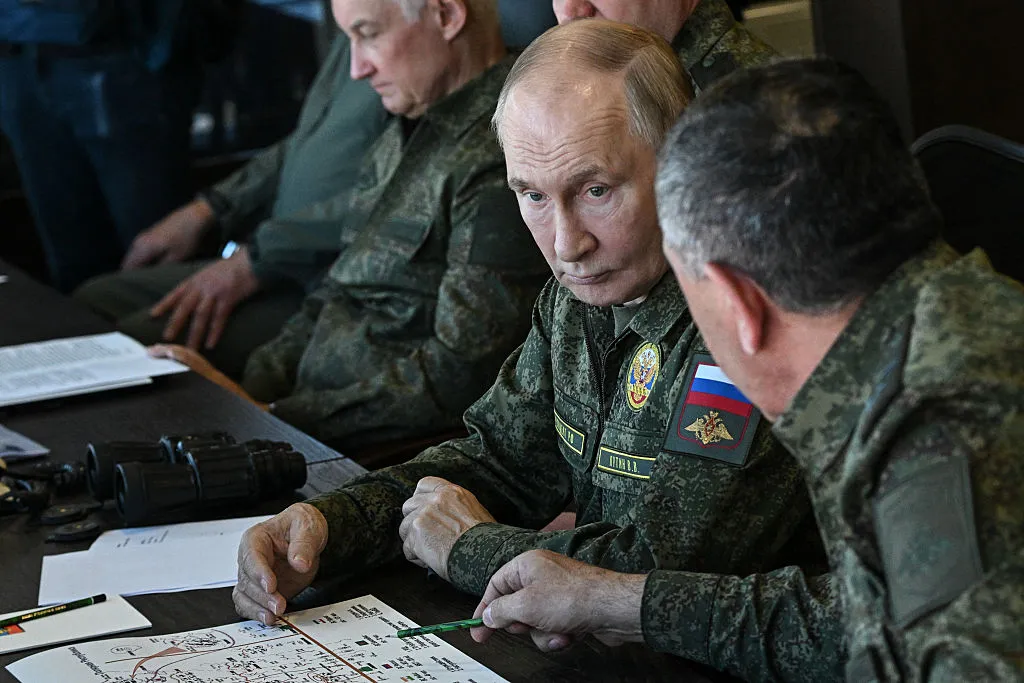 ANALYSIS
Against the backdrop of a record slowdown in the pace of the Russian offensive, the Kremlin carried out another round of personnel purges within the top military command. Vladimir Putin removed the generals in charge of key sectors of the front in Donbas, replacing them with little-known figures. Read the article in "Komersant Ukrainian" to find out whether this reshuffle could change the course of the fighting, why the Russians are losing in “low-altitude air combat,” and where to expect the enemy’s main strike.
Lies About “Victories” and Fear of New Uprisings
The reason for the personnel reshuffles in the “Center” and “East” groups was a stark discrepancy between the generals’ victory reports and the actual events on the ground. Military analyst Dmitry Snegirev discusses this in a commentary in "Komersant Ukrainian". For a long time , Russia’s top military leadership convinced the Kremlin that it had complete control over Kupyansk-Vuzlovy and Konstantinovka, and that it was achieving successes near Liman.
When even Russian “military correspondents” themselves debunked the fake reports, a scandal erupted. Putin, who had personally repeated these claims, found himself in an awkward position. To shift the blame for the lack of breakthroughs, the Kremlin decided to make an example of the commanders, specifically by removing General Valery Soluchuk from his post.
“This is nothing more than an attempt to shift the blame for the political leadership’s failures onto the military. Furthermore, the Kremlin systematically minimizes the risks of a military opposition forming. The purge of the general staff, which began after the so-called ‘March of Justice’ by the Wagner PMC, continues,” notes Dmitry Snegirev.
According to the analyst, popular military commanders are now being deliberately removed from the public eye and replaced with “gray” operatives who lack public authority and pose no threat to the political regime.
Watch us on YouTube: important topics – without censorship
The Failure at Dobropillya and a Record Slowdown in the Offensive
These personnel rotations coincided with the worst advance figures for the occupying forces in the past year. In July, the Russian Federation’s military gains fell to a record low of 36 square kilometers—3.5 times less than in previous periods.
In an attempt to curry favor with the dictator, the Russian command made fatal mistakes. A telling example was the assault on the Dobropillya front, where the Russians sent tank columns into the attack without adequate cover. The result was catastrophic: Ukrainian UAV operators completely destroyed the armored vehicles and killed dozens of invaders. It was precisely these “meat grinders”—carried out solely for the sake of reporting metrics—that finally pushed the Kremlin’s patience to its limit.
At the same time, the Ukrainian Defense Forces are not only holding back the onslaught but also effectively counterattacking. At the junction of the Donetsk, Zaporizhzhia, and Dnipropetrovsk regions, Ukrainian units managed to liberate approximately 105 square kilometers.
“This is essentially shuffling that same well-worn deck of cards. They’re swapping one group for another, but it’s unlikely to have any real impact. Most likely, in the first month, the new generals will again try to step up the offensive in order to report on their supposedly successful personnel decisions,” notes Snegirev.
The War for “Small Airspace”: Why Does Putin Need General Lemin?
The only rotational appointment that drew particular attention from analysts was the appointment of General Lemin to command the Russian Federation’s unmanned systems forces. Unlike most appointees, he has a reputation as a strong-willed commander with an unconventional mindset.
This decision indicates that the Russians acknowledge their deep crisis in the areas of strike drones and tactical reconnaissance airspace. Currently, the Ukrainian Defense Forces hold an absolute advantage in FPV drones: Ukrainian troops can afford to expend up to 10 UAVs to take out a single target, whereas the Russians’ drone deployment density does not exceed 20 drones per square kilometer. Furthermore, Ukrainian forces are capable of striking deep into the enemy’s operational rear—up to 250 km—while Russia operates only within the tactical zone.
“Lemin’s appointment is linked to an attempt to minimize the occupying army’s lag in the field of advanced technologies. They will try to ramp up production of fiber-optic-guided strike drones and ground-based robotic systems, areas where the Ukrainian Armed Forces hold a significant advantage,” explains Snegirev.
Mobilization Plans and the Threat of a Major Offensive
The analyst urges people not to pay attention to rumors about mythical “deadlines” for the capture of Donbas, since Putin has set only one overarching goal for himself—complete control over the Donetsk and Luhansk regions. This is precisely where the main strike will be delivered. In the near future, we should expect a sharp intensification of fighting in the Konstantinovka, Liman, and Pokrovsk-Dobropol directions.
To maintain this pressure, Russia is preparing a new wave of mobilization. According to analysts from the civic initiative “Prava Sprava,” a closed-door meeting involving representatives of the occupation administrations has already taken place in the Volgograd region. Contrary to reports of 500,000 new recruits, the enemy’s actual plans call for mobilizing up to 1.2 million people by late fall.
“They will try to use World War II tactics again—superiority in manpower—what is known in modern Russian terminology as ‘meat grinders’ or ‘banzai attacks,’” emphasizes a military analyst.
IPSO in the North: “The Tactics of a Thousand Cuts”
In parallel with preparations for an offensive in the east, Russian propaganda is actively fueling rumors of a possible renewed invasion from Belarus or an offensive against the Chernihiv and Sumy regions.
However, Ukrainian intelligence and the Border Guard Service have not yet detected any signs of strike forces being assembled along the northern borders: there are no field hospitals, ammunition depots, or redeployment of reserves there. All of these disinformation campaigns are part of a tactic to tie down Ukrainian Armed Forces.
“The tactic of creating so-called ‘buffer zones’ has completely discredited itself and proven ineffective. All other directions—Sumy, Kharkiv, and Chernihiv—are diversionary tactics of ‘a thousand small cuts.’ They will try to keep the entire front on edge, but the main direction of the offensive is the Donetsk region,” concludes Dmitry Snegirev.
Personnel rotations in the Russian Federation’s army are not a matter of military prowess, but rather an attempt by the Kremlin to cover up its own failures, avoid political accountability for dubious reports, and prevent the emergence of a credible opposition among the generals. However, simply shuffling a “rigged deck” cannot solve the occupiers’ systemic problems. The Donetsk region will remain the main battlefield in the near future, while any other threats along the borders are merely elements of information warfare and an attempt to divert Ukrainian resources.
Read us on Telegram: important topics – without censorship