
Poland has found itself at the center of a crypto scandal—a Warsaw-based company has been linked to Iranian billions
19 August 07:55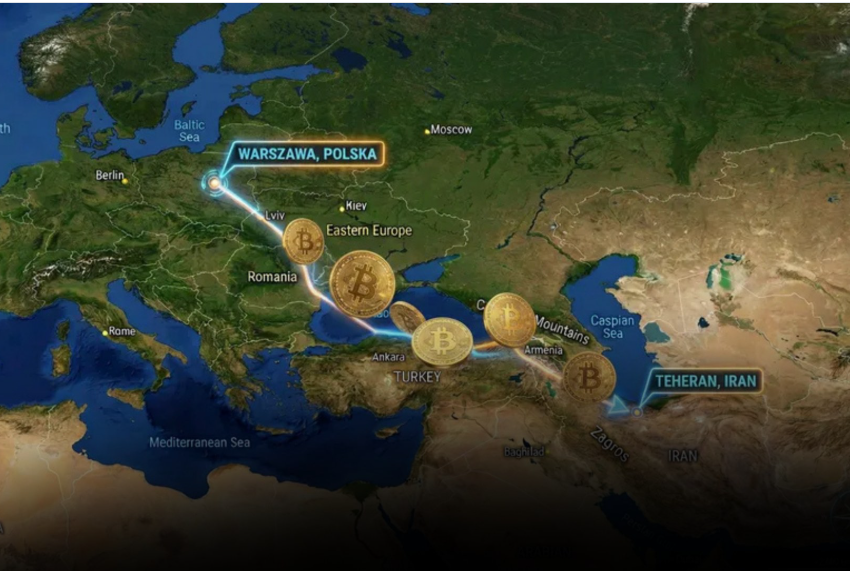
Shelbit Technologies, a company registered in Warsaw, and its Iranian owner, Siavash Kayvanpour, have been added to the U.S. sanctions list. U.S. authorities consider them part of an international cryptocurrency network that served Iranian entities and helped conduct transactions outside the traditional banking system.
Gazeta Wyborcza reported on the Polish connection to the case, and the company’s inclusion on the sanctions list has been confirmed by the U.S. Department of the Treasury and an official OFAC announcement, according to "Komersant Ukrainian"
The company is listed on the sanctions list under its full name: Shelbit Technologies Ltd Spółka z ograniczoną odpowiedzialnością w likwidacji. The phrase “w likwidacji” means that the company is in the process of liquidation.
According to OFAC, the company was registered on August 24, 2023. Its registered address is:
- 22B Bartycka Street;
- Suite 21A;
- Warsaw, Poland.
The company’s registration number in the Polish court registry is KRS 0001053647. Its primary business activity was listed as “other financial intermediation.”
In 2024, Iranian citizen Siavash Kayvanpour took over as head of the company. U.S. authorities identify him as the owner of the Polish company Shelbit Technologies and the head of a network of companies that operated in Georgia, the United Arab Emirates, and Poland.
Why the U.S. Imposed Sanctions
The U.S. Department of the Treasury’s Office of Foreign Assets Control (OFAC) added Kayvanpour and his affiliated companies to the sanctions list on August 7, 2026.
According to the U.S. Treasury Department, Kayvanpur managed the Shelbit Exchange cryptocurrency platform through SHPS Shelbit, a company registered in Georgia.
U.S. authorities allege the following transactions:
| Nature of Transactions | Amount |
|---|---|
| From addresses associated with the IRGC to Shelbit | over $1 million |
| From Shelbit to addresses linked to the IRGC | over $2 million |
| From addresses controlled by Kayvanpur to the sanctioned exchange Nobitex | over $2 million |
| Funds linked to a Persian-language online casino network | tens of millions of dollars |
The IRGC—the Islamic Revolutionary Guard Corps—is subject to U.S. sanctions and is designated by the U.S. as a foreign terrorist organization.
Along with the Polish company Shelbit Technologies, the sanctions list includes the Georgian company SHPS Shelbit, the Dubai-based Shelbit General Trading, as well as the companies Crypto Home DMCC and NFT Home DMCC in the UAE.
Billions of dollars may have been funneled through Shelbit
The amounts specified in the official OFAC announcement pertain to specific transactions with sanctioned entities. The total volume of funds that passed through Shelbit’s infrastructure could have been significantly higher.
According to a Reuters investigation, the platform may have processed at least $4 billion since May 2024.
Journalists linked Shelbit to:
- the Central Bank of Iran;
- Iranian Bitcoin miners;
- cryptocurrency addresses that Israel links to the IRGC;
- the sanctioned Iranian exchange Nobitex;
- a network of over 2,000 Persian-language gambling websites;
- international cryptocurrency platforms.
TRM Labs provides an even higher estimate. According to its analysis of blockchain transactions, from May 2024 to March 2026, over $6.3 billion passed through addresses linked to Shelbit.
How the Cryptocurrency Network Operated
According to TRM Labs, based on its operational characteristics, Shelbit resembled a transit settlement channel rather than a typical cryptocurrency exchange.
Several features pointed to this:
- funds were rarely held in wallets;
- the amounts of incoming and outgoing transfers matched with an accuracy of 0.1%;
- wallet addresses were changed every one to four months;
- about 88% of transactions were conducted via the TRON network;
- dollar-pegged stablecoins were predominantly used for transactions;
- the highest monthly transaction volume reached approximately $735 million.
These figures may indicate that the platform was used primarily for the rapid transfer of funds between various network participants, rather than for the long-term storage of client assets.
A Russian connection was found in the Shelbit network
Of particular interest to Ukraine is Shelbit’s connection to the Russian sanctions-targeted infrastructure.
TRM Labs claims to have identified transactions totaling approximately $318 million involving the Russian payment network A7. This entity is subject to international sanctions and is used for cross-border settlements amid Russia’s limited access to the traditional financial system.
Analysts also uncovered Shelbit’s ties to Russian and Central Asian cryptocurrency services such as Grinex, Rapira, and other platforms with elevated sanctions risk.
This may indicate that Shelbit’s infrastructure served not only Iranian entities but also a broader network of participants seeking to circumvent international financial restrictions.









