What happened at Nike: The company is laying off 1,400 employees worldwide
25 April 07:21
American sports giant Nike has announced a new round of layoffs. The company plans to lay off approximately 1,400 employees, representing just under 2% of its global workforce. This was reported by Reuters, according to "Komersant Ukrainian"
Nike explains this decision as an effort to streamline work processes, better integrate supply chains, and improve business efficiency amid a long-standing decline in sales.
According to Reuters, the cuts will affect the company’s global operations, with the technology division being hit hardest. Employees in North America, Asia, and Europe will be laid off.
“In a memo to employees, Chief Operating Officer Venkatesh Alagirisamy stated that Nike will cut jobs in global operations—primarily in technology—in North America, Asia, and Europe, representing just under 2% of the global workforce,” the article states.
Why Nike is laying off employees again
This is not the first round of layoffs at the company in recent times. Reuters notes that back in January, Nike announced the elimination of 775 positions as part of its automation efforts.
The new wave of layoffs indicates that the brand’s problems are systemic rather than temporary. The company has been struggling for several years with weak sales, pressure on profitability, and intensifying competition from more agile market players.
Nike forecasts that its sales will decline by another 2–4% in the current quarter. The situation in China remains particularly challenging, with Reuters identifying it as the company’s main trouble spot: there, Nike expects sales to drop by approximately 20% for the quarter.
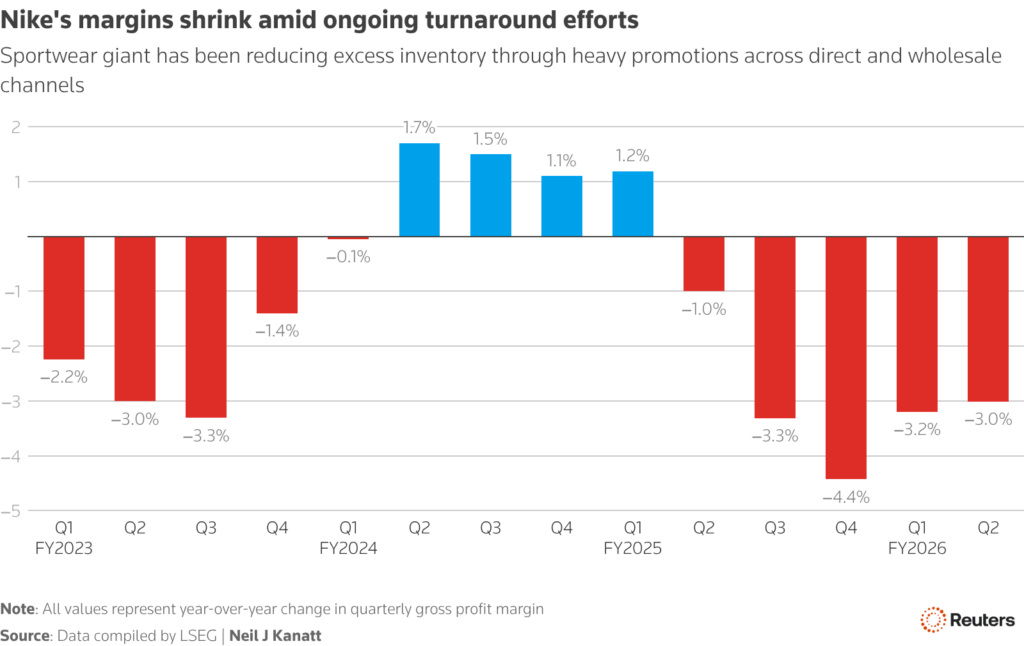
Against this backdrop, the company is forced to push discounts to clear out old inventory. This is precisely why Nike’s margins remain under pressure, and new shoe models have not yet been able to consistently regain consumer interest.
Watch us on YouTube: important topics – without censorship
Why Nike Is Losing to Its Competitors
Over the past three years, Nike’s stock has lost more than half its value. Reuters notes that the brand is losing ground to more dynamic competitors such as On, Hoka, and Anta, which have captured more shelf space and are better at responding to new consumer demands.
This means that Nike is facing not only temporary difficulties but also the need to rethink its market strategy as shoppers increasingly turn to alternative brands.
CEO Elliott Gill, who took the helm at Nike in 2024, is trying to return the brand to its athletic roots. He has promised to focus on the company’s key categories—primarily running and soccer—and to bring new, innovative models to market more quickly. According to management, Nike’s recovery depends on its ability to regularly offer consumers something new.
However, Reuters notes that new releases have not yet delivered the expected results. The only notable success has been the Vomero 18 model, which generated $100 million in sales within three months of its launch.
Profits remain low as Nike uses significant discounts to clear out old inventory.
What analysts are saying about Nike’s situation
Morningstar analyst David Schwartz believes that the new layoffs indicate deeper problems than previously assumed.
“Thursday’s layoffs signal that the problems are deeper than initially thought,” the analyst said.
In his view, Nike should already be further along the path to recovery.
He also suggested that the company may have been overstaffed, as previous management tried to solve problems by increasing headcount, particularly in the technology segment.
M Science analyst Drake McFarland also noted that the headline about the layoffs is not a surprise, as Nike had already warned in its March filing with the SEC that workforce adjustments were possible.
A Nike spokesperson declined to provide a figure for the cost savings from the layoffs.
According to Reuters, the current cuts are intended to help Nike better integrate its supply chains for materials, footwear, and apparel, as well as consolidate technology operations into just two main hubs: its headquarters in Beaverton, Oregon, and Nike’s technology center in India. In other words, the company is not simply cutting costs but restructuring its management model itself.
Read us on Telegram: important topics – without censorship