Ukrainians most often buy electronics and clothing online, according to a study
1 June 12:14
Electronics, home goods, and fashion remain the main drivers of Ukrainian e-commerce. At the same time, Ukrainians are increasingly ordering online food delivery, health products, and everyday purchases via their smartphones, according to "Komersant Ukrainian", citing a WayForPay study.
WayForPay analysts examined the structure of payments made through the platform in 2025 and compiled data on the most popular online shopping categories, average order values, transaction volumes, and the share of mobile payments. The study also identified the fastest-growing categories and seasonal peaks in Ukrainian consumer activity.
Electronics and home goods — the main categories of online purchases
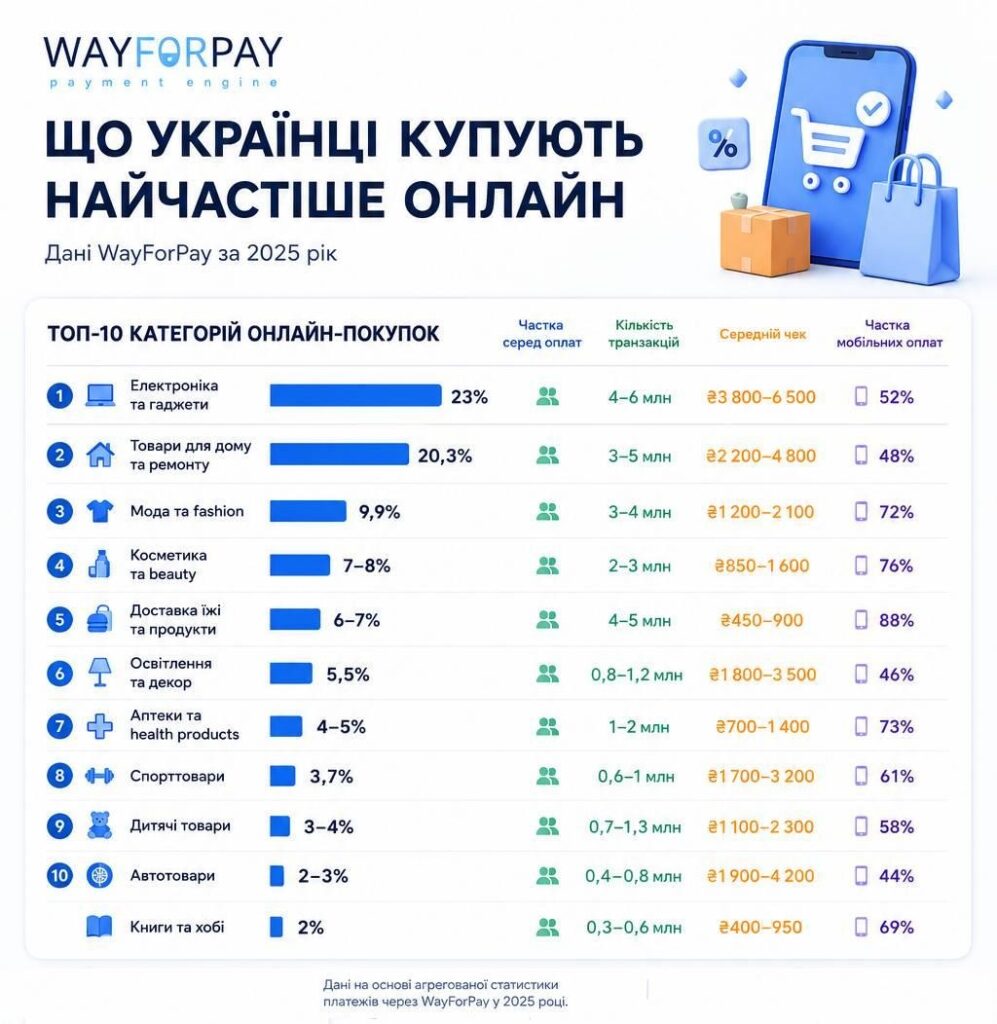
Electronics and gadgets account for the largest share of Ukrainians’ online payments in 2025—about 23% of all transactions via WayForPay. This category also has one of the highest average transaction values—₴3,800–6,500—and the number of transactions per year is estimated at ~4–6 million.
The second most popular category is home goods and home improvement, accounting for about 20.3% of payments. Demand for this category remains consistently high, with an average transaction value of ₴2,200–4,800.
Third place goes to the fashion segment—clothing, footwear, and accessories. This category accounts for ~9.9% of payments, and fashion leads in the share of mobile purchases—about 72%.
Also making the top list are:
- cosmetics and beauty — ~7–8%;
- food delivery and groceries — ~6–7%;
- lighting and decor — ~5.5%;
- pharmacies and health products — ~4-5%;
- sports goods — ~3.7%;
- children’s goods — ~3-4%;
- auto goods — ~2-3%;
- books and hobbies — ~2%.
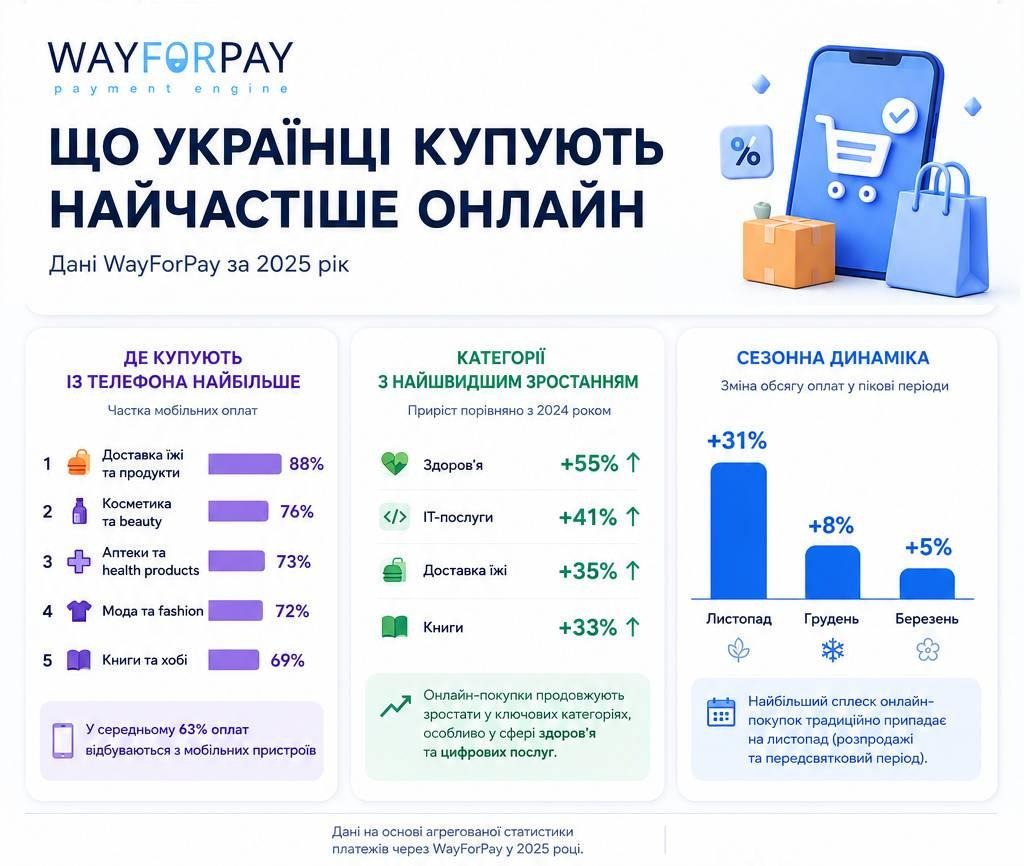
One of the main trends of the year was the growth of mobile-first purchases. The highest share of mobile payments is observed in the categories of food delivery (~88%), cosmetics and beauty (~76%), pharmacies (~73%), and fashion (~72%).
Conversely, the lowest share of mobile purchases is in the electronics (~52%), home improvement (~48%), and automotive (~44%) categories, where users are more likely to complete purchases on desktop devices due to higher average order values and longer product selection cycles.
The e-commerce market in Ukraine continues to grow
WayForPay’s data on the popularity of electronics, home goods, and fashion is corroborated by research from other players in the Ukrainian e-commerce market.
According to Prom and EVO, Ukrainians spent ₴256 billion on online purchases in 2025. This is 7% more than the previous year. The share of online purchases in total retail remained at 10%, indicating the market’s potential for further growth.
According to Prom and EVO, the highest number of orders in 2025 was in the following categories:
- auto repair products;
- home and garden goods;
- appliances and electronics;
- cosmetics;
- perfumes;
- clothing, footwear, and accessories.
The average online order value was ₴1,320, and each shopper placed an average of 17.5 online orders per year. In total, there were 11.2 million online shoppers in Ukraine, which is 3% more than the previous year.
Certain categories grew significantly faster than the market as a whole. According to Prom and EVO, the number of orders in the pet supplies category increased by 66%. Food products, tools, and home improvement and construction goods also showed strong growth.
Promodo ’s results for the second half of 2025 paint a similar picture. In the electronics category, revenue grew by 37% in hryvnia, and the number of purchases increased by 19%. In the food and alcohol category, the number of purchases rose by 36%, and revenue increased by 39% in hryvnia.
Growth is also evident in regular categories of everyday demand. In the second half of 2025, revenue in the pet supplies category rose by 51%, and the number of purchases by 35%. Meanwhile, the pharmacy category saw revenue increase by 10% and the number of purchases by 8%.
However, not all segments grew at the same rate. In the clothing and footwear category, revenue in the second half of 2025 fell by 1%, while the number of purchases rose by only 1%. Promodo attributes this to more restrained demand and the fact that Ukrainians tend to buy clothing out of necessity rather than on impulse.
The overall trend is also confirmed by statistics from the National Bank of Ukraine. In 2025, Ukrainians made over 1.2 billion online transactions for goods and services totaling nearly ₴770 billion. The average amount per online transaction was ₴608, compared to ₴561 in 2024.
The market remains stable from the business side as well. According to a Khoroshop study, half of online stores increased their order volume in 2025, and 17% of business owners reported sales growth of more than 30%. Looking ahead to 2026, 58% of surveyed business owners are optimistic, with nearly half expecting further growth in order volume.
Globally, e-commerce is shifting toward a model of “frequent smartphone purchases”
The global e-commerce market in 2025–2026 is increasingly shifting from large one-time purchases to regular everyday consumption. While online shopping was previously associated mainly with electronics or high-end goods, the main drivers of the market are now fashion, groceries, home goods, cosmetics, health products, and fast delivery.
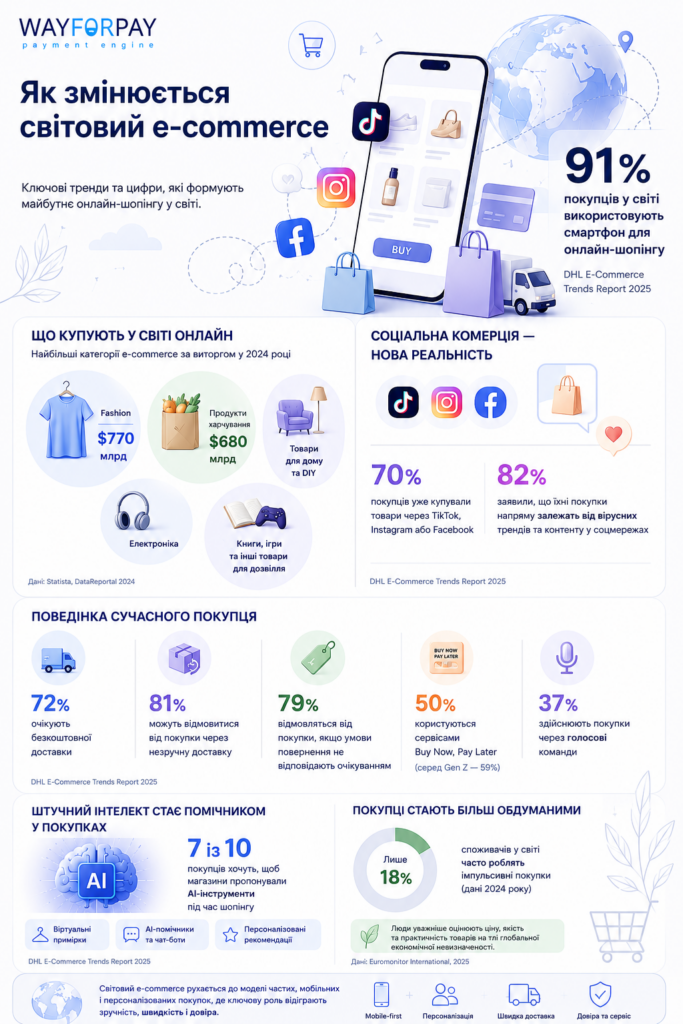
According to the DHL E-Commerce Trends Report 2025, 91% of shoppers worldwide already use a smartphone for online shopping, and 70% of consumers expect social media to become the primary shopping channel by 2030, rather than traditional online stores.
Social commerce is becoming one of the major global trends. According to DHL, 70% of shoppers have already purchased goods via TikTok, Instagram, or Facebook, and 82% stated that their purchases are directly influenced by viral trends and content on social media.
At the same time, the structure of global e-commerce is changing. According to estimates by Statista and DataReportal, the fashion segment remains the largest category of online commerce worldwide, with annual revenue exceeding $770 billion. It is followed by food, home goods, electronics, and beauty products.
This differs significantly from Ukraine, where, according to WayForPay, electronics and gadgets still account for the largest share of payments. Globally, however, electronics are gradually losing their dominance to regular mobile-first purchases—such as groceries, cosmetics, food delivery, and everyday goods.
Another global trend is the sharp rise in the role of artificial intelligence in online commerce. According to DHL, 7 out of 10 shoppers want stores to offer AI tools for product selection: virtual try-ons, voice search, AI assistants, and personalized recommendations. Already, 37% of users worldwide make purchases via voice commands.
The popularity of installment payment services is growing separately. According to DHL, 50% of shoppers worldwide use the Buy Now, Pay Later model, and among Gen Z, this figure reaches 59%.
At the same time, competition in e-commerce is increasingly shifting toward service and logistics:
- 81% of shoppers may cancel an order if the store does not offer their preferred delivery method;
- 79% will cancel if the return policy is inconvenient;
- 72% of shoppers expect free shipping;
- 60% of shoppers regularly order goods from abroad.
Shoppers have also become more pragmatic. According to Euromonitor, by 2025, consumers worldwide will be increasingly careful in evaluating the balance of price, quality, and practicality of products, while impulse purchases will decline amid global economic uncertainty.
Against this backdrop, e-commerce is increasingly evolving not just into a sales channel, but into a digital ecosystem where delivery speed, mobile experience, personalization, and the integration of purchases into social media play a decisive role. It is these factors that will shape the development of online commerce over the next few years—both globally and in Ukraine.
Watch us on YouTube: important topics – without censorship