One Year After “The Web”: How an SBU Operation Exposed the Vulnerability of Russia’s “Nuclear Shield”
1 June 14:18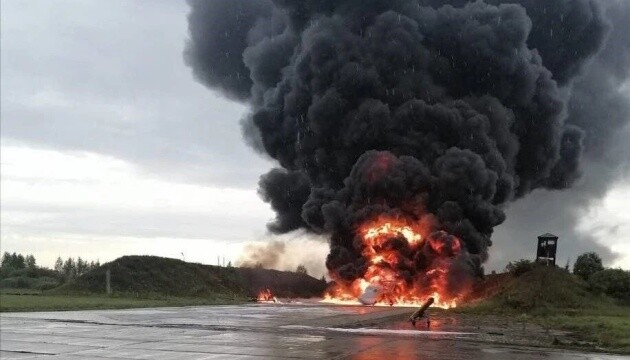 ANALYSIS FROM
Exactly one year has passed since June 1, 2025, when Russia’s strategic air force suffered a devastating blow. The SBU’s unique special operation “Spiderweb,” which had been in the works for a year and a half, put 41 aircraft out of commission, including strategic cruise missile carriers. Today, in June 2026, the consequences of this “web” still hamper the aggressor’s actions, and experts point to an even deeper crisis in the Russian military-industrial complex. How did the SBU manage to carry out an operation from thousands of kilometers away? Why does Russia’s “nuclear shield” now rest on a “word of honor,” and why do Soviet technologies no longer work? What does the Kremlin truly fear, and why is it concealing the consequences of new attacks on strategic targets?
The “Spiderweb” Effect: $7 Billion in Damages and a Change in Tactics
The operation, led by Vasyl Malyuk, was historic. The use of remotely controlled AI-guided FPV drones, disguised in civilian trucks, made it possible to strike four airfields—from Murmansk to Irkutsk. The loss of 34% of its strategic air fleet forced the Kremlin to frantically relocate the surviving Tu-95MS and Tu-160s to remote bases, such as “Ukrainka,” and to build protective hangars on a massive scale.
Today, the enemy attacks Ukraine with significantly fewer forces, and before each raid, it shuts down mobile internet within the radius of the bases, fearing a repeat of “The Web.”
A “nuclear shield” held together by “instrument readings”
Ivan Kirichevsky, a serviceman of the 413th Regiment of the “Raid” Unmanned Systems Forces and an arms expert at Defense Express, commented to
“This is an equation that no one has been able to solve yet. After ‘Spiderweb,’ the Russians can no longer attack us even with a dozen ‘Tushkas.’ Their carriers, which have been in service for just 40 years, lack the resources for modernization. The Russians find themselves in a situation where old American B-52s (the youngest of which is 62 years old) appear more reliable, because the U.S. still has systematic support, while in Russia, production cycles for new warheads have ‘fallen apart’ and problems have arisen with the maintenance of intercontinental ballistic missiles,” notes Kirichevsky.
When analyzing current satellite images of “nuclear bases,” the expert advises looking not at new “guard booths” but at actual storage facilities. According to him, there are about 12 large storage facilities in Russia, and some of them, for example, in the Belgorod region, could potentially contain tactical nuclear shells for “Pion” cannons.
“The Russians’ attempts to intimidate the world with the resumption of nuclear tests on Novaya Zemlya have failed, because there is simply nothing left to test there. Operation ‘Spiderweb’ laid bare the enemy’s main problem: they are threatening the world with a ‘nuclear club,’ while themselves fearing that their shield has become ‘full of holes’ and technically obsolete,” Kirichevsky concludes.
Operation “Spiderweb” has proven that modern warfare is won not only by the number of warheads, but by technological intelligence and the ability to strike the enemy where they feel safest. The question of “Spiderweb 2.0” remains open, but one thing is clear—Russian aviation will never be the same again.
The consequences of Operation “Spiderweb”: a “triad” cracking at the seams
Operation “Spiderweb,” which dealt a devastating blow to Russian strategic aviation, marked the point of no return for the myth of Russian “nuclear might.” Grigory Tamar, a reserve officer in the IDF, shared his assessment of the situation in a comment to the publication
According to Tamar, following the SBU’s successful attack, the capabilities of the Russian nuclear triad are now at risk of disappearing. The loss of most of its strategic bombers has effectively deprived Moscow of the necessary delivery systems.
“They have only a handful of aircraft left capable of carrying strategic nuclear weapons. All the rest of the talk about ‘might’ is just speculation,” Tamar emphasizes.
The IDF officer pays particular attention to issues with intercontinental ballistic missiles (ICBMs). For a long time, the entire effectiveness of Russia’s nuclear arsenal was based on Soviet designs developed in Dnipropetrovsk.
“These missiles were maintained by Ukrainian technical personnel. Since 2014, following the occupation of Crimea, this process has ceased. The Russians are still unable to independently establish the operation of these systems. Everything they present today as ‘new weapons’ is mostly fake,” Tamar explains.
Russia’s Fear of “Spider Web 2.0”
Moreover, the night strike by the Unmanned Systems Forces (USF) on the airfield in Taganrog was not just another successful operation, but a serious challenge to Russian strategic security. The Tu-142 is not just an aircraft; it is a specialized anti-submarine complex for the open ocean, designed to hunt nuclear submarines armed with intercontinental ballistic missiles. For such aircraft, the Black or Baltic Seas are merely “puddles,” as their true habitat is the vastness of the Pacific and Atlantic Oceans.
Military expert Ivan Kirichevsky explains: the Russian Federation has very few of these aircraft in its arsenal:
- Tu-142M/MZ (anti-submarine): only 12 aircraft.
- Tu-142MR (communication aircraft): only 10 units, responsible for controlling nuclear-armed submarines.
“In other words, for Russia, this family of aircraft is a key link in the deployment of nuclear weapons at sea or in defense against NATO’s strategic assets. The loss of two aircraft at once is a critical blow to the Russian Navy,” notes Kirichevsky.
The successful SBS attack in Taganrog is a direct continuation of the strategy initiated by “Spiderweb” a year ago. At that time, Ukraine demonstrated for the first time that it could strike strategic targets thousands of kilometers away, forcing the enemy to chaotically redeploy its aircraft to remote airfields and jam communications in its own regions.
Today, the Russian command is trying to “obfuscate” this strike in the information sphere, because it realizes: Ukrainian drones are no longer just “flying”—they are systematically undermining the Russian Federation’s ability to maintain its status as a “nuclear power.”
“This is an episode where Ukrainian drones confidently wiped the occupiers’ ‘red lines’ with a rag. And the fact that they are trying to hide it only confirms that the strike achieved its goal,” concludes Kyrychevsky.
Grigory Tamar is convinced that June 1, 2025, was only the beginning of a major strategic campaign. The expert openly hints that the operation’s results will have a follow-up that will significantly alter the security landscape not only in Ukraine but throughout the entire region.
“I am certain that Operation ‘Spiderweb’ is not over. We will see a continuation, and it will be significant,” concluded the IDF reserve officer.
Today, Russian strategic aviation is in a deep crisis: a shortage of spare parts, a lack of resources for modernization, and a constant fear of new attacks are forcing the Kremlin to change tactics and conceal the true state of affairs. The drone war is just beginning, and the results of “Spiderweb” are merely a prologue to sweeping changes in the geopolitical landscape.