The Wars Trump Didn’t End: A Historian Explains Why “Peace in 24 Hours” Failed and Where a New Front Will Open Up
27 May 12:14 ANALYSIS
The world remains engulfed in conflict, despite the White House’s promises. Donald Trump has cast himself as a “peacemaker” who will put an end to global conflicts in a matter of days. However, as of May 2026, most of his initiatives remain in limbo, and the U.S. administration is instead stoking a new hotbed of conflict right on its doorstep—in Cuba. The clock is ticking: there are just over five months left until the midterm congressional elections in the fall of 2026, writes "Komersant Ukrainian".
Promises vs. Reality: What Trump (Didn’t) Finish
Returning to the Oval Office, Donald Trump promised “instant peace.” But the spring of 2026 shows that his signature “diplomacy of ultimatums and agreements” is faltering badly. His successes turned out to be tactical, not strategic.
War in the Middle East
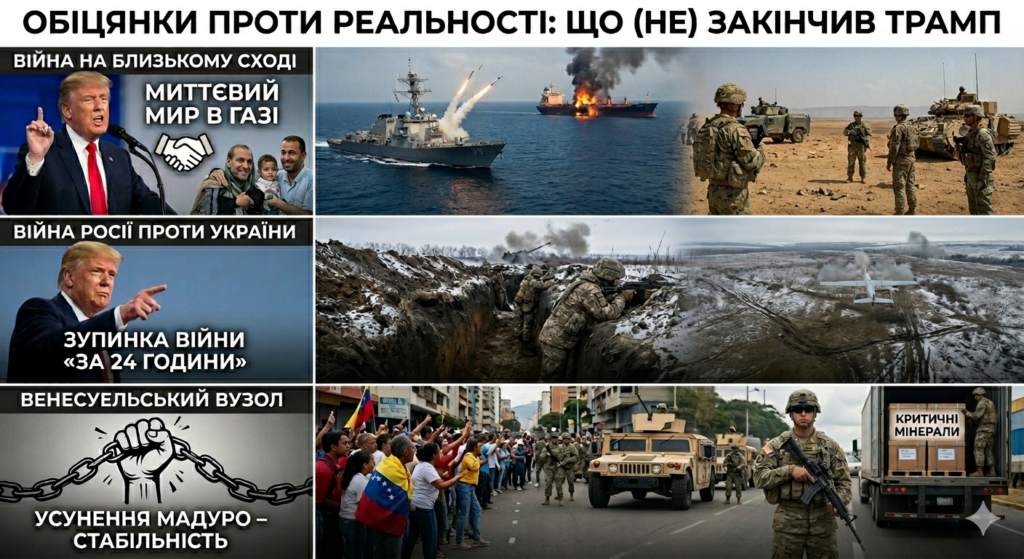
The ceasefire and hostage release agreements in Gaza, reached in the fall of 2025, halted the large-scale bloodshed but did not resolve the root problem. Instead, the conflict has transformed into a direct military confrontation between the U.S. and Israel against Iran and the Houthis, which has already cost the U.S. budget tens of billions of dollars.
Russia’s War Against Ukraine
Despite claims that the war would end “within 24 hours,” Trump faced the Kremlin’s intransigence. The White House did not dare to completely cut off aid to Ukraine due to resistance in Europe and the risk of geopolitical collapse, so a grueling and bloody war of attrition continues on the front lines. Putin is ignoring the pressure, and Trump has yet to find the leverage to force Moscow into a real peace.
The Venezuelan Knot
Following U.S. intervention and the removal of Maduro, the situation in the region remains explosive, and stability in Caracas is maintained solely by force of arms and U.S. control over critical minerals.
Experts from the Council on Foreign Relations (CFR) note in their 2026 report: the world has become even more chaotic. Instead of lasting peace, the Trump administration has managed to secure only shaky “framework agreements” that defer the resolution of complex issues to the future.
The Fall 2026 Factor: Will Trump Make It to the Midterms?
On November 3, 2026, the U.S. will hold midterm elections for Congress. For Trump, this is the moment of truth. If Republicans lose control of the House of Representatives or the Senate, Democrats will block any of his foreign policy and financial initiatives through budget appropriations and investigations.
Will the president manage to demonstrate at least one “total victory” to voters before November? Experts tend to believe this is unlikely.
Domestic economic pressure: Military campaigns in the Middle East and operations in Latin America are driving up inflation within the United States. American voters are growing weary of spending on “foreign wars,” which Trump promised to end.
Lack of time: Less than six months remain. It is impossible to diplomatically resolve any of the deep, protracted conflicts (Ukraine, Iran, Sudan) in that timeframe. Trump will have to either make compromises that are humiliating to the U.S. image or admit that the wars will continue.
A New Front: Will War Break Out in Cuba?
While Trump tries to put out fires on other continents, Cuba—located just 150 kilometers off the coast of Florida—is under the threat of an imminent explosion. In May 2026, the Island of Freedom entered the peak of the most severe energy and political crisis in decades.
The Trump administration has launched a large-scale pressure campaign against Havana, codenamed “Southern Spear.” The goal is clear: to bring about the overthrow of the communist regime by the end of 2026, in order to present this to the American electorate as a grand victory over the “ghosts of the Cold War.”
Military analyst, historian, and IDF reserve officer Grigory Tamar explained in a commentary for "Komersant Ukrainian" why Cuba is not just a poor island, but a critically important card in the U.S. geopolitical game.
“Cuba is very close to the U.S., about 150 kilometers away. That is, even if—just think about it—ATACMS launchers, which the Ukrainians know all too well, were deployed on Cuban territory, they could strike the U.S. coastline. There [in Ukraine] it’s a 400-kilometer distance, but here it’s 150,” says Tamar
In addition to the missile threat, the island blocks the world’s most vital maritime arteries. It is a universal logistics hub and, from a geographical standpoint, offers the ability to influence the routes of the merchant fleet connecting the Atlantic and Indian Oceans.
For Trump, Cuba is also a domestic political jackpot on the eve of the election, since the Cuban diaspora in the U.S. wields enormous influence:
“There is a large diaspora of descendants of immigrants living in the U.S. They have votes. That’s many hundreds of thousands of people—it’s not a small number. Plus, there are traditional Republican values, which it would also be wrong to completely discount. Therefore, I fully admit that the Americans may try to play their own game in Cuba,”—Grigory Tamar
Grigory Tamar is convinced: there will be no new large-scale war with tribunals and American soldiers on Cuban beaches. No one will allow a repeat of the failed Bay of Pigs invasion of 1961, because Trump has much more subtle tools at his disposal.
The expert sees two possible scenarios:
Scenario 1
“As we have seen recently, a popular uprising could very well occur there. And then it would simply need to be supported,” — Grigory Tamar
Scenario 2 (the most realistic)
“There are certain people in the elite there now—figures who are ready to follow the Venezuelan scenario. That is, let’s say, to come to power with the aim of normalizing relations with the United States and revising this internal ideology, which, understandably, is now as outdated as mothballs,” says Tamar
So, Donald Trump’s myth of “instant peace in 24 hours” has been dispelled in practice. Despite all the promises to end global conflicts, as of May 2026, the wars have not stopped. The war in Ukraine has turned into a bloody stalemate, and the U.S. administration has faced the Kremlin’s intransigence and its own economic difficulties on the eve of the midterm elections. It is clear that the White House does not possess a “magic wand.” This poses an existential question for Ukraine and its European allies: what next?
IDF officer Grigory Tamar draws attention to the degradation of the military capabilities of leading European states. The United Kingdom, for example, is no longer the country that in 1982 was capable of assembling a squadron within 48 hours to defend the Falkland Islands. In France, the situation is somewhat better, but only in the nuclear sphere.
And here lies a partial justification for Donald Trump’s logic, despite all his cynicism.
“Putin is, first and foremost, Europe’s problem. Why are major economic powers—the UK, France…—unable to unite and finally begin fulfilling their historic mission?”
Shaky “framework agreements” and tactical successes of American diplomacy cannot replace a real long-term strategy, Tamar believes. On the eve of the fall 2026 elections, the Trump administration may seek humiliating compromises, but this will not stop the Kremlin’s aggression.
Against the backdrop of the crisis in Cuba, which, according to analysts, is yet another geopolitical thorn in the side of the U.S., Trump may become even more disoriented. In this situation, the only way out for Europe is to immediately reassess its priorities, tighten its belt, “sacrifice some of the benefits of a democratic society,” and flood Ukraine with weapons: from fourth-plus-generation aircraft to long-range missiles and air defense systems. This is not only a moral obligation to Ukraine, but also the only path to its own survival on the brink of annihilation.