For every hryvnia owed, only 1.5 kopecks can be collected: what is the reason?
6 May 16:01
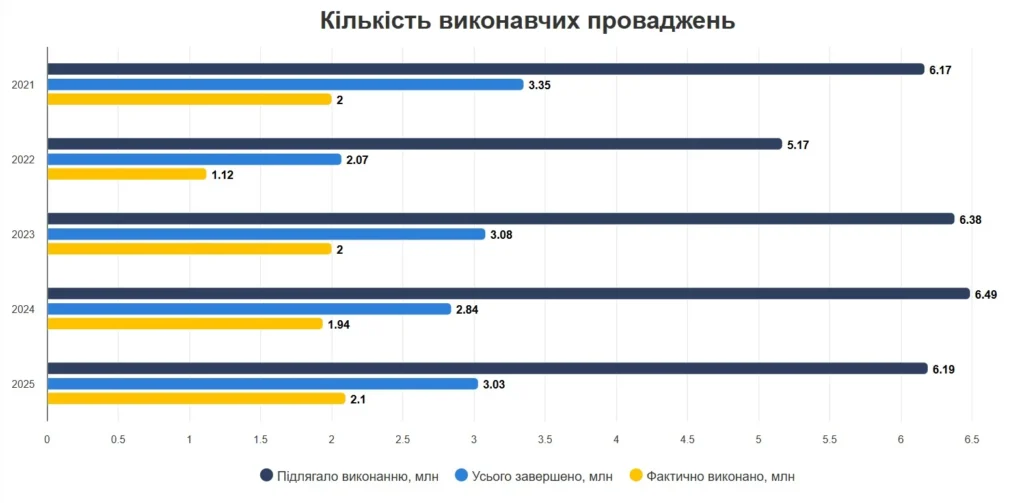
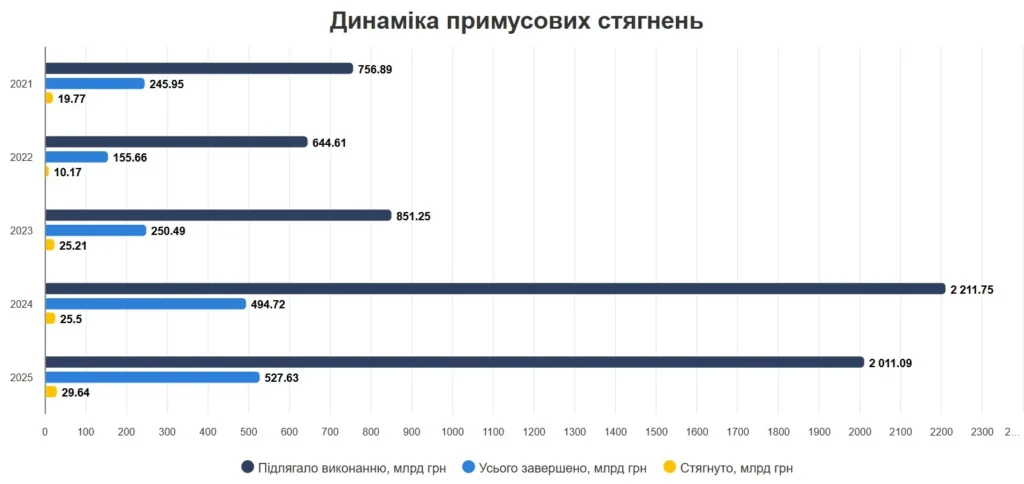
By the end of 2025, enforcement agencies had managed to collect 29.63 billion in debts from Ukrainians. Nearly half of the 6.3 million enforcement cases referred for collection have been closed, but funds were actually recovered in only one-third of the cases, according to OpenDataBot, as reported by "Komersant Ukrainian".
“More than 6.3 million enforcement proceedings totaling 2.32 trillion hryvnia were accepted by state and private enforcement agents in 2025. Half of them were received for enforcement during the year, while the rest have been pending from previous years. Overall, the number of new cases decreased by 3% compared to 2024,” the report states.
Over the course of the year, 3.03 million enforcement proceedings were completed, but funds were actually recovered in only one-third of cases.
Only 1.5 kopecks are recovered for every hryvnia of debt
In total, enforcement agencies managed to collect 29.63 billion hryvnias in debts. This is 16% more than in 2024. But on average, enforcement officers recover only 1.5 kopecks for every hryvnia of debt.
According to Andriy Haichenko, Deputy Minister of Justice for Enforcement Services, the actual recovery rate is significantly higher: out of every 1,000 documents, approximately 300–400 are enforced, or 30–40%.
Such low efficiency in the statistics is largely explained by the presence of so-called dead debts—amounts that are virtually impossible to collect. It is these debts that significantly distort the overall picture. If such debts are excluded, the actual enforcement rate appears significantly higher.
“Some cases are those that, in principle, cannot be enforced at this time: either due to the effect of moratoriums, of which there are currently about 25, or, for example, in cases regarding compensation for damage caused by the Russian Federation’s war. For cases involving the Russian Federation, in my opinion, there should be a separate mechanism altogether—for example, a registry of damages to be compensated in the future: through reparations or international compensation mechanisms. This is not strictly a matter of enforcement proceedings in the classical sense,” said Gaichenko.
State enforcement officers were assigned 4.94 million cases totaling 1.84 trillion UAH. Private enforcement officers received 1.36 million cases totaling over 471 billion UAH.
State enforcement officers resolved one in four cases, while private ones resolved one in five.
However, in terms of amounts, private enforcement agents were able to collect 3% of the claimed amounts (12.46 billion UAH), while state agents collected only 1% (17.17 billion UAH).
Watch us on YouTube: important topics – without censorship
Limitations on collections
At the same time, even in “active” enforcement cases, the system faces a number of limitations. Private enforcement officer Andriy Avtorgov also attributes the low recovery rate to a significant share of “frozen” amounts that are effectively impossible to enforce—specifically, the Russian Federation’s debts to Ukrainians. Furthermore, in his view, the statistics were influenced by changes in enforcement procedures following the start of the full-scale invasion: even debtors with the means often evade enforcement by exploiting loopholes in the law and moratoriums.
“Since the start of the full-scale invasion, the state has focused more on the problems of debtors rather than creditors, introducing more and more bans and moratoriums on enforcement. A haphazard approach to reforming the enforcement of court decisions, further delays in equalizing the powers of private and state enforcement agents, and relying solely on the Debtors’ Registry for enforcement mechanisms will lead to a further decline in the enforcement rate of property-related court decisions,” Avtorgov believes.
Law on the Digitalization of Enforcement Proceedings
Against the backdrop of these issues, the Verkhovna Rada adopted a law on the digitization of enforcement proceedings, which is intended to change approaches to debt collection. According to Gaichenko, the law will allow for the automation of certain processes, reduce delays in debt collection and the unblocking of accounts, and lower the level of everyday corruption.
The key change is connecting all banks to the ASVP (Automated System of Enforcement Proceedings). Currently, about half of the banks are connected to it and automatically execute seizure orders. The others operate on paper, which can drag out the process and give the debtor an opportunity to avoid collection.
There are currently numerous cases of abuse: while the bank awaits a paper copy of the account seizure order from the enforcement service, the debtor transfers funds to an account at another bank not connected to the ASVP—and such financial transfers can continue indefinitely, explained Gaichenko.
The private enforcement agent takes a cautious view of the changes. In his opinion, digitalization as such cannot be an end in itself for reforming enforcement proceedings legislation, although its role is very important.
“These changes are not so much about digitalization as they are about a further shift toward the so-called registry-restrictive model, where the consequences of being entered into the Debtors’ Registry are strengthened and the ability to dispose of property without the enforcement officer’s involvement is restricted. Currently, ‘digitalization’ sometimes even hinders enforcement—for example, when a debtor sees the proceedings in Diia and manages to withdraw funds faster than the seizure is imposed,” Avtorgov noted.
As a reminder, as of early March 2026, the Unified Register of Debtors contained over 9.5 million debts. Over the past year, their number has grown, with the majority of debts relating to fines for traffic violations.
The number of debts entered into the Ukrainian Unified Register of Debtors has increased by 514,300 (6%) over the past year
Read us on Telegram: important topics – without censorship