Minister on the way out: why lawmakers are unhappy with Lisovyi and who might take over the Ministry of Education and Science
5 June 17:14
Behind the scenes at the Verkhovna Rada, there is active discussion about the possible dismissal of Minister of Education and Science Oksen Lisovyi. While lawmakers are counting votes and looking for compromise candidates to replace him, the minister himself insists he hasn’t seen any resolutions and continues to work as usual.
Will the behind-the-scenes rumors turn into an actual vote? Who is being considered as a successor, and what are Ukrainian educators and civic activists complaining about—in this article
What complaints are lawmakers raising against Lisovyi?
Oleksiy Honcharenko, a member of parliament from the “European Solidarity” faction, described the situation within the Verkhovna Rada. In a comment to “Kommersant Ukrainian,” he noted that a substantial list of specific complaints has accumulated against Oksen Lisovyi’s leadership, concerning key educational reforms and exams. Among the main issues, the MP highlighted:
- The organization and administration of the NMT (National Multidisciplinary Test);
- Delays and problems in implementing the NUS (New Ukrainian School) reform
“And there are quite a few complaints against him—this includes the NMT, the NUS (New Ukrainian School), and generally poor management of the ministry,” says Goncharenko.
I would like to add that on Tuesday, June 9, the Verkhovna Rada of Ukraine may consider the dismissal of the current Minister of Education and Science , Oksen Lisovyi. This was reported on his Telegram channel by MP Yaroslav Zheleznyak of the “Holos” faction.
According to the lawmaker, a “confidential” personnel matter has been added to the preliminary agenda of the session, which directly points to changes in the leadership of the Ministry of Education and Science (MES).
“Secret” item on the agenda
Yaroslav Zheleznyak noted that the document does not specify a particular name, but clearly identifies the relevant committee that is to consider the decision.
“It’s so secret that they specified the relevant committee—the Verkhovna Rada Committee on Education. The only position on which this Committee can put personnel decisions to a vote in Parliament is that of the Minister of Education,” Zheleznyak explains.
The MP emphasizes that the preliminary agenda is set by the majority party (“Servant of the People”), and rumors about personnel changes, particularly within the Ministry of Education, are actively circulating in the corridors of Parliament this week.
Will there be enough votes for the dismissal?
People’s Deputy Georgiy Mazurashu of the “Servant of the People” faction commented
“I would support such a dismissal,” the MP stated, confirming the existence of internal dissatisfaction with the ministry’s work within parliamentary circles.
Who will replace Lisovyi?
Despite the numerous complaints, Lisovyi’s dismissal could still fall through at the last minute. As Goncharenko noted, the main obstacle to the process is the lack of an agreed-upon successor for the permanent position.
“I haven’t heard of any specific candidates to replace him. As I understand it, this is precisely one of the issues. Why, perhaps, this issue may ultimately not be brought to a vote—because there are no specific candidates to replace him,” explained Goncharenko.
This partially confirms earlier insider information from MP Yaroslav Zheleznyak. According to him, if a vote is held on Oksen Lisovyi’s resignation, the Rada will not immediately appoint a new full-fledged minister. The ministry will be temporarily headed by an acting minister.
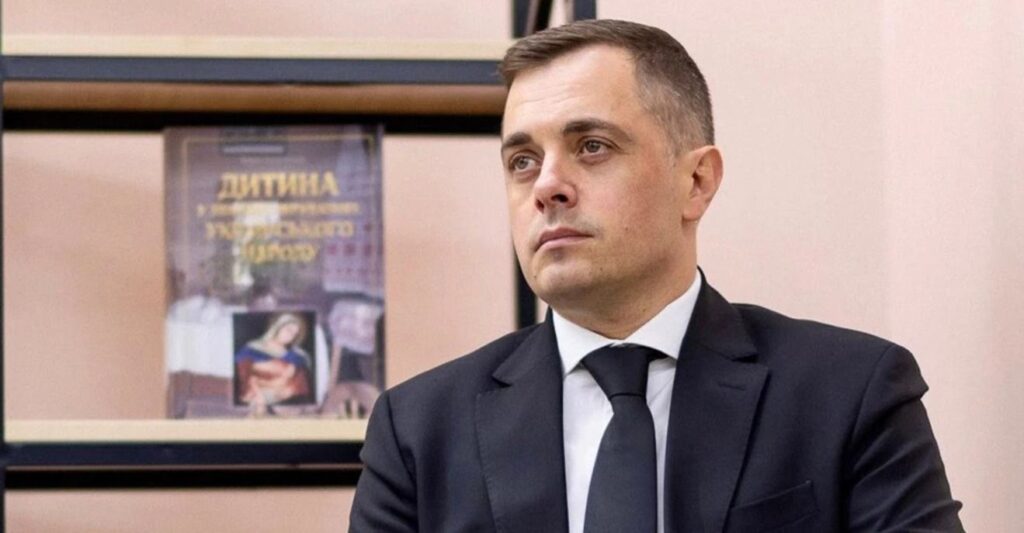
Currently, one of the current deputies— Mykola Trofimenko— is being named as the leading candidate for the position of acting Minister of Education . He currently holds the position of Deputy Minister of Education and Science of Ukraine. Since 2020, he has served as rector of Mariupol State University (MSU) and oversaw the relocation of the institution after the start of Russia’s full-scale invasion.
At the same time, Zheleznyak adds that it is too early to speak of these personnel changes as a final decision.
“This is really the 100,500th time they’ve said they’re going to make changes (the previous 100,499 times the issue was ultimately dropped), but it seems like the chances are high this time,” Zheleznyak notes.
He also commented ironically on the specifics of the current government’s personnel policy, hinting that this news might come as a surprise even to the head of the Ministry of Education and Science himself.
“Not informing your own ministers about personnel decisions—that’s practically the hallmark of this administration in recent years. I know at least a dozen people who read about their dismissal on my Telegram or in the media,” Zheleznyak concluded.
At the same time, Zheleznyak spoke positively of Oksen Lisovyi himself, calling him a “normal person” and “certainly not the worst member of the government,” while refraining from commenting on the specific reasons for the minister’s possible dismissal.
What does Lisovyi say?
Oksen Lisovyi, Ukraine’s Minister of Education and Science, stated that he has no information about a resolution regarding his dismissal and has not yet had any official discussions about his resignation. According to him, this is not the first time such initiatives regarding his dismissal have emerged. The head of the Ministry of Education and Science spoke about this during a conversation with journalists.
“There have been no discussions with me regarding this. In fact, I just spoke with the Prime Minister there. I know nothing about a resolution regarding my dismissal, but it seems to me that these resolutions or attempts at dismissal appear very often. That is why I am not even commenting on this,” Lisovyi said.
What complaints do educators have against Lisovyi?
According to posts by educators on social media, the main points of contention are excessive bureaucracy, disregard for children’s psychological well-being during the war, and the artificial complication of exams, which leads to an exodus of students and teachers.
One of the most painful issues remains the administration of the National Multidisciplinary Test (NMT) amid constant airstrikes. Zoya Gurska, a teacher of Ukrainian language and literature, emotionally pointed out that the ministry completely ignores the stress factor and the unequal conditions for applicants from different regions.
“While adults are trying to pull themselves together after a sleepless night of shelling, 17-year-old teenagers, including those from Kyiv, Dnipro, Zaporizhzhia, and Kharkiv, are taking the NMT today, after this hellish night,” the teacher notes.
According to her, countless people have been trying for several years to get the Ministry of Education and Science to listen to their demand not to hold the test the day after heavy shelling, because it is unfair to compare the results of a child who spent the night in a shelter with those of a teenager from a peaceful region.
The consequence of this deafness on the part of the relevant ministry is a catastrophic situation in education against the backdrop of a general demographic crisis (according to demographers, by 2026, approximately 29 million people will remain in Ukraine’s government-controlled territories—one million fewer than the previous year).
“From my own experience—11th-grade classes are half-empty, and universities are underenrolled. (…) Well, keep testing the patience of teenagers and their parents—that’s how, after so many years of war, you haven’t offered a single solution,” states Zoya Gurskaya.
Teacher and educator Svitlana Chernyshova speaks about the real reason teachers are leaving. And it’s not the low salaries, for the most part, but the catastrophic professional burnout caused by the senseless bureaucracy spawned by the NUS (New Ukrainian School) reform. According to her, a particular absurdity lies in filling out the so-called “learning profile,” which consists of 27 items.
“The homeroom teacher must rate on a scale of one to three whether the child can think systematically, whether they are capable of recognizing manipulation and potential threats. A total of 27 items. Are you serious? Do we really believe this can be assessed objectively? Or is this just another piece of paper for the sake of paperwork?” Svitlana Chernyshova exclaims indignantly.
Another wave of criticism concerns the content of the NMT itself. Amid rumors of a possible abolition of mandatory math (which Minister Oksen Lisovyi later denied), the public is outraged by the other extreme—the unjustified annual increase in the difficulty of test questions.
Read us on Telegram: important topics – without censorship
Social activist Natalia Didukh shared her own experiment: she took the math test on the Ministry of Education and Science website every year and noticed that her personal score was plummeting (from 158 points in 2021 and lower), even though her actual knowledge level could not have objectively changed during that time. Subject teachers share this view—the tests are being made more difficult on purpose.
“The question arises—WHY on earth do they do this? What is the goal? The test authors’ self-satisfaction? Lowering graduates’ motivation and self-esteem? I believe the test should be designed so that all graduates can complete the tasks based on the 7th–9th-grade curriculum, and those who truly need a high score will solve all the problems,” the activist emphasizes.
Thus, the personnel intrigue surrounding the position of Minister of Education and Science has highlighted the deep disconnect between the reform strategy devised in the office and the daily struggle for survival of Ukrainian schools amid a full-scale war. Even if the lack of a consensus candidate allows Oksen Lisovyi to retain his position during the next vote in the Verkhovna Rada, this will not remove the glaring systemic problems from the agenda.
Watch us on YouTube: important topics – without censorship