Technocrats vs. Generals: Will Zelenskyy Untangle the Knot Between Syrskyi and Fedorov with a New Personnel Shuffle?
17 July 09:54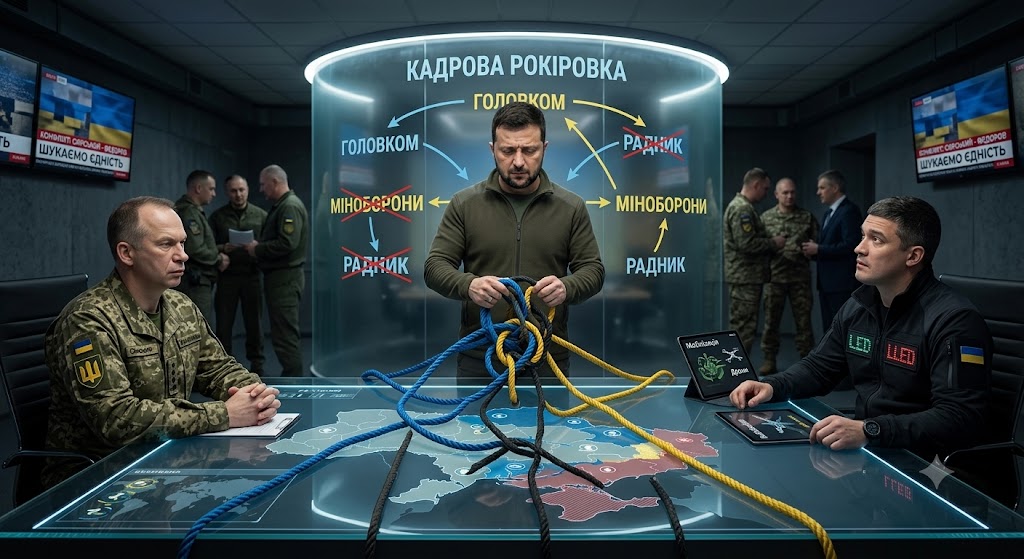 ANALYSIS
President Volodymyr Zelenskyy has not yet made a final decision regarding Mykhailo Fedorov’s future role in the government and possible changes in the leadership of the Armed Forces of Ukraine. Against the backdrop of Fedorov’s statements that “as long as Syrskyi is around, nothing will get done,” an alternative figure capable of defusing the crisis has become the subject of active discussion behind the scenes.
Mykhailo Fedorov has publicly highlighted Andriy Gnativ, commander of the Joint Forces of the Armed Forces of Ukraine, as a competent, professional, and compromise-oriented candidate for the position of Commander-in-Chief of the Armed Forces of Ukraine.
Now the President faces an extremely difficult task: either to try to maintain the precarious balance or to decide on a radical overhaul of the entire military command in the midst of the war’s most intense phase.
Why is Volodymyr Zelenskyy still delaying a final decision on Oleksandr Syrskyi—a candidate described as the key to restoring the balance between the military and technocrats? "Komersant Ukrainian" investigated.
Zelenskyy’s Position
During a joint briefing with British Prime Minister Keir Starmer, the President of Ukraine publicly confirmed for the first time the existence of sharp disagreements between civilian and military leadership. According to Zelenskyy, the situation had reached a breaking point where the parties could not find common ground without his direct intervention.
“I would very much like to see unity. The parties have not found it. Without me, they won’t sit down at the table. But they must work on their own—every day, constantly,” the President noted.
At the same time, Zelenskyy assured that Mykhailo Fedorov would remain on his team, though his exact role would be announced later. Commenting on the street protests that erupted over personnel decisions, the President expressed solidarity with citizens’ right to freedom of expression.
“I understand, hear, and respond to what society is saying. We are fighting for freedom and democracy. People do what they want. They wanted to take to the streets—and rightly so,” said Volodymyr Zelenskyy.
Fedorov’s Position
Mykhailo Fedorov himself stated at his own briefing that he does not consider the President’s decision to be a final choice in favor of Syrskyi. According to him, the disagreements stem from fundamentally different views on governance and reforms during wartime. The former minister also openly shared details of recent personnel decisions in the relevant agencies, noting that he was not consulted regarding the appointments of his former deputies at the Ministry of Digital Transformation and Ukroboronprom. Despite this, Fedorov expressed his full support for the President.
“I am confident that the president is listening to the Ukrainian people, knows what to do, and the situation will be 100% resolved. I’ve known him for seven years… Right now, we’re in a situation where both he and I are acting based on our own perspectives on the world. That’s normal,” says Fedorov.
At the same time, he added that it is objectively difficult for Zelenskyy to make decisions due to the enormous flood of complaints he receives from people facing problems within the Ministry of Defense system.
Why does the President have to choose?
The main problem with the current processes within the government is that part of the Ukrainian political establishment has still not grasped the depth of the challenges posed by martial law. Lyudmyla Pokrovshchuk, Ph.D. and an expert on foreign and domestic policy, comments on the situation surrounding the personnel turmoil.
“Unfortunately, our political elites cannot fully grasp that we are living in a state of war. When a war is ongoing, all domestic processes must not be politicized. The country cannot operate within the political paradigms that existed before 2014 or even before 2022. We are trying to draw on European practices, but no European country since World War II has found itself in a situation like Ukraine’s. “There are simply no ready-made solutions,” notes Lyudmyla Pokrovshchuk.
Mykhailo Fedorov is one of the President’s closest allies, having accompanied him since the 2019 election campaign and having been considered Zelenskyy’s key favorite. However, the realities of war demand different priorities.
According to Pokrovshchuk, tensions between Fedorov and Commander-in-Chief of the Armed Forces of Ukraine Oleksandr Syrskyi have reached a point where the leaders of the defense and technology sectors have lost the ability to engage in constructive dialogue.
“Amid the most difficult phase of the war, Zelenskyy, as Supreme Commander-in-Chief, has sided with the military chain of command and Commander-in-Chief Syrskyi,” says Pokrovshchuk.
In other words, the President bears personal responsibility for the military-political direction, so this choice was dictated first and foremost by the logic of the state’s survival.
“Only time will tell if this step was the right one. Perhaps the president should have sought a consensus or taken a more radical step—completely overhauling both areas by removing both figures involved,” Pokrovshchuk emphasizes.
However, the greatest danger of this personnel scandal lies in attempts by domestic political forces to use Fedorov’s figure to destabilize the situation within the country. The politicization of this conflict directly undermines national security.
“We need to unite, not politicize these processes. We need to keep a cool head and act wisely in this situation, because the enemy will certainly try to use our internal strife against us,” concludes Lyudmila Pokrovshchuk.
Reactions from the military, volunteers, and opinion leaders
Personnel changes in the Cabinet of Ministers of Ukraine—in particular, the high-profile dismissal of Mykhailo Fedorov from the post of Minister of Defense—have sparked a powerful wave of reactions across society. Prominent military commanders, volunteers, political analysts, and technology experts unanimously describe this event as a symptom of a deep systemic crisis in relations between civil society and the current government.
Among military personnel and defense technology specialists, Fedorov’s resignation is seen as a severe blow to the modernization of the army.
Anatoliy Khrapchynskyi (aviation expert, reserve officer of the Ukrainian Air Force) spoke highly of the minister’s work:
“Mykhailo Fedorov’s six months as Minister of Defense clearly demonstrated how a modern defense ministry should operate. He was the first head of the Ministry of Defense with a clear strategic vision and an understanding of the mathematics of modern warfare.”
The expert added that such strategic acumen in Ukrainian government circles tends to provoke envy rather than a desire to learn.
Serhiy Beskrestnov “Flash,” for his part, announced that he is stepping down from his position as advisor to the minister and expressed deep regret at being unable to complete critically important projects.
“I had extensive access to various systems and was able to analyze our enemy’s actions. I will no longer be able to do so. The enemy is celebrating in their own circles that I am no longer at the Ministry of Defense,” says Beskrestnov.
Denis Prokopenko “Radish” (commander of the 1st Corps of the National Guard of Ukraine “Azov”) thanked Fedorov for his consistent statesmanlike stance and the rapid strengthening of the country’s defense capabilities. At the same time, he expressed cautious optimism regarding the appointment of the new Minister of Defense, Ihor Klymenko (former Minister of Internal Affairs), noting his experience in implementing the corps system and bringing order to mobilization and the Territorial Defense Forces:
“He [ed. – Ihor Klymenko] consistently advocates for the interests of National Guard servicemembers and pays close attention to ensuring that National Guard units are properly supplied, and, I believe, from now on this approach will be applied to the soldiers of all units defending Ukraine on the front lines.”
For the volunteer movement, Fedorov’s resignation was an alarming signal that the state is abandoning groundbreaking reforms.
Serhiy Prytula,founder of a charitable foundation, emphasized that Fedorov’s team had done tremendous work to root out corruption in procurement and had established direct communication with drone manufacturers. He described the current situation as yet another round in the standoff between civil society and the presidential administration.
“The president has his own position, which today, unfortunately, does not align with that of the proactive segment of Ukrainian society. If Zelenskyy had provided a clear explanation of the grounds for the dismissal, it could have eased the tension. But that didn’t happen,” says Prytula.
Political analysts and activists view the purge in a much broader context, seeing it as a sign of the monopolization of power.
Yuriy Kasyanov (a civic activist and volunteer) described the dismantling of Fedorov’s team as “the elimination of any alternative and pluralism of opinion”:
“What we’re seeing now… is yet another step toward absolute power, a police state, and dictatorship… Today they came for him; tomorrow they’ll come for you. Russia and Belarus went down this path a little before us.”
Political expert Viktor Taran emphasized that this crisis raises fundamental questions about members of parliament and the state system.
Journalist and columnist Vitaly Portnikov, meanwhile, approached the situation with harsh criticism of both the former minister himself and society as a whole. Commenting on Fedorov’s complaints about harassment by anonymous Telegram channels, Portnikov noted that Fedorov had become a victim of the very system he himself helped create during the 2019 election campaign.
“This is the Office of the President’s bet on Telegram. On bots. On liars. On scoundrels… It has created an opportunity for Russians and their agents to pose as their own liars and undermine the Ukrainian state and government. For some reason, the former minister did not notice this danger earlier,” Portnikov notes.
The journalist is convinced that as long as Ukrainians treat the choice of government like a lottery and focus on charismatic personalities instead of building strong state institutions and strengthening the role of parliament, the country will remain hostage to media narratives.
An insider report from military analyst Vasyl Pekhnya confirms that it is still too early to call it a day in this standoff.
“I was at Fedorov’s press conference. In short: he said that as long as Syrskyi is around, nothing will happen. According to him, the president, by the way, has not yet made a final decision regarding either Fedorov or Syrskyi,” writes Pekhno.
A key indicator of this crisis is the emergence of Andriy Gnativ, commander of the Joint Forces of the Armed Forces of Ukraine, as a potential successor to Syrskyi—a candidate whom Fedorov is actively promoting as a compromise and professional alternative.
And so, according to Pekhno, for President Zelenskyy, this means facing a difficult choice: not simply quelling the conflict, but likely opting for a major restructuring of the military command, in which Gnatov could become a new key figure capable of restoring the military-technical balance.